SaaS growth rarely comes from a single breakthrough campaign. In most cases, sustainable saas growth happens when companies consistently test, optimize, and scale systems that improve customer acquisition, activation, retention, and monetization.
At Growth Hackers, we have worked with SaaS companies, B2B platforms, and professional service providers that wanted faster revenue growth without wasting budget on marketing gimmicks that fail to produce measurable results.
The reality is simple. The best SaaS growth hacking strategies are practical, repeatable, and grounded in data.
Whether you run a product led growth company, a subscription platform, project management software, or a service-focused SaaS business, the right growth hacking strategy can help you attract qualified leads, reduce customer acquisition costs, improve conversion rates, and scale your user base faster.
This guide breaks down the top SaaS growth hacking tactics we have seen generate measurable impact across multiple industries. Every section includes actionable ideas, funnel-stage alignment, and realistic implementation steps that SaaS teams can apply immediately.
What SaaS Growth Hacking Means Here
For this article, SaaS growth hacking refers to rapid experimentation across the entire customer journey with the goal of improving measurable business outcomes.
Instead of relying only on traditional marketing, SaaS companies use growth hacking to identify scalable opportunities across:
- Acquisition
- Activation
- Retention
- Referral
- Revenue
This follows the AAARRR framework often used by growth marketing teams.
At Growth Hackers, we approach SaaS growth hacking as a process built around continuous testing. The goal is not to chase vanity metrics. The goal is to measure growth through key metrics tied directly to customer lifetime value, customer retention, and revenue growth.
Many SaaS companies focus heavily on traffic while ignoring activation rate or churn rate problems that quietly damage long-term growth.
The best SaaS growth hacking tactics improve the full funnel instead of only increasing clicks or impressions.
These strategies are especially valuable for:
- B2B SaaS platforms
- Product led growth companies
- Professional services
- Project management platforms
- Subscription businesses
- Developer tools
- Early stage companies
How We Selected These Growth Hacking Strategies
Not every growth hacking strategy works for every SaaS business.
At Growth Hackers, we selected these SaaS growth hacking tactics based on several practical criteria.
Data-Driven Selection Criteria
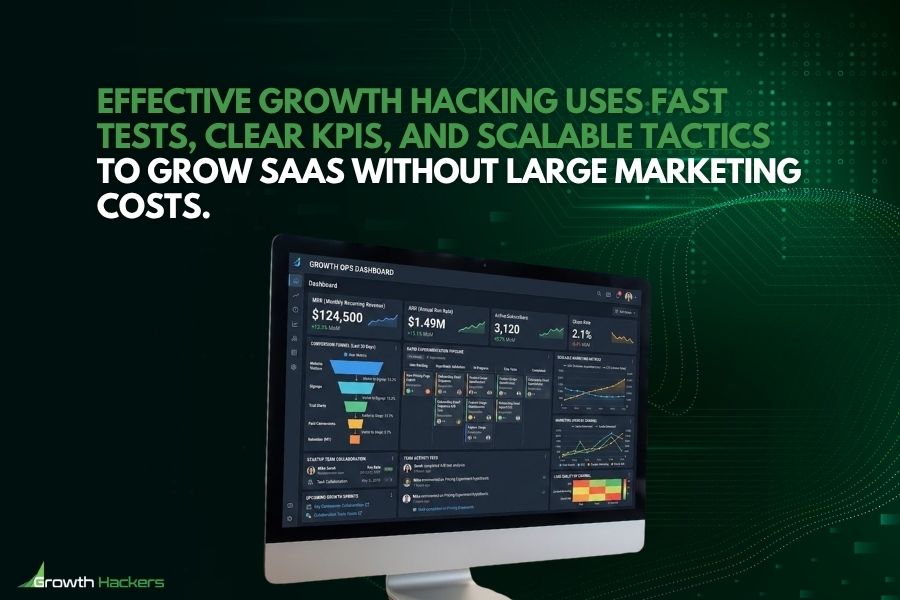
We prioritized strategies with:
- Clear KPIs
- Fast implementation cycles
- Measurable conversion rates
- Repeatable testing opportunities
- Scalable acquisition potential
Low-Cost High-Velocity Tactics
Many SaaS startups operate with limited marketing budget flexibility.
Because of this, we focused heavily on low cost tactics capable of generating meaningful SaaS growth without requiring massive paid acquisition spending.
Repeatable Systems Over One-Time Campaigns
Sustainable SaaS growth hacking depends on systems, not isolated campaigns.
The best growth hacking tactics create repeatable frameworks that SaaS teams can continuously improve over time.
Want to boost your conversions with data-driven SaaS growth hacking?
Contact Growth Hackers
Top 10 Growth Hacking Tactics
The most effective growth hacking tactics are built around experimentation, scalability, and measurable impact. In this guide, we’ll break down proven strategies businesses use to improve acquisition, activation, retention, and long-term growth across different stages of the customer journey.
1. Build Product Viral Loops and Referrals
One of the most effective SaaS growth hacking tactics involves building viral loops directly into the product experience.
Viral loops occur when existing users naturally invite new users because collaboration or sharing creates additional value.
This is especially effective for:
- Project management software
- Communication platforms
- Workflow tools
- Team collaboration products
Many of the best SaaS companies scaled quickly because their products encouraged natural sharing behavior.
A referral program works best when timing feels organic.
Instead of asking users to refer friends immediately after signup, trigger referral requests after users experience a clear win or milestone.
For example:
- Completing a successful project
- Reaching onboarding goals
- Inviting teammates
- Achieving measurable results
At Growth Hackers, we have seen referral marketing campaigns generate qualified leads with significantly lower customer acquisition costs than paid channels.
Implementation Checklist
- Design a double-sided referral program incentive
- Add referral tracking parameters
- Test referral placement timing
- Reward both existing customers and new users
- Track conversion rates by referral source
2. Create Shareable Content for Rapid Distribution
Content marketing remains one of the most reliable SaaS growth hacking techniques because it compounds over time.
The goal is not simply publishing articles. The goal is to create shareable content that drives visibility, backlinks, trust, and lead generation.
High-performing content marketing formats include:
- Industry reports
- Case studies
- Comparison guides
- Templates
- Viral content
- Educational videos
- Interactive checklists
One important lesson we learned at Growth Hackers is that content marketing performs best when it addresses real customer pain points instead of pushing aggressive sales messaging.
For professional services and legal-focused SaaS products, examples may include:
- Immigration eligibility guides
- Visa process calculators
- Compliance checklists
- Contract templates
Every content asset should include a shareability checklist:
- Clear value proposition
- Strong headline
- Easy social sharing
- Visual formatting
- SEO optimization
- CTA placement
Strong content marketing increases more traffic while helping educate users throughout the customer journey.
3. Ship Free Tools and Calculators as Lead Magnets
Free tools are one of the highest-performing SaaS growth hacking tactics for organic acquisition.
Users actively search for calculators, templates, analyzers, and generators because they solve immediate problems.
Examples include:
- ROI calculators
- Pricing estimators
- SEO analyzers
- Time tracking templates
- Budget forecasting tools
- Workflow planners
Free tools work especially well because they match user intent closely.
At Growth Hackers, we often recommend gating minimal information such as email addresses after users receive value from the tool.
This creates lead generation opportunities without adding friction too early in the signup process.
Landing pages for free tools should include:
- SEO-focused keywords
- Fast loading speed
- Clear CTA placement
- Simple UX
- Strong mobile experience
Many SaaS companies underestimate how powerful free tools can become for long-term SaaS growth.
4. Integrations and Strategic Partnerships
Strategic integrations can accelerate SaaS growth dramatically when partnerships align with the same audience.

The best integration partners:
- Serve similar ideal customers
- Complement your product functionality
- Possess strong distribution channels
- Offer co-marketing opportunities
For example, project management platforms often integrate with communication apps, CRM systems, and analytics software.
Partnership-driven growth hacking creates added exposure across multiple marketing channels simultaneously.
One effective strategy involves creating dedicated partner landing pages optimized for SEO.
These pages help capture search traffic while reinforcing partnership credibility.
Co-marketing outreach should focus on mutual value:
- Shared webinars
- Guest articles
- Joint social media posts
- Email collaborations
- Cross-promotions
At Growth Hackers, we have seen integrations produce faster revenue growth than standalone advertising campaigns.
5. Optimize Activation Rate with In-App Onboarding
Activation rate is one of the most important metrics in SaaS growth hacking.
If users fail to experience value quickly, they leave before becoming paying customers.
The goal of onboarding is helping users reach their first “Aha” moment as quickly as possible.
A simple onboarding structure often works best:
- Quick account setup
- Guided first action
- Immediate value realization
Many SaaS teams make the mistake of overcomplicating onboarding flows.
The best product led growth systems reduce friction throughout the sign up process while delivering personalized messages that guide users toward success.
Examples include:
- Interactive walkthroughs
- Progress checklists
- Personalized messages
- Setup prompts
- Guided tutorials
At Growth Hackers, we frequently recommend reducing unnecessary form fields because complicated signup process flows hurt activation rate significantly.
6. Run Conversion Rate Experiments and Pricing Tests
Strong conversion rates create compounding SaaS growth over time.
Even small lifts in paid conversion rate can dramatically improve customer lifetime value.
Growth hacking strategies for optimization should prioritize:
- Bottom-funnel landing pages
- Pricing pages
- Trial signup flows
- CTA messaging
- Product positioning
At Growth Hackers, we typically build test matrices comparing:
- Price points
- Value proposition angles
- CTA placement
- Feature framing
- Social proof formats
The goal is identifying which messaging converts potential customers into paying customers most effectively.
Many SaaS companies focus heavily on acquisition while ignoring pricing optimization opportunities that directly impact revenue growth.
7. Reduce Churn Rate with Reactivation and Pause Flows
Reducing churn rate is often more profitable than increasing acquisition.
One of the most effective growth hacking tactics for customer retention involves proactive reactivation campaigns.
Instead of allowing users to cancel permanently, offer alternatives such as:
- Pause subscription options
- Downgrade plans
- Reduced usage tiers
- Temporary discounts
Growth hacking for retention should segment churn rate reasons carefully.
For example:
- Price sensitivity
- Lack of onboarding
- Missing features
- Low engagement
- Technical issues
Each segment should receive tailored retention messaging.
A basic reactivation sequence may include:
- Honest feedback request
- Educational resources
- Product updates
- Win-back incentives
- Personalized offers
Strong retention systems improve customer lifetime metrics while lowering customer acquisition costs.
8. Use Paid Channels as Market Research
Paid acquisition is not only about generating leads.
Smart SaaS growth hacking uses advertising campaigns as market research tools.
At Growth Hackers, we often run small-budget campaigns specifically to test:
- Headlines
- Messaging angles
- Audience segments
- CTA language
- Positioning strategies
The top-performing campaigns reveal what resonates with the target audience.
These learnings can then improve:
- Organic content marketing
- Sales messaging
- Landing pages
- Email campaigns
- Product positioning
This approach helps SaaS teams avoid making assumptions based on internal opinions.
The best growth hacking strategy uses real customer behavior data to guide decisions.
9. Leverage LinkedIn and Niche Communities for Acquisition
For many B2B SaaS companies, LinkedIn remains one of the strongest growth marketing platforms available.
Consistent visibility builds trust with potential customers over time.
An effective LinkedIn content cadence may include:
- Educational posts
- Case studies
- Product updates
- Founder insights
- Industry trends
- Customer success stories
Niche communities also create valuable opportunities for customer acquisition.
Examples include:
- Slack groups
- Reddit communities
- Discord servers
- Facebook groups
- Industry forums
The key is avoiding promotional spam.
Instead, focus on helping users solve problems and deliver personalized messages naturally within conversations.
This approach builds customer relationships more effectively than aggressive sales outreach.
10. Institutionalize Rapid Test-and-Scale Experiments

The best SaaS growth hacking systems become part of company culture.
Instead of treating experimentation as occasional projects, successful SaaS teams establish weekly testing cadences.
At Growth Hackers, we recommend:
- Weekly experiment reviews
- Clear success criteria
- Central reporting dashboards
- Shared learnings documentation
- Cross-team collaboration
Every experiment should answer:
- What is being tested?
- What metric defines success?
- What timeline applies?
- What will happen if results succeed?
This structured approach helps measure SaaS growth consistently while avoiding random experimentation.
Quick Comparison of The Top Hacks
Viral Loops and Referral Program
Best for collaboration-heavy products and network-based platforms.
These strategies encourage existing users to bring in new users through rewards, incentives, or built-in sharing features. Viral loops work especially well for products where collaboration naturally increases the value of the platform, such as team tools, marketplaces, and communication apps. A well-designed referral system can lower customer acquisition costs while helping brands scale through word-of-mouth marketing.
Shareable Content
Best for expertise-driven businesses and thought leadership positioning.
Creating highly shareable content helps brands build visibility, trust, and authority within their industry. Educational blogs, industry insights, case studies, infographics, and social media posts can attract organic engagement and encourage audiences to share content within their networks. This approach is particularly effective for businesses aiming to strengthen brand credibility and long-term audience growth.
Free Tools
Best for SEO-driven lead generation and scalable organic acquisition.
Free calculators, templates, generators, or assessment tools can attract high-intent users through search engines while offering immediate value. These tools often generate recurring traffic, improve search visibility, and help convert visitors into leads. Businesses can also use them to collect user insights and nurture prospects through email marketing or retargeting campaigns.
Integrations
Best for SaaS companies with strong engineering capacity.
Integrating with widely used platforms allows products to become part of a customer’s existing workflow, increasing usability and stickiness. Strategic integrations can also unlock partnership opportunities, expand reach to new audiences, and improve customer retention. Many SaaS companies use integrations to reduce friction and make adoption easier for businesses already using complementary tools.
Onboarding Optimization
Best for improving activation rate and product-led strategies.
A strong onboarding experience helps users quickly understand the product’s value and achieve early success. Simplifying setup steps, offering interactive tutorials, and guiding users toward key actions can significantly improve activation and engagement rates. Optimized onboarding is especially important for product-led growth models where the product experience directly influences conversions.
Retention Flows
Best when churn rate begins increasing.
Retention-focused campaigns help businesses re-engage inactive users and strengthen long-term customer relationships. Email sequences, personalized recommendations, loyalty incentives, and proactive customer support can all improve user retention. Focusing on retention not only increases customer lifetime value but also helps create a more sustainable and predictable growth strategy.
Accelerate user acquisition with proven SaaS growth hacking strategies.
Work with Growth Hackers
How To Choose The Right Growth Hack
Choosing the right growth hacking strategy depends heavily on product maturity, budget, and internal resources.
Choose Based On Stage
Early stage companies often benefit most from:
- Paid acquisition testing
- Messaging experiments
- Product validation
More established SaaS companies may prioritize:
- Viral loops
- Referral program optimization
- Customer retention
- Revenue growth scaling
Choose Based On Team Capacity
Pick content marketing if your team has strong writing bandwidth.
Choose integrations if engineering resources are available.
Prioritize free tools if your company has design and development capacity.
Which Hack Is Best For Your Business?
Different SaaS growth hacking tactics fit different business models.
Choose hack #1 if your product depends heavily on collaboration.
Choose hack #2 if your brand relies on expertise and education.
Choose hack #3 if your goal is scalable SEO-driven lead generation.
The best growth hacking strategy always aligns with:
- Product stage
- User behavior
- Customer base
- Marketing budget
- Team strengths
Measurement And Metrics To Track
To measure SaaS growth effectively, focus on metrics tied directly to revenue and retention.
Track:
- Activation rate
- Conversion rates
- Churn rate
- Customer lifetime value
- Customer acquisition costs
- Revenue growth
- Referral program participation
Strong SaaS growth hacking depends on continuous measurement and iteration.
Execution Roadmap (First 90 Days)
First 30 Days
- Run three prioritized growth hacking experiments
- Audit onboarding flows
- Launch free trials
- Optimize landing pages
Days 31–60
- Scale successful growth hacking tactics
- Expand high-performing marketing channels
- Improve free trials onboarding
- Analyze conversion rates
Days 61–90
- Institutionalize testing systems
- Build central dashboards
- Improve customer relationships
- Refine product led growth workflows
Final Thoughts and Next Steps
The best SaaS growth hacking systems combine speed, experimentation, and measurable outcomes.
Start with two complementary strategies instead of trying everything at once. For example:
- Content marketing plus free tools
- Referral program plus onboarding optimization
- Paid acquisition research plus pricing tests
Avoid chasing vanity metrics. Focus on activation rate, churn rate, conversion rates, and customer lifetime value instead.
At Growth Hackers, we help SaaS businesses and professional service companies scale through structured growth marketing systems designed for sustainable revenue growth.
If you want to acquire more users, improve retention, and lower customer acquisition costs, book a free 30-minute strategy session with our team today.
Growth Hackers is a leading digital growth agency helping businesses from all over the world grow. There is no fluff with Growth Hackers. We help entrepreneurs and business owners unlock scalable results through smarter SaaS growth hacking, increase their productivity, generate qualified leads, optimize their conversion rate, gather and analyze data analytics, acquire and retain users and increase sales.
We go further than brand awareness and exposure. We make sure that the strategies we implement move the needle so your business grow, strive and succeed. If you too want your business to reach new heights, contact Growth Hackers today so we can discuss about your brand and create a custom growth plan for you. You’re just one click away to skyrocket your business.