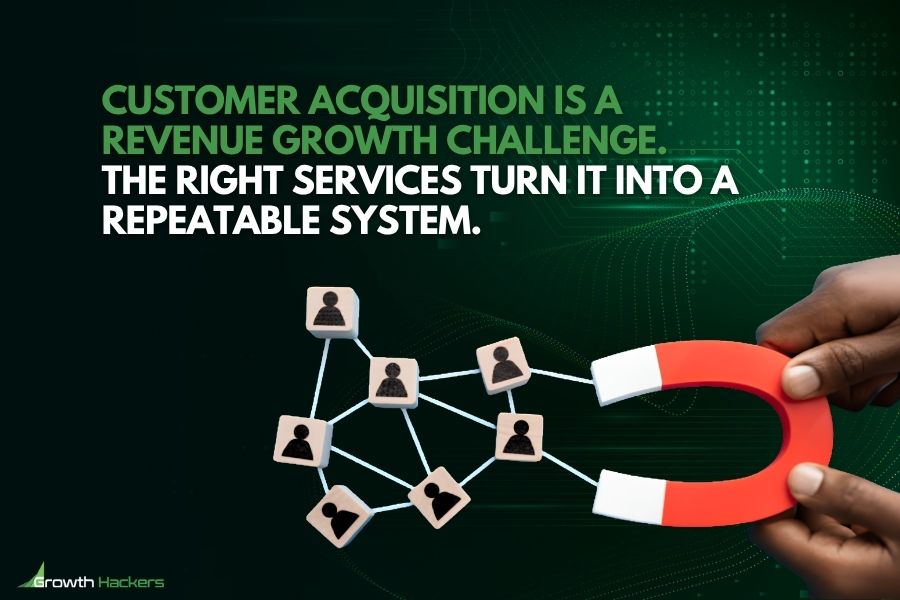
Customer acquisition is not simply a marketing problem. It is a revenue growth challenge.
A business may have a capable sales team, a strong offer, and an ambitious growth plan, yet still struggle to acquire customers consistently. Paid advertising becomes more expensive. Organic growth takes time. Outbound sales generates meetings but not enough qualified opportunities. Marketing campaigns create activity, but the connection between marketing spend, pipeline growth, and closed revenue remains unclear.
These issues become especially serious for startups and SaaS companies. When customer acquisition cost rises faster than customer lifetime value, growth becomes difficult to sustain. The company may continue bringing in new customers while losing money on every acquisition.
Customer acquisition services help businesses solve this problem by connecting strategy, channels, technology, creative execution, sales, and measurement. The objective is not simply to produce more leads. It is to attract the right potential customers, move them efficiently through the sales process, and turn them into profitable, paying customers.
At Growth Hackers, we view customer acquisition as a connected growth system. SEO, GEO, content marketing, paid advertising, email marketing, conversion optimization, analytics, automation, and targeted outreach should not operate as separate projects. They should work together to improve lead quality, control acquisition costs, and create sustainable growth.
What Are Customer Acquisition Services?
Customer acquisition services are professional growth solutions that help businesses attract, engage, convert, and measure new customers across multiple marketing and sales channels.
Customer acquisition refers to the complete process of moving someone from initial awareness to purchase. Acquisition services provide the strategy, technology, expertise, and execution required to manage that process effectively.
What a Customer Acquisition Program Includes
Depending on the business model, a customer acquisition program may include market research, SEO, paid advertising, account-based marketing, content creation, email nurturing, landing pages, outbound sales, referral programs, conversion rate optimization, CRM integration, and advanced analytics.
The value does not come from the number of services included. It comes from how those services work together.
Why Individual Channels Are Not Enough
A paid advertising campaign may create website traffic, but that traffic will not produce strong revenue outcomes if the landing page fails to address the audience’s pain points. A content marketing program may improve visibility, but it will struggle to generate qualified leads without a clear conversion path. A sales representative may conduct dozens of calls, but those conversations will remain inefficient if the marketing team continues sending poorly qualified prospects.
Professional customer acquisition solutions connect these moving parts. They also provide analytics and reporting that show which channels are producing new customers, which campaigns are creating higher-quality opportunities, and how each investment affects customer acquisition cost.
Build In-House or Outsource?
Businesses often consider outsourcing when acquisition becomes too complex for existing internal teams, growth has stalled, or a new market requires capabilities the company does not currently have.
Building everything in-house can make sense for organizations with sufficient expertise, budget, technology, and management capacity. For many small businesses and scaling tech companies, however, a hands-on growth partner provides faster access to specialized skills without requiring the immediate expansion of internal headcount.
Outsourced customer acquisition can reduce costs by 20 to 30% compared to in-house teams, and agencies can help businesses ramp up pipeline and enter new markets up to 40% faster. Outsourced sales development representatives also tend to ramp up three times faster than in-house hires, which matters significantly when the business needs qualified leads quickly.
Why Customer Acquisition Services Matter
Customer acquisition strategies aim to increase a company’s revenue and market share by building a reliable process for reaching and converting potential customers. When executed well, customer acquisition services can achieve a 5:1 ROI ratio, meaning every dollar invested in a well-structured acquisition program can return five dollars in revenue.
Without that process, growth depends on irregular referrals, isolated campaigns, or the individual performance of a few sales leaders. Revenue may increase during a strong month and fall sharply during the next because the company has no predictable way to replenish its customer base.

Understanding Customer Acquisition Cost
One of the central financial metrics is customer acquisition cost, commonly known as CAC. It represents the average expense required to gain one new customer.
A simple CAC calculation divides total sales and marketing costs by the number of customers acquired during the same period:
CAC = Total Sales and Marketing Costs ÷ New Customers Acquired
The calculation is straightforward, but interpreting it requires context. A $1,000 CAC may be unsustainable for a low-margin service and highly profitable for a SaaS company with strong retention and a high contract value.
CAC and Lifetime Value Together
That is why CAC should be considered alongside customer lifetime value. A commonly used planning guideline is an LTV-to-CAC ratio of approximately 3:1. This means the expected lifetime value of a customer is roughly three times the cost required to acquire that customer. It is a guideline rather than a universal rule because margins, churn, cash flow, and payback periods differ across industries.
Why Analytics Changes the Outcome
Measurement also changes how companies approach customer acquisition. Data-driven companies are 23x more likely to acquire customers than those relying on instinct alone. McKinsey’s research reinforces this, finding that intensive users of customer analytics were also nine times more likely to outperform competitors in customer loyalty.
The lesson is not that data automatically creates growth. It is that businesses with a deep understanding of customer behavior can allocate resources more intelligently, identify valuable audience segments, and correct weak acquisition efforts before they consume too much budget. Effective customer acquisition uses data-driven insights to boost channel efficiency and make faster, more confident decisions about where to scale.
Ready to maximize ROI with smarter customer acquisition services?
Contact Growth Hackers
Measure CAC and the 3 Metrics Behind It
Overall CAC provides a useful starting point, but it should not be the only measure of performance.
A business spending $100,000 to acquire 100 customers has an average CAC of $1,000. However, that figure may hide major differences between channels. Google Ads could be acquiring customers for $700, while outbound sales costs $1,600 per customer. Referral partnerships may generate fewer customers but deliver stronger retention and a higher lifetime value.
Calculating CAC by channel helps the business understand where growth is efficient and where weaker campaigns are being subsidized by stronger ones.
1. Customer Lifetime Value
Customer lifetime value provides the other side of the equation. LTV estimates the financial value a customer is likely to contribute throughout the relationship. A channel with a higher CAC may still be worthwhile when it attracts loyal customers who remain longer, purchase more, or expand into higher-value plans.
2. Payback Period
Payback period measures how long it takes to recover the cost of acquiring a customer. This is particularly important for startups and SaaS businesses because a profitable customer can still create cash flow pressure if the initial investment takes too long to recover.
3. Conversion Rates
Conversion rates reveal where potential customers are being lost. A weak visitor-to-lead rate may indicate a landing page or offer problem. Strong lead volume followed by poor opportunity creation usually points to lead quality or qualification. A healthy pipeline with low close rates may reveal pricing, positioning, sales enablement, or follow-up issues.
Conversion rate optimization addresses these gaps by systematically improving the customer journey and increasing the percentage of visitors who take a meaningful action. It is one of the highest-leverage ways to improve acquisition efficiency without increasing spend.
Outbound channels like cold email carry their own cost considerations. The average cold email cost per lead runs between $250 and $300, which makes lead quality and follow-up sequencing critical to making that channel viable. Unified sales and marketing processes can reduce customer acquisition costs by up to 20% by eliminating the waste that happens when both teams operate with different definitions and disconnected data.
Growth Hackers evaluate these metrics as one connected system. Optimizing a single number can create unintended consequences. Lowering CAC by pursuing cheaper leads is not an improvement if those leads rarely become paying customers.
How Customer Acquisition Services Work | 7 Steps to Follow
Step 1 | Audit the ICP, Funnel, and Existing Channels
The first step is to establish an accurate baseline.
This begins with the ideal customer profile, or ICP. The business needs to identify which customer segments experience the strongest need, receive the greatest value, convert efficiently, and remain customers over time. Market research, customer interviews, CRM records, sales calls, and historical data can reveal patterns that surface-level demographics often miss.
The audit should then map the full customer journey. Where do prospective clients first encounter the brand? Which pages do they visit? What makes them submit a form or request a demonstration? How quickly does the sales team respond? At what point do qualified leads stop progressing?
Existing customer acquisition channels must also be evaluated by commercial contribution, not visibility alone. Website traffic, impressions, followers, and clicks can be useful diagnostic measures, but they become vanity metrics when disconnected from pipeline and revenue.
At Growth Hackers, this audit is designed to identify both growth opportunities and operational constraints. There is little value in increasing demand if slow lead routing, weak qualification, or limited sales capacity prevents the business from converting it.
Step 2 | Create a Customer Acquisition Strategy Aligned With Business Goals
A customer acquisition strategy should begin with the company’s economics and growth priorities, not a list of trending channels.
The business must decide which markets it wants to enter, which customers it wants to attract, how much it can afford to spend, and how quickly the investment needs to produce returns. These decisions shape the entire acquisition strategy.
A startup focused on market validation may prioritize fast feedback and shorter experiments. An established SaaS business may concentrate on reducing payback periods and increasing customer lifetime value. A professional services firm with a longer sales cycle may place greater emphasis on authority, trust, and lead qualification.
Organic, Owned, and Paid Channels
Customer acquisition strategies are often grouped into organic, owned, and paid channels. Organic channels include SEO, referrals, community participation, and unpaid distribution. Owned channels include the website, email list, CRM, and branded content. Paid channels include paid search, paid social, sponsorships, and other forms of advertising.
A strong strategy usually combines a focused group of complementary channels rather than distributing resources across every available platform. The right mix depends on the target audience, market position, sales cycle, available budget, and internal ability to execute.
Step 3 | Orchestrate Paid, Organic, and Outreach Channels
Customers rarely move from first contact to purchase through a single interaction.
A prospective buyer may discover an article through organic search, encounter the company again through paid ads, subscribe to an email sequence, review a case study, and finally respond to targeted outreach from a sales rep. Each interaction contributes to the decision.
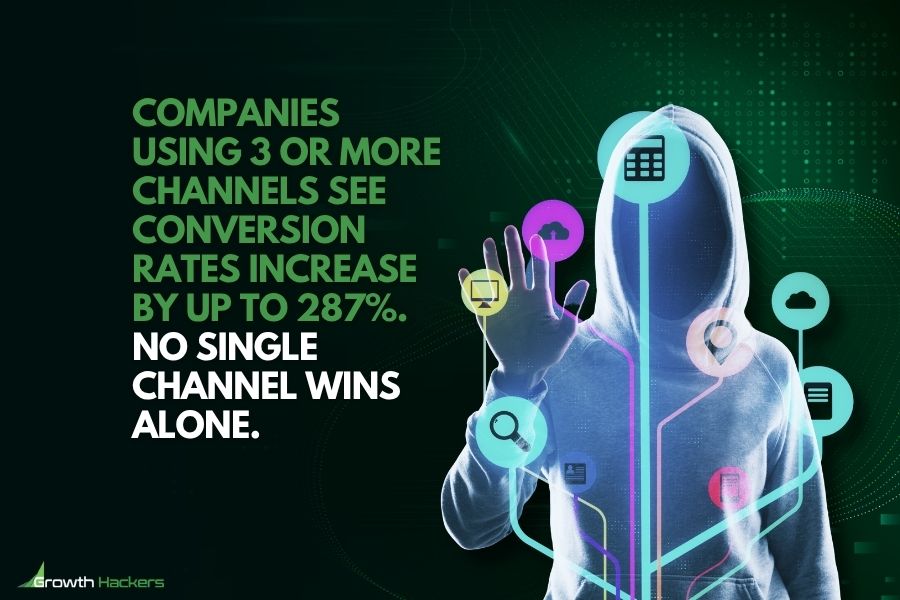
This is why coordinated campaigns are more useful than a collection of disconnected tactics. Companies using three or more channels see conversion rates increase by up to 287% compared to single-channel strategies. Multichannel campaigns also convert two to three times better on average because they give the business more opportunities to educate potential customers, reinforce positioning, address objections, and respond to different buying behaviors across the customer journey.
Matching Channels to the Business Model
For a B2B company, the mix may include account-based marketing, LinkedIn outreach, executive content, email marketing, and sales calls. A local service business may rely more heavily on local SEO, GEO (Generative Engine Optimization), Google Ads, reviews, referral programs, and optimized service pages. An e-commerce company may combine paid social, search, creator partnerships, email, SMS, and retention campaigns.
The objective is not to be everywhere. It is to create continuity across the channels that matter most to the customer journey.
Step 4 | Build Content and Conversion Paths
Acquisition campaigns create attention. The conversion experience determines whether that attention becomes revenue.
Content That Moves Buyers Forward
Content marketing should help prospective customers understand their problem, compare possible solutions, evaluate risk, and decide what to do next. That may require educational articles early in the customer journey, comparison pages during consideration, and detailed service pages or case studies closer to purchase.
Email marketing plays an important role by nurturing prospective customers through the sales funnel. It allows the business to continue the conversation after the initial visit rather than relying on the customer to return independently.
Landing Pages and Conversion Rate Optimization
Landing pages should match the message and intent of the campaign that brought the visitor there. A person responding to an account-based marketing offer should not be sent to a generic homepage. Someone searching for pricing should not be forced to navigate through multiple pages to find basic information.
Conversion rate optimization improves the customer journey by removing friction, clarifying the offer, and making the next step easier to complete. This may involve simplifying forms, strengthening calls to action, improving mobile usability, adding relevant proof, or testing different page structures.
Sales funnel optimization is not simply a design exercise. It requires a close review of what customers need at each stage and where uncertainty prevents them from acting.
Step 5 | Connect Marketing Activity to Revenue
Customer acquisition services should provide analytics and reporting that explain what is producing business growth.
That requires more than installing a website analytics tool. The CRM, advertising platforms, website events, email system, and sales records should share enough information to trace the customer journey from source to revenue.
What Reporting Should Show
At a minimum, reporting should show which channels generate qualified leads, how much each channel costs, which campaigns create sales opportunities, which customer segments close efficiently, and which activities contribute to pipeline and revenue.
This level of attribution will not always be perfect. Customers move between devices, return through different channels, and sometimes involve several decision-makers. The goal is not to create a flawless model. It is to produce enough reliable information to support better decisions.
Aligning Sales and Marketing
Unified sales and marketing processes can also reduce waste. When both teams agree on qualification criteria, handoff rules, response times, and feedback processes, fewer prospects are lost between systems. The company can then improve lead generation and sales execution as one connected process.
Step 6 | Use Automation, Analytics and AI to Improve Efficiency
Automation becomes valuable when it removes repetitive work or helps teams respond more intelligently.
Lead scoring can identify high-value prospects based on behavior, company fit, and engagement. Email automation can deliver relevant content after a form submission or product action. CRM workflows can route opportunities to the appropriate sales representative and trigger follow-up before interest declines.
Where AI Adds Value
Advanced analytics can help data analysts identify which combinations of channels, messages, audiences, and offers are associated with stronger conversion rates. Companies using predictive analytics improve conversion rates significantly by estimating which high value prospects are most likely to progress and prioritizing outreach accordingly.
AI tools add another layer of efficiency. They can assist with audience research, content adaptation, campaign analysis, and personalization in customer interactions, making each touchpoint more relevant without requiring manual effort at scale. However, AI should improve execution rather than replace strategic judgment. Poor customer data, weak positioning, and an unclear offer will still produce weak outcomes, regardless of how advanced the technology appears.
The strongest acquisition systems use automation to improve speed and consistency while keeping people responsible for judgment, creativity, and customer understanding.
Step 7 | Scale the Channels That Create Profitable Growth
Scaling should follow evidence.
A campaign that generates a few conversions during a short test may not remain efficient when the budget increases. Audience quality can decline, media costs can rise, and internal teams can become overwhelmed by higher lead volume.
When to Scale
Before scaling, the business should confirm that the channel produces repeatable demand, acceptable CAC, manageable payback, sufficient lead quality, and a sales process capable of handling additional opportunities.
Growth can then be expanded through higher budgets, broader content coverage, new customer segments, additional markets, partner channels, or more coordinated campaigns.
Referral and Incentive Programs
Referral and incentive programs can also turn existing customers into advocates. These programs are especially valuable when customer success is strong because satisfied customers can introduce prospects with greater trust and clearer expectations. 72% of companies report lower CAC from partner channels than from direct acquisition methods, which makes referral systems one of the most cost-efficient ways to retain customers and grow the customer base simultaneously.
The goal is not simply to acquire more customers. It is to build a base of loyal customers that supports profitable growth and strengthens the company’s market position over time.
Which Customer Acquisition Channels Work Best?
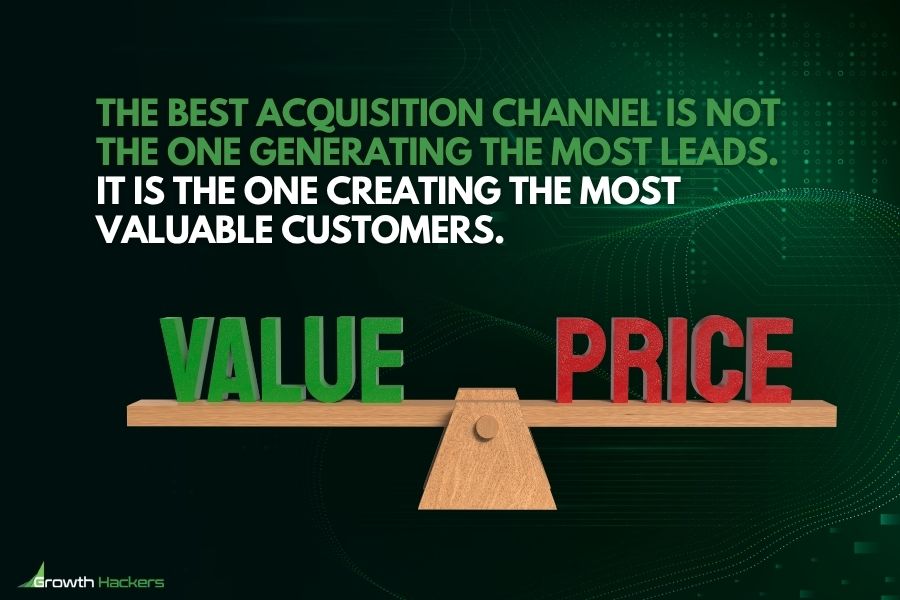
There is no universally superior acquisition channel.
Organic and Content-Driven Channels
SEO and GEO can create compounding visibility and capture existing demand, but it requires time and consistent execution. Content marketing, community building, and referral programs take longer to scale but often attract higher quality leads at lower long-term costs.
Paid Channels
Google Ads can reach customers who are ready to act, but competitive search terms may increase acquisition costs. Paid social and social media ads can generate awareness and demand, but performance depends heavily on creative quality, targeting, and offer strength. Direct mail remains a viable channel for specific target industries, particularly in local and high-ticket B2B markets where physical touchpoints still carry weight.
Outbound Sales
Outbound sales gives a company greater control over which accounts it approaches. It can work well for high-value B2B offers, particularly when supported by strong market research and personalized outreach. Generic sequences, however, often produce weak responses and may damage brand perception.
Matching Channels to the Customer Journey
Channel selection should reflect the customer journey, not personal preference or industry hype.
A high-value enterprise service may need thought leadership, account-based marketing, and direct sales involvement. A self-service SaaS product may focus on SEO, free tools, product-led onboarding, and trial-to-paid conversion. Local small businesses may benefit most from location-based search, reviews, paid search, and referral networks.
How to Choose the Right Customer Acquisition Services | 5 Key Factors
Selecting the right partner requires more than comparing service package descriptions or pricing model options. Many growth marketing agencies can launch campaigns. Fewer can connect acquisition efforts to the company’s economics, sales process, customer success function, and revenue goals. The key factors to evaluate go well beyond the pitch deck.
1. Ask How They Define Success
Start by asking how the provider defines success. A credible partner should be comfortable discussing CAC, lifetime value, conversion rates, payback periods, lead quality, pipeline growth, and revenue outcomes. When every conversation returns to impressions, clicks, and traffic, the provider may be optimizing activity rather than acquisition.
2. Examine the Channel Strategy
Examine the proposed channel strategy. The agency should explain why each channel fits the target audience, customer behavior, market position, and business model. A standardized package may be easier to sell, but customer acquisition rarely succeeds through a one-size-fits-all plan.
3. Data Access and Reporting
Data access and reporting are also important. The business should retain visibility into its advertising accounts, analytics, CRM data, research tools, campaign assets, and performance history. Reporting should make decisions clearer rather than overwhelm stakeholders with dashboards.
4. Team Integration
The provider should also explain how it will work with internal teams. Customer acquisition affects marketing, sales, customer success, operations, and leadership. A strong partner will have a clear process for communication, approval, experimentation, lead handoff, and sales feedback.
5. Pricing Models
Pricing should be evaluated in context. Retainers support ongoing strategy and execution. Project pricing may suit audits, technical setup, or a defined campaign launch. Performance-based arrangements can align incentives, but they may create disputes when attribution and lead standards are unclear. Custom pricing is often appropriate when the scope depends on channel mix, technical requirements, advertising budget, or sales complexity.
A pilot can help both sides validate the working relationship, but it should be long enough to produce meaningful learning. Expecting every channel to demonstrate its full value within a few weeks often leads to poor decisions, especially for SEO, content marketing, and complex B2B acquisition.
Choose customer acquisition services that deliver results.
Work with Growth Hackers
10 Common Customer Acquisition Mistakes to Avoid
A customer acquisition program can fail even when its individual campaigns appear active.
- Optimizing for lead volume instead of lead quality. More leads do not create growth when they do not fit the offer or progress through the sales process.
- Scaling paid advertising before proving the economics. Increasing the budget magnifies existing conversion and targeting problems.
- Treating channels as isolated projects. SEO, GEO, email, outbound, paid media, and sales should support the same customer journey.
- Measuring only blended CAC. Overall averages can hide inefficient channels, weak segments, and expensive customer groups.
- Sending every visitor to a generic page. Landing pages should reflect the visitor’s intent, audience, and stage of awareness.
- Ignoring the relationship between acquisition and retention. A low acquisition cost has limited value when customers leave quickly.
- Separating marketing data from the sales process. Without shared definitions and feedback, teams cannot identify why leads fail to convert.
- Using automation without clear messaging or reliable data. Automation makes weak execution faster rather than making it effective.
- Choosing a provider based only on price. A low fee becomes expensive when the work produces weak leads, poor reporting, and no measurable pipeline.
- Expanding before validating demand and capacity. Entering a new market without sufficient research or operational support increases risk.
Avoiding these mistakes requires disciplined measurement and smarter execution, not simply more marketing activity.
What Results Can Customer Acquisition Services Produce?
Effective customer acquisition services can improve lead quality, conversion efficiency, pipeline consistency, market reach, and revenue growth. They may also help a company expand its acquisition capabilities without immediately adding multiple full-time specialists to its internal team.
Results Depend on the Starting Point
The exact results depend on the business’s starting position, target market, offer, pricing, margins, sales cycle, existing brand awareness, channel maturity, and ability to convert demand.
A company with a proven offer and weak campaign execution may improve relatively quickly once its targeting, messaging, and conversion paths are corrected. A startup still validating product-market fit may require more research and experimentation before it can scale. A B2B company with a six-month sales cycle should not evaluate success on the same timeline as an eCommerce business selling low-cost products.
What a Strong Partner Delivers
No service provider can guarantee a fixed CAC, return on investment, or rate of growth. A strong partner can create the strategy, systems, testing discipline, and reporting needed to improve performance over time.
Agencies also improve lead quality by qualifying leads before handoff, which means the sales team spends more time on conversations that are likely to close and less time on prospects that were never a fit. They also provide access to specialized expertise and resources that would take years and a significant budget to build internally.
The most meaningful result is not a temporary increase in traffic or lead volume. It is greater control over how customers are acquired, what that acquisition costs, and how efficiently marketing and sales investment turns into revenue.
Create a Smarter Customer Acquisition Strategy
Customer acquisition works when the business understands who it wants to reach, selects the right channels, builds a persuasive customer journey, measures the economics, and scales only what produces profitable results. The goal is not to run more campaigns. It is to create a repeatable process that turns marketing and sales investment into sustainable revenue growth.
Growth Hackers is a top-rated customer acquisition agency that helps startups, SaaS companies, e-commerce stores, entrepreneurs, business owners, and marketers acquire more qualified customers through SEO, GEO, content marketing, paid advertising, conversion optimization, AI-powered distribution, analytics, branding, and scalable growth systems.
Request a free Growth Audit to identify gaps in your customer acquisition process, channel performance, conversion paths, and measurement.
You can also book a 30-minute strategy call with the Growth Hackers team to discuss a customer acquisition strategy aligned with your business goals, sales process, and growth potential.