Many businesses still rely heavily on advertising, outbound outreach, and traditional sales processes to generate revenue. While those approaches can work, modern buyers increasingly prefer to evaluate products on their own before speaking with a salesperson.
This shift has made product led growth marketing one of the most effective growth strategies for SaaS companies, technology businesses, and digital platforms seeking scalable growth.
At Growth Hackers, we’ve helped organizations refine their growth strategies by aligning product experiences, marketing initiatives, and revenue operations around one central idea: let the product demonstrate its value before asking prospects to buy.
This guide explains what product led growth is, how a successful product led growth strategy works, and the practical steps businesses can take to implement a sustainable PLG engine.
Whether you’re a founder, marketer, product leader, or revenue executive, this article will help you understand how to turn your product into the primary driver of customer acquisition, activation, expansion, and retention.
Executive Summary | Product Led Growth and Growth Strategy Snapshot
Product led growth is a business methodology where the product itself becomes the main engine for customer acquisition, conversion, and expansion.
Rather than depending exclusively on sales teams and marketing campaigns, organizations use product experiences to attract users, demonstrate value, and convert them into paying customers.
One of the biggest promises of product led growth is achieving lower customer acquisition costs while maintaining strong organic growth. This is especially important because acquiring a new customer can cost 5 to 25 times more than retaining an existing one. By helping users experience value before engaging with sales teams, product led organizations can improve conversion efficiency while reducing reliance on expensive acquisition channels.
The three most important outcomes to measure include:
- Activation rate
- Customer retention
- Revenue growth
Organizations that successfully implement product led growth often experience stronger user satisfaction, increased customer value, and more sustainable business growth over time.
What is Product-Led Growth Marketing
Product led growth is a growth model where the product serves as the primary driver of acquisition, conversion, retention, and expansion.
Unlike traditional demand generation approaches, product led organizations focus on enabling users to experience value before making a purchase decision.
In many sales led growth environments, marketing teams generate leads and pass them to sales teams for qualification. In contrast, a product led approach shifts marketing toward product enablement, onboarding optimization, education, and activation.
Instead of convincing prospects through presentations and sales efforts alone, the goal is to let users discover value through direct interaction.
A product led growth strategy is particularly effective when:
- The product can be explored through self service
- New users can experience immediate value quickly
- Product usage naturally drives expansion opportunities
- User behavior can be measured accurately
- The buying process benefits from hands-on evaluation
5 Key Characteristics of Successful Product Led Teams
Before implementing a product led growth motion, companies should evaluate whether they possess the key characteristics required for success.
1. Faster Time to Value is The Core Metric
The best product led companies obsess over faster time to value.
If users discover meaningful outcomes within minutes instead of days, activation rates improve dramatically.
Rather than focusing solely on feature adoption, successful teams identify the shortest path to a user’s first meaningful success. This helps new users experience customer value early in their journey and increases the likelihood of long-term engagement.
2. Strong Product and Marketing Alignment
Successful product led growth requires close collaboration between the product team and marketing teams.
Marketing teams must understand product usage data, onboarding friction points, and activation barriers.
When product and marketing operate from the same set of insights, messaging becomes more accurate and acquisition efforts attract higher-quality users. Alignment also helps ensure that expectations set before signup match the actual product experience, creating a smoother customer journey.
3. Data-Driven Decision Making
Organizations need systems to track user behavior, monitor usage patterns, and understand customer behavior throughout the customer journey.
Effective decision-making depends on reliable data rather than assumptions. Teams should regularly analyze activation metrics, feature adoption trends, retention indicators, and conversion paths to identify opportunities for improvement and prioritize the highest-impact initiatives.
4. Self-Service Product Experience
A strong self service experience allows potential customers to explore the platform independently before involving sales reps.
The onboarding process should be intuitive, allowing users to navigate key features without extensive guidance. Clear product education, contextual support, and streamlined setup flows help reduce friction while enabling users to reach immediate value more efficiently.
5. Continuous Customer Learning
Product led organizations continuously collect customer feedback and user feedback to improve onboarding, features, and retention experiences.
The most effective teams establish ongoing feedback loops through surveys, support interactions, product analytics, and customer interviews. These insights help uncover emerging needs, identify obstacles to adoption, and improve user satisfaction over time. Continuous learning also enables organizations to adapt their product led growth strategy as customer expectations evolve.
Want to build a smarter growth strategy with product led growth marketing?
Contact Growth Hackers
Product Led Growth Model | Framework and the 4 Phases
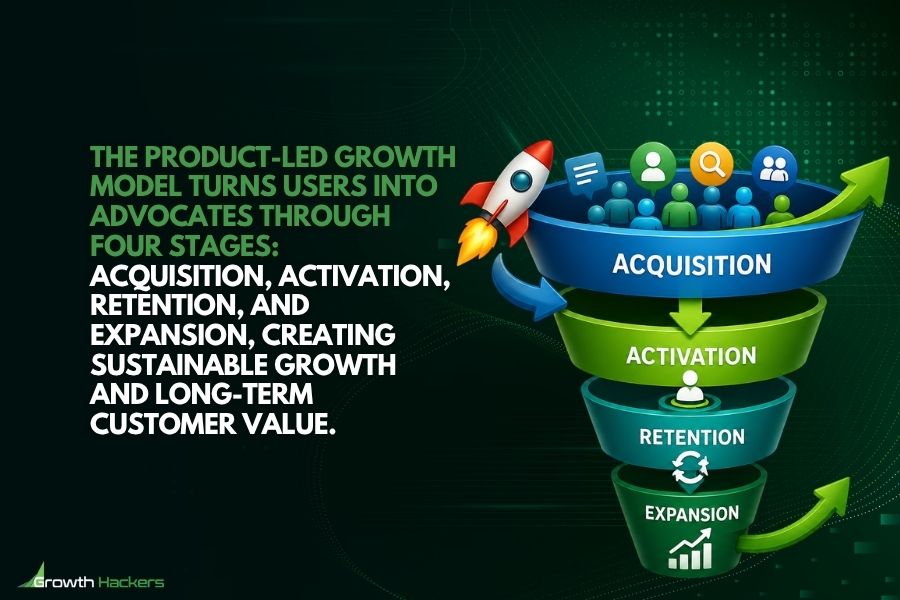
The product led growth model typically consists of four major phases. While the stages appear straightforward, each phase requires clear goals, measurement, and alignment between product, marketing, and revenue teams to create a seamless customer journey.
1. Acquisition
Potential customers discover the product through content, referrals, communities, product SEO, GEO (Generative Engine Optimization) or viral growth mechanisms.
Unlike a traditional sales led growth approach, acquisition in a product led environment is designed to encourage direct product interaction as early as possible. The objective is not simply generating traffic, but attracting users who are likely to experience value quickly and continue engaging with the product.
2. Activation
Activation occurs when users interact with core features and experience immediate value for the first time.
The activation milestone should represent a meaningful outcome rather than a simple login or signup.
For example, a project management platform might define activation as creating and completing a first project, while a collaboration tool may measure activation when team members successfully invite colleagues and begin working together. Reducing friction during onboarding is critical because activation strongly influences long-term customer retention.
3. Retention
Retention measures whether users continue receiving ongoing value after activation.
Strong customer retention is one of the clearest indicators that a product led growth strategy is working.
Teams should regularly analyze product usage trends, feature adoption, and customer behavior to identify early warning signs of churn. Continuous improvements based on customer feedback and user feedback help maintain engagement and strengthen user loyalty over time.
4. Expansion
As product usage increases, upgrade opportunities emerge naturally.
This is where product qualified leads become highly valuable.
Rather than relying solely on form fills, sales teams engage prospects who demonstrate strong user intent through meaningful product usage.
Expansion can take many forms, including additional seats, premium features, advanced integrations, or enterprise-level plans. In mature PLG organizations, product led sales complements self service adoption by helping highly engaged users expand into larger contracts while ensuring they continue receiving maximum customer value from the platform.
PLG Strategy Playbook | 5 Practical Steps to Build a PLG Strategy
Building a successful PLG strategy requires more than offering a free trial.
1. Define Your Ideal Customer Profile Through Product Signals
Analyze product usage data from existing customers to identify common success patterns.
Look for:
- Feature adoption
- Session frequency
- Usage patterns
- Expansion behavior
These insights help identify customer segments most likely to succeed.
2. Map The Shortest Path to First Value
Every additional step creates friction.
The best product led strategies reduce complexity and help users discover value as quickly as possible.
3. Design Onboarding Around the Aha Moment
A successful onboarding experience focuses on enabling users to reach the moment where the product’s benefits become obvious.
This “aha” moment often determines whether free users become paying customers.
4. Build Upgrade Triggers
The strongest product led growth systems connect upgrades to meaningful outcomes.
Examples include:
- Team collaboration limits
- Workflow automation thresholds
- Storage limits
- Advanced reporting access
5. Create a Testing Cadence
The most effective growth strategies involve continuous experimentation.
Run onboarding tests weekly and measure activation improvements over time.
Tactical Growth Strategy | 4 Acquisition Channels For PLG
Not all acquisition channels work equally well for product led growth.
1. Product SEO
Product-led SEO allows users to discover solutions directly through search.
Companies like Zapier built substantial organic growth by creating pages aligned with user needs and workflows.
The most effective product SEO strategies target problem-specific searches and use cases rather than broad industry terms. By connecting search intent directly to a product experience, businesses can attract potential customers who are already seeking a solution and are more likely to activate quickly.
2. Viral Loops
Viral growth occurs when existing users invite new users through product interactions.
Collaboration products often benefit significantly from this approach.
Features such as shared workspaces, team invitations, collaborative documents, and referral programs naturally encourage adoption. When each new user increases the value of the platform for others, the product itself becomes a customer acquisition channel.
3. Educational Content
Content should support the customer journey by helping users understand how to solve problems with the product.
The goal is not merely attracting traffic but encouraging product trials.
Tutorials, use-case guides, implementation playbooks, and product-led webinars can help prospects understand the value of the solution before they sign up. High-quality content also helps marketing teams nurture interest while supporting self service evaluation.
4. Paid Acquisition
Paid campaigns remain valuable.
However, product led companies use paid channels strategically to attract high-intent cohorts that can quickly activate and convert.
Instead of optimizing solely for clicks or signups, successful PLG organizations evaluate campaign performance based on activation, product usage, and conversion to paying customers. This approach helps improve customer acquisition efficiency while ensuring advertising spend supports long-term growth objectives.
Lower Customer Acquisition Costs With 4 Product-Led Tactics
Reducing acquisition costs is one of the most compelling benefits of product led growth.
When users can evaluate a product independently and reach meaningful outcomes before speaking with a salesperson, companies often reduce friction throughout the customer journey. This creates a more efficient path from discovery to conversion while allowing teams to scale growth without proportionally increasing marketing spend.
1. Measure Customer Acquisition Cost By Cohort
Track customer acquisition cost across different customer segments rather than averaging all channels together.
This creates a more accurate picture of performance.
For example, users acquired through product SEO, referrals, or partner integrations may have significantly different acquisition costs and conversion rates. Cohort-level analysis helps identify which acquisition sources generate the highest-quality users and the strongest long-term returns.
2. Improve Funnel Efficiency
Optimizing onboarding, activation, and retention often has a larger impact than increasing ad spend. Even small improvements can create meaningful business results. According to Contentsquare’s Digital Experience Benchmark Report, top-performing websites achieve conversion rates that are up to 2.7 times higher than average performers. Better conversion rates naturally reduce customer acquisition cost while helping organizations generate more value from existing traffic.
Even small improvements in activation can create substantial gains across the funnel. When more new users successfully experience value during onboarding, businesses can generate more revenue from existing traffic and trial volume without increasing acquisition budgets.
3. Introduce Referral Incentives
Referral programs help acquire customers through trusted recommendations while reducing dependence on paid channels.
This contributes to sustainable growth and stronger user loyalty.
The most effective referral programs are closely tied to product usage and customer value. By rewarding users for inviting colleagues, teammates, or business partners, companies can encourage organic growth while attracting prospects who already have a trusted connection to the product.
4. Reduce Dependence On High-Cost Sales Processes
In many organizations, traditional sales motions require significant investments in prospecting, qualification, and sales efforts. A product led approach allows potential customers to explore the platform through self service experiences before engaging with the business.
As a result, sales teams can focus their attention on the most promising opportunities, improving efficiency while lowering the overall cost of customer acquisition. This becomes particularly valuable as companies pursue scalable growth across larger markets.
Metrics And Measurement | Customer Acquisition Cost, TTV, And More
Successful product led growth depends on measurement.
Key metrics include:
Customer Acquisition Cost (CAC)
Track customer acquisition cost at the cohort level.
Analyzing acquisition costs by channel, audience, and signup cohort provides a clearer picture of which growth initiatives generate the highest-quality users. This approach helps marketing teams allocate budgets more effectively and identify opportunities to improve customer acquisition efficiency over time.
Time to Value (TTV)
Measure how quickly different user segments achieve meaningful outcomes.
Organizations that achieve faster time to value typically experience stronger activation rates.
Tracking the average time required for new users to complete key actions can reveal onboarding friction and adoption barriers. Reducing delays between signup and value realization is often one of the fastest ways to improve conversion rates and support a successful product led growth motion.
PQL to Revenue Conversion
Monitor how effectively product qualified leads convert into opportunities and revenue.
Strong conversion rates often indicate that product usage is accurately identifying high-intent prospects. Reviewing feature adoption, account activity, and engagement trends can help determine which usage signals are most predictive of future purchases.
Expansion Revenue
Track growth generated from existing customers through upgrades and additional seats.
Expansion revenue is a critical indicator of long-term product-market fit. When customers continue increasing their investment as product usage grows, it demonstrates that the platform is delivering ongoing value and supporting business outcomes.
Net Dollar Retention
This metric reflects the ability to retain and expand customer relationships over time.
A strong net dollar retention rate shows that revenue generated from existing customers is growing faster than revenue lost through churn or downgrades. For many product led organizations, this metric serves as a leading indicator of sustainable growth because it captures both customer retention and account expansion within a single measurement framework.
Product Led Growth Examples | Case Studies and Benchmarks
Reviewing product led growth examples helps illustrate how PLG operates in practice.
SaaS Freemium Example
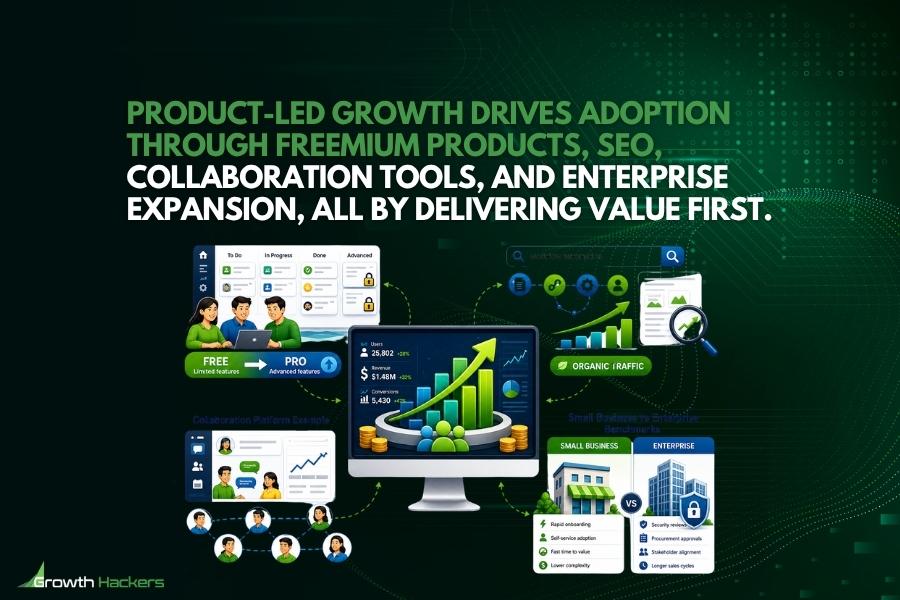
A project management platform using a freemium model allows free users to collaborate with limited functionality.
As teams grow and require advanced features, upgrades occur naturally.
Product-Led SEO Example
Zapier has become one of the most recognized product led growth examples through product-focused SEO.
Their content aligns directly with workflow-related searches and drives qualified trial users.
Collaboration Platform Example
Many collaboration platforms use a self service model that spreads through departments before reaching enterprise-wide adoption.
This approach allows users to interact with the product before procurement becomes involved.
Small Business Versus Enterprise Benchmarks
Small businesses often prioritize rapid onboarding and self service adoption.
Meanwhile, enterprise clients typically require additional security reviews, procurement approvals, and stakeholder alignment.
Turn your product into a growth engine with product led growth marketing today.
Work with Growth Hackers
Product Led For Enterprise Clients | Adapting PLG at Scale
PLG is not limited to startups.
Many enterprise software companies successfully combine product led growth with strategic sales involvement.
Hybrid Product Led And Sales Motion
A hybrid product led growth motion allows prospects to explore independently before engaging sales teams.
Define Escalation Criteria
Sales teams should intervene when:
- Product usage reaches defined thresholds
- Multiple departments adopt the platform
- Expansion potential increases significantly
Enterprise Readiness
For enterprise clients, onboarding should address:
- Security requirements
- Compliance standards
- Governance controls
- Procurement processes
These proof points strengthen customer satisfaction and accelerate enterprise adoption.
Pricing and Monetization in a PLG Strategy
Pricing plays a critical role in any PLG strategy.
Strategic Freemium Boundaries
A successful freemium model provides enough value to attract users while preserving incentives to upgrade.
The goal is to help potential customers experience meaningful outcomes without giving away the entire product. Many successful product led companies reserve advanced collaboration features, automation capabilities, analytics, or administrative controls for premium plans. This approach encourages adoption while creating a natural progression toward paid tiers as product usage grows.
Trial Optimization
Some organizations find success with short trials paired with seamless payment experiences.
Trial periods should be long enough for users to experience immediate value but short enough to create urgency. Monitoring user behavior during trials can reveal where prospects encounter friction and where onboarding improvements may increase conversion rates. The most effective trials focus on helping users achieve specific outcomes rather than simply exploring features.
Align Packaging To Expansion
Packages should reflect customer value generated through product adoption.
As teams expand their usage, pricing should scale in a way that feels logical and predictable. Usage-based pricing, seat-based pricing, or feature-based tiers can all work when aligned with customer value. The strongest product led strategies align pricing with outcomes rather than feature lists alone.
Experimentation and Analytics Foundation
A successful product led growth strategy requires robust analytics.
Instrument Event Tracking
The product team should define meaningful usage events tied directly to customer outcomes.
Rather than tracking vanity metrics, focus on actions that indicate engagement and long-term success. Product usage data can reveal which actions correlate most strongly with activation, customer retention, and expansion opportunities.
Run Continuous Tests
High-performing growth organizations conduct frequent experiments focused on onboarding, activation, and retention.
Small improvements can compound significantly over time. Testing onboarding sequences, feature adoption prompts, upgrade messaging, and self service experiences often uncovers opportunities to improve conversion rates without increasing customer acquisition spending.
Share Insights Across Teams
Weekly reviews help marketing teams, product team members, and sales teams align around growth priorities.
Sharing insights across departments ensures decisions are based on actual customer behavior rather than assumptions. This creates a comprehensive understanding of how customers control their purchasing decisions and where growth opportunities exist throughout the customer journey.
4 Common Pitfalls and How to Avoid Them
1. Optimizing For Signups Instead Of Activation
Many businesses celebrate signup growth while ignoring whether users achieve immediate value.
A growing user base has little impact if new users fail to engage with the product. Activation should remain the focus because it serves as the foundation for retention, expansion, and long-term revenue generation.
2. Allowing Freemium To Become A Cost Sink
A freemium model should support conversion, not simply accumulate inactive accounts.
Organizations should regularly evaluate conversion rates, engagement levels, and support costs associated with free users. If a large percentage of users consume resources without progressing toward paid plans, adjustments to onboarding, feature access, or upgrade triggers may be necessary.
3. Treating PLG As A Campaign
Product led growth is not a temporary initiative.
Unlike a traditional sales campaign, it represents an operational framework that influences acquisition, retention, and expansion.
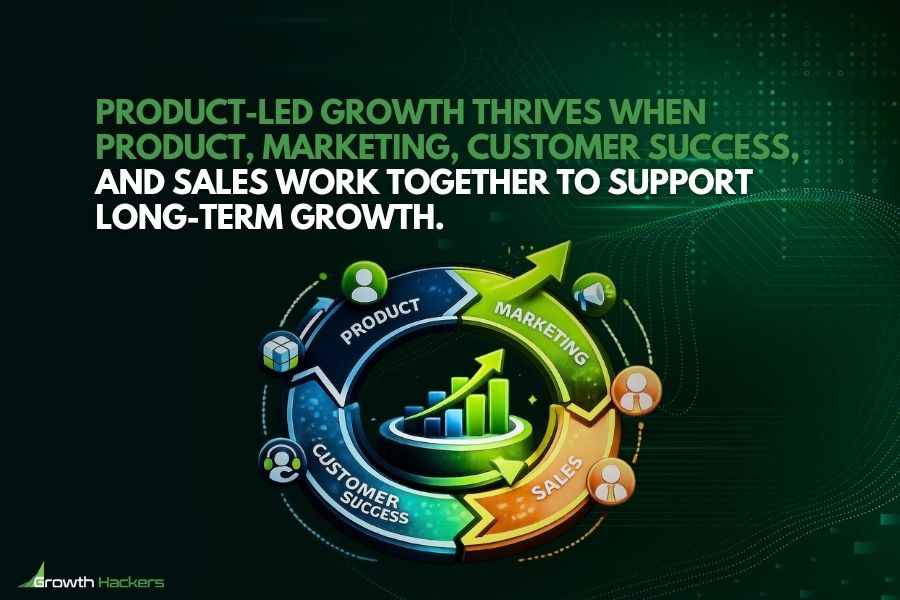
Successful product led growth requires ongoing collaboration between marketing teams, the product team, customer success, and sales teams. Organizations that treat PLG as a long-term capability tend to outperform competitors relying exclusively on a sales led strategy or sales led model.
4. Ignoring Customer Feedback Signals
Many companies collect customer feedback but fail to act on it consistently.
Product led growth thrives when teams use customer feedback and product usage insights to improve onboarding experiences, remove friction, and increase user satisfaction. Continuous learning helps organizations adapt to changing customer needs while strengthening customer relationships over time.
Implementation Roadmap | 90, 180, 365 Day Plan
First 90 Days
- Launch pilot cohorts
- Measure activation rates
- Establish baseline metrics
- Analyze user satisfaction
First 180 Days
- Expand onboarding experiments
- Refine product led strategies
- Improve customer retention
- Strengthen organic growth channels
First 365 Days
- Institutionalize PLG reporting
- Improve customer lifetime value
- Expand successful growth strategies
- Scale sustainable growth initiatives
The objective is to create a repeatable go to market strategy that consistently generates new customers while increasing value from existing customers.
Conclusion | Make Product Led Growth Marketing Work With Growth Hackers Digital Marketing Agency
The most successful companies increasingly recognize that buyers prefer evaluating products firsthand rather than navigating lengthy traditional sales processes.
A well-executed product led growth approach helps organizations create scalable growth, improve customer satisfaction, reduce friction across the buying process, and strengthen long-term customer relationships
Growth Hackers is a dynamic product marketing agency working with companies seeking to implement a sustainable product led growth strategy that aligns product experiences, acquisition channels, onboarding systems, and revenue operations.
If you’re evaluating whether your organization is ready for product led growth, our team can help.
Run a PLG readiness audit with Growth Hackers.
Benchmark your current customer acquisition cost against industry standards.
Review your activation funnel and onboarding experience.
Or launch a pilot engagement designed to shorten time to value and accelerate growth.
Contact Growth Hackers today for a tailored proposal and discover how a strategic product led approach can transform your growth trajectory.