
Many companies do not have a marketing activity problem. They have a growth management problem.
They are publishing content, running paid ads, sending email campaigns, posting on social media, building landing pages, checking Google Analytics, and reviewing reports. From the outside, the team looks busy. But when leadership asks which efforts are lowering customer acquisition cost, improving conversion rates, strengthening retention, or creating measurable business growth, the answer is often unclear.
That is where growth marketing management becomes valuable.
A seasoned growth marketing manager does more than manage marketing campaigns. This person connects marketing strategy, customer acquisition, product adoption, customer retention, analytics, and business outcomes into one measurable growth system. Instead of focusing only on awareness, traffic, or leads, the role looks at the full customer journey and asks a more important question:
What is stopping more people from becoming customers, staying longer, and spending more over time?
At Growth Hackers, we often see companies investing in digital marketing without a clear system for prioritizing growth opportunities. Some teams have strong content but weak conversion. Others have paid campaigns driving traffic but no retention strategy. Some have good products but poor onboarding, unclear messaging, or disconnected sales and marketing follow up.
Growth marketing management helps solve that problem. It gives companies a structured way to test ideas, measure performance, improve the funnel, and scale what works. It also helps connect demand generation, lead generation, customer acquisition, retention, product usage, and sales impact into one focused growth strategy.
What is Growth Marketing Management?
Growth marketing management is the process of planning, testing, measuring, and scaling strategies that directly support long term business expansion.
Unlike traditional marketing management, which often focuses on brand awareness, communications, events, campaigns, and visibility, growth marketing management focuses on measurable outcomes across the full funnel. It looks at customer acquisition, activation, conversion rates, customer retention, customer lifetime value, referral opportunities, sales funnel performance, and scalable growth.
This is what makes the function different from standard campaign management. Growth marketing management brings together growth strategy, marketing operations, performance marketing, lifecycle marketing, marketing analytics, conversion optimization, customer insights, and data driven marketing so every decision can be tied to business impact.
A growth marketing manager is responsible for turning scattered marketing efforts into a clear growth system. The role blends digital marketing, analytics, experimentation, customer insights, product thinking, and revenue accountability.
A traditional marketing manager may ask how to increase awareness for a campaign. A digital marketing manager may ask how to increase traffic, clicks, and leads from a channel. A growth marketing manager asks which part of the customer journey is limiting growth and what experiment can be run to improve it.
That difference matters.
A company can increase traffic and still lose money if conversion rates are weak. It can generate leads and still miss sales goals if the leads are not qualified. It can acquire customers and still struggle to grow if retention is poor.
Growth marketing management keeps the focus on business outcomes, not activity alone.
What Does a Growth Marketing Manager Do?
A growth marketing manager owns the strategy and execution behind measurable growth. The role can vary by company, but the core responsibility is usually the same: find the highest impact growth opportunities, test them quickly, and scale the ones that create real business value.
This role may work across search engine optimization, search engine marketing, paid advertising, performance marketing, email marketing, marketing automation, conversion rate optimization, landing pages, customer onboarding, referral programs, retention campaigns, content marketing, content creation, product marketing, analytics, reporting, and sales alignment.
The role is not limited to one channel. A strong growth marketing manager understands how each channel connects to the larger customer journey.
For example, paid ads may bring in new users, but landing pages determine whether those users convert. Email marketing may nurture leads, but customer segmentation determines whether those emails are relevant. Product onboarding may activate new customers, but retention flows determine whether they stay.
At Growth Hackers, we often see that growth problems are rarely isolated to one campaign. A company may think it has a paid advertising problem when the real issue is weak landing page messaging. Another company may think it needs more leads when the real issue is poor follow up, unclear positioning, or weak customer retention.
A growth marketing manager looks at the system, not just the channel. In many companies, this role also brings a growth hacking mindset to the team by using fast experiments, customer data, user feedback, and practical testing to find better ways to acquire, convert, and retain customers.
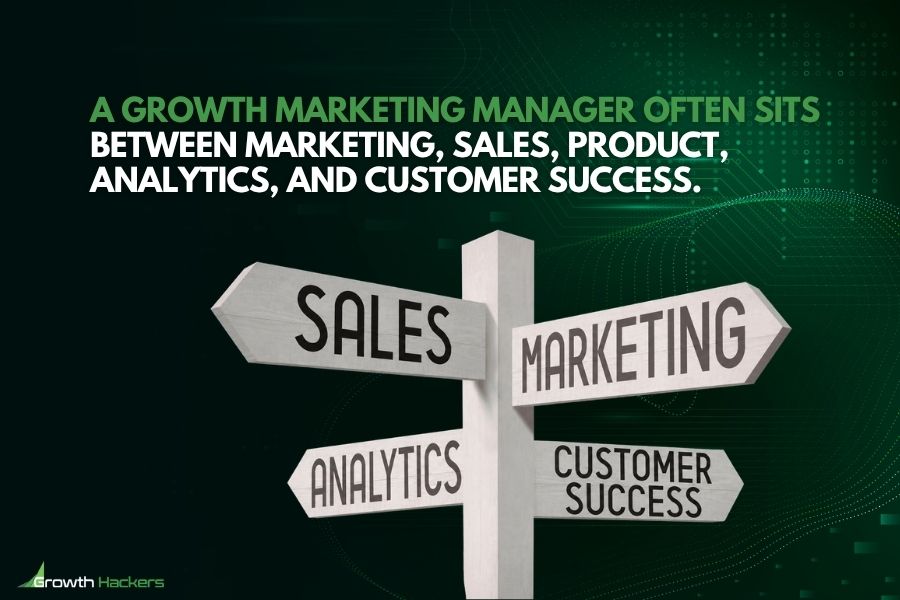
Growth Marketing Manager vs. Digital Marketing Manager vs. Traditional Marketing Manager
These roles often overlap, but they are not the same.
A traditional marketing manager usually focuses on brand positioning, campaign planning, communications, events, PR, market research, and long term visibility. This work is valuable because businesses need trust, awareness, and consistent messaging.
A digital marketing manager focuses on online channels such as SEO, GEO (Generative Engine Optimization), paid search, paid social, email marketing, content marketing, and social media. This role is often responsible for traffic, clicks, leads, cost per lead, and channel performance.
A growth marketing manager goes further. The role connects marketing channels to business outcomes across the full funnel. This includes acquisition, activation, retention, revenue, and referral.
For example, if a SaaS company wants more trial users, a digital marketing manager may improve paid ads and landing page traffic. A growth marketing manager may look at the entire trial journey, including ad messaging, signup friction, onboarding, product usage, lifecycle emails, sales handoff, and trial to paid conversion.
This is why growth marketing management is especially useful for startups, SaaS companies, eCommerce brands, marketplaces, service businesses, and companies trying to scale with more discipline.
It is not just about getting more attention. It is about turning attention into measurable growth.
Ready to accelerate customer acquisition and retention with an experienced growth marketing manager?
Contact Growth Hackers
When Should You Hire a Growth Marketing Manager?
Not every company needs a growth marketing manager right away. Hiring too early can create scattered experiments without enough data, budget, or product clarity. Hiring too late can leave growth opportunities untapped.
A company should consider hiring a growth marketing manager when it already has some traction but needs a stronger system for scaling.
This is especially important when the business has several acquisition channels running but no clear growth framework for deciding which campaigns deserve more budget, which ones need improvement, and which ones should be stopped.
Common signs include rising customer acquisition cost, weak conversion rates, inconsistent lead quality, poor retention, unclear reporting, and marketing campaigns that look active but do not clearly support business goals. Another warning sign is when the sales team says leads are not ready, while the marketing team believes the campaigns are performing well.
At Growth Hackers, we often see companies reach this point after their first phase of growth. Early marketing may have worked through founder relationships, referrals, content, or paid campaigns. But as the company grows, the same tactics stop producing the same results.
That is usually when growth marketing management becomes valuable.
A seasoned growth marketing manager can bring structure, prioritization, and accountability. Instead of trying random marketing tactics, the company can build a growth roadmap based on customer behavior, funnel data, target audience insights, and business goals.
Growth Marketing Manager Salary, Demand, and Hiring Expectations
Hiring a seasoned growth marketing manager is also a budget and talent planning decision. Typical salaries can range from $90,000 to $147,000 per year across the US, with a median salary of $128,000. This usually includes base salary and additional compensation, depending on company size, location, industry, and scope of responsibility.
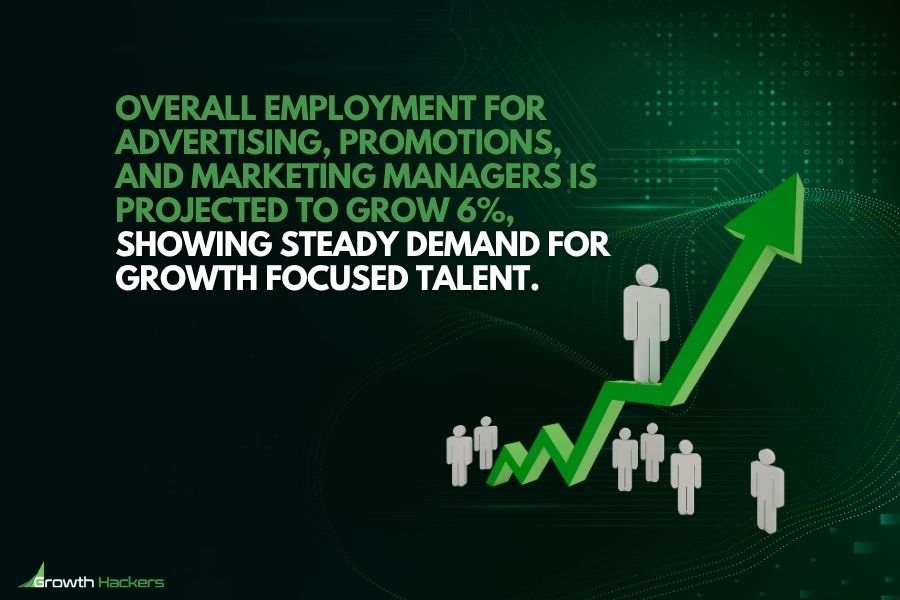
The job outlook is positive because more companies need leaders who can connect marketing campaigns, performance metrics, customer acquisition, retention, and business outcomes. Labor statistics project a 6% growth rate for marketing managers, which reflects continued demand in the digital space.
Demand is especially strong in competitive markets like New York, where companies are actively recruiting growth-focused marketers for digital growth initiatives. Hybrid work models are also becoming more common in many NYC companies for marketing roles, giving businesses more flexibility when hiring experienced talent.
These roles are also common in fintech and financial services sectors in NYC, where customer acquisition, user feedback, data driven insights, lifecycle strategy, and campaign performance are especially important. In many companies, the role is typically reporting to a Head of Growth, CMO, VP of Marketing, or founder.
A bachelor’s degree in marketing, business, communications, analytics, or a related field can be helpful. However, hiring teams should focus more on proven results. Strong candidates should be able to show case studies, explain how they develop and implement successful marketing strategies, and demonstrate how they use tools such as Google Analytics, CRM platforms, and product analytics to optimize campaigns.
What Skills Should a Growth Marketing Manager Have?
A strong candidate needs more than channel experience. The best ones combine analytical thinking, creative execution, customer understanding, and cross functional leadership.
They should understand performance marketing, search engine marketing, content creation, product marketing, email strategy, conversion rate optimization, and marketing tactics across the full customer journey. They should also know how to define a target audience, analyze user feedback, and turn data driven insights into practical experiments.
This combination is essential because the role is not just about launching campaigns. It is about knowing which opportunities matter, which tests deserve priority, and which actions can improve performance without wasting budget.
Analytics and Data Interpretation
Growth marketing is data driven, but data alone is not enough. A growth marketing manager must know how to turn numbers into decisions.
The most important metrics usually include customer acquisition cost, customer lifetime value, conversion rate, activation rate, retention rate, churn rate, return on ad spend, lead quality, funnel drop off, campaign performance, and pipeline contribution.
A seasoned manager should be able to identify what the numbers mean and what to test next. For example, if traffic is increasing but conversions are flat, the problem may be messaging, offer fit, page structure, audience quality, or trust signals.
At Growth Hackers, we value marketers who can look beyond surface level metrics. Website traffic, impressions, and clicks are useful, but they do not matter much if they do not connect to qualified leads, customer acquisition, retention, or sales impact.
Experimentation and Testing
Growth marketing management depends on structured experimentation.
A growth marketing manager should know how to build a test around a clear hypothesis, success metric, timeline, and decision rule. For example, if the hypothesis is that reducing form fields will increase demo requests, the manager should define the metric, the testing timeline, and the criteria for scaling the change.
This structure prevents random testing. It also helps teams learn faster.
The best growth focused marketers do not test everything at once. They prioritize experiments based on potential impact, confidence, and ease of execution. That is how growth experiments become a repeatable process instead of disconnected ideas.
Funnel Strategy
Growth marketing managers should understand the full customer journey, not just top of funnel acquisition.
That means knowing how to improve awareness, lead generation, signup or demo conversion, onboarding, activation, purchase behavior, retention, referral, and expansion revenue.
A company may have different growth bottlenecks at different stages. One business may need more qualified traffic. Another may need better conversion rate optimization. Another may need stronger customer retention.
A good growth marketing manager identifies the constraint before choosing the tactic.
Channel Expertise
A growth marketing manager does not need to be the deepest expert in every channel, but they should understand how major growth channels work together.
This may include SEO, content marketing, paid search, paid social, email marketing, lifecycle marketing, social media marketing, influencer marketing, referral marketing, marketing automation, and landing page optimization.
A strong candidate is often broad across several areas, with deeper experience in one or two. They may be especially strong in paid acquisition, lifecycle strategy, or content, while still having enough knowledge to manage and connect other channels.
Customer Insight
Growth marketing is not only about analytics. It is also about understanding people.
A strong growth marketing manager studies customer behavior, pain points, objections, motivations, and buying triggers. They use customer feedback, sales conversations, surveys, reviews, support tickets, and user behavior to improve marketing strategies.
At Growth Hackers, we often find that the best growth opportunities come from listening carefully to what customers are already saying. Sales objections can become bottom funnel content. Support questions can become onboarding improvements. Customer reviews can become stronger paid ad angles.
Growth improves when marketing is built around real customer insight.
Cross Functional Collaboration
Growth marketing managers rarely work alone.
They often collaborate with founders, CMOs, sales teams, product managers, designers, developers, data analysts, customer success teams, content teams, and paid media specialists.
This matters because growth problems often sit between teams. A landing page issue may require design and copy. An activation issue may require product and email marketing. A retention issue may require customer success and lifecycle systems.
A seasoned growth marketing manager knows how to bring teams together around shared metrics.
Core Responsibilities of a Growth Marketing Manager
A growth marketing manager should be responsible for outcomes, not just tasks.
Instead of simply managing channels, this person should build a repeatable process that helps the company improve qualified leads, optimize campaigns, strengthen customer retention, and drive revenue growth through clearer testing and execution.
The exact job description depends on the company, but common responsibilities include building a growth roadmap, identifying funnel bottlenecks, launching experiments, managing customer acquisition campaigns, improving conversion rates, strengthening retention strategies, coordinating with sales and product teams, reporting on growth KPIs, testing landing pages, improving lead quality, reviewing data driven insights, and documenting successful playbooks.
A strong growth marketing manager should also create a regular reporting cadence. Growth should not be reviewed only when performance drops. It should be monitored consistently so teams can adjust quickly.
A weekly growth report may include top performing channels, cost per lead, conversion rate by campaign, lead quality, pipeline contribution, retention trends, experiment results, and next tests. This keeps the entire team aligned around what is working, what is not, and what needs to happen next.
How Growth Marketing Managers Drive Results Across the Funnel
Growth marketing management becomes most valuable when it improves the entire customer journey.
This is where the role becomes different from campaign management. It looks at each stage of the customer lifecycle and identifies which growth levers can create the strongest measurable impact.
Acquisition is about attracting the right people, not just more people. A growth marketing manager may improve acquisition by testing paid ads, SEO content, partnerships, referral programs, webinars, social media strategies, search engine marketing, and lead magnets. The goal is to identify which channels bring in qualified prospects at a sustainable cost.
Activation is the moment when a prospect or user experiences enough value to keep moving forward. For a SaaS company, activation might mean completing onboarding or using a core feature. For a service business, it might mean booking a consultation. For an eCommerce brand, it might mean adding a product to cart or completing the first purchase.
Retention is where many companies quietly lose growth. A business can spend heavily on customer acquisition, but if customers do not stay, repeat, renew, or expand, growth becomes expensive. A growth marketing manager may improve retention through lifecycle email campaigns, customer segmentation, loyalty programs, product usage prompts, customer education, and win back campaigns.
Revenue work depends on more than new customers. Growth marketing managers also look at pricing, packaging, upsells, cross selling, average order value, expansion opportunities, and customer lifetime value. The goal is to increase the value of each customer relationship without creating a poor customer experience.
Referral growth happens when satisfied customers bring in new customers. A growth marketing manager may build referral programs, advocate campaigns, review requests, partner campaigns, or customer success stories that encourage word of mouth. Referral programs work best when they are timed around moments of customer satisfaction, not forced too early.
In House Growth Marketing Manager vs. Agency vs. Consultant
Companies often wonder whether they should hire a full time growth marketing manager, work with an agency, or bring in a consultant.
The right choice depends on the company’s stage, budget, internal team, and growth goals. Some companies need daily internal ownership, while others need an experienced growth partner that can bring strategy, execution, analytics, and channel expertise together faster than an internal hire.
An in house growth marketing manager may be the right choice when the company needs daily ownership, deep product knowledge, and constant cross functional collaboration. This works well when the company already has enough marketing activity, budget, and internal resources to support the role.
A growth marketing consultant may be useful when the company needs strategy, audits, prioritization, or a temporary growth roadmap. This is often a good option for companies that need expert direction but are not ready to hire full time.
A growth agency can be valuable when the company needs both strategy and execution. At Growth Hackers, we act as a hands-on growth partner for companies that need more than advice. Our work often includes strategy, SEO, paid advertising, content marketing, conversion optimization, automation, analytics, and experimentation.
This can be especially useful when internal teams are busy, missing specialist skills, or struggling to connect marketing execution to measurable business growth.
What to Look for When Hiring a Seasoned Growth Marketing Manager
Hiring the wrong growth marketing manager can be expensive. The best candidates should show a clear track record of improving business outcomes, not just managing campaigns.
A strong candidate should be able to explain what growth problems they solved, which metrics they improved, how they prioritized experiments, what they learned from failed tests, how they worked with sales and product teams, and how their work affected pipeline and sales.
They should also be able to show how they used user feedback to improve strategy and how they turned case studies into repeatable playbooks.
Good interview questions include:
- What funnel metric do you usually evaluate first, and why?
- Tell me about a growth experiment that failed. What did you learn?
- How do you decide which tests to prioritize?
- How do you balance brand building with short term performance?
- How do you measure lead quality?
- How do you improve retention?
- How do you work with sales and product teams?
- What would you do in your first 90 days?
- Which performance metrics would you review first?
- How would you use Google Analytics and CRM data to find growth opportunities?
The best answers should be specific. Be cautious with candidates who speak only in vague marketing language or focus too heavily on vanity metrics.
Get ready to scale faster with an experienced growth marketing manager.
Work with Growth Hackers
Common Mistakes Companies Make When Hiring a Growth Marketing Manager
One common mistake is hiring too early. If a company has no clear offer, no product market fit, and no baseline customer data, a growth marketing manager may not have enough foundation to work with. In that case, the company may first need positioning, customer research, product clarity, or basic marketing infrastructure.
Another mistake is hiring a channel specialist for a full funnel role. A paid ads specialist may be excellent at acquisition, but that does not always mean they can improve activation, retention, or customer lifetime value. A growth marketing manager needs broader ownership than one channel.
Some companies also expect instant results without clean data. Growth works through testing, but testing needs reliable tracking, enough traffic, and clear goals. If analytics are broken or leadership cannot define success, the role will be limited from the start.
Focusing only on acquisition is another issue. Many companies hire growth marketers because they want more leads or customers. Acquisition matters, but growth also depends on conversion, retention, and revenue expansion.
Finally, companies sometimes fail to give the role enough authority. Growth requires collaboration across teams. If the manager cannot influence landing pages, messaging, product onboarding, sales handoff, or reporting, they may be limited to surface level campaign changes.
What a Growth Marketing Manager Should Do in the First 90 Days
The first 90 days should focus on diagnosis, prioritization, and early wins.
During the first 30 days, the manager should audit current marketing channels, customer acquisition cost, conversion rates, lead quality, retention metrics, analytics setup, landing pages, email flows, sales funnel performance, customer feedback, product marketing materials, content creation workflows, and target audience definitions.
The goal is to understand where growth is currently leaking.
From days 31 to 60, the manager should build a prioritized growth backlog. This may include experiments across landing page messaging, paid ad creative, SEO opportunities, email nurturing, onboarding flows, lead magnets, conversion rate optimization, sales handoff, retention campaigns, search engine marketing tests, product messaging, and lead generation offers.
The focus should be on tests that can create meaningful learning quickly.
From days 61 to 90, the manager should begin scaling early winners and documenting playbooks. This may include a repeatable testing process, reporting dashboards, channel performance updates, conversion improvement plans, retention strategy, campaign templates, case studies from early wins, and clear next steps for successful marketing strategies.
At Growth Hackers, we believe documentation is one of the most underrated parts of growth. A successful test should not stay as a one time win. It should become a repeatable system the business can use again.
Growth Marketing Management Metrics That Matter
A growth marketing manager should be measured by business impact.
A strong measurement system should include both leading indicators and business outcomes. Leading indicators help teams understand early movement, while business outcomes show whether the growth marketing strategy is actually creating value.
The most important metrics often include customer acquisition cost, customer lifetime value, conversion rate, activation rate, retention rate, churn rate, return on ad spend, marketing qualified leads, sales qualified leads, pipeline influenced, repeat purchase rate, expansion revenue, referral rate, lead quality, campaign performance, and funnel drop off.
The right metrics depend on the business model. A SaaS company may focus on trial to paid conversion, activation, churn, and expansion revenue. An eCommerce brand may focus on conversion rate, average order value, repeat purchases, and customer lifetime value. A service business may focus on qualified leads, booked calls, close rate, and pipeline value.
What matters is that every metric connects back to the company’s growth goals.

How Growth Hackers Helps Companies Build Growth Marketing Systems
Growth marketing management is not just about hiring one person. It is about building a system that helps the company test, learn, and scale more effectively.
At Growth Hackers, we help businesses turn fragmented marketing activity into structured growth systems. Our team works across strategy, SEO, content marketing, paid advertising, conversion rate optimization, email marketing, automation, analytics, and customer acquisition to help companies identify the highest impact opportunities.
We do not treat growth as a list of disconnected tactics. We look at the full customer journey and identify where the business is losing momentum. Then we build focused experiments to improve the metrics that matter most.
For some companies, that means improving lead quality. For others, it means lowering customer acquisition cost, strengthening retention, improving landing page performance, or building clearer lifecycle systems.
The goal is always the same: create scalable, measurable, and sustainable growth.
Hire a Growth Marketing Manager With the Right Growth System
Growth marketing management is not just about hiring someone to run more campaigns. The companies that scale successfully are the ones that test ideas, study customer behavior, and improve every part of the customer journey with clear growth goals in mind.
Growth Hackers is a top-tier growth marketing agency helping businesses build scalable systems through search engine optimization, paid campaigns, content marketing, conversion optimization, automation, analytics, and customer acquisition strategy.
If you want to improve marketing performance, lower acquisition costs, strengthen retention, and create sustainable business growth, request a free growth audit today.
You can also book a 30 minute strategy call with our team to discover which growth marketing management approach fits your company’s goals best.