Why does growth feel harder even when you have more data than ever?
You collect numbers from several tools, yet answers still feel out of reach. As a result, growth starts to feel slow and confusing. Instead of clarity, you often see more noise.
The root cause of this problem is that your data lives in too many places. Marketing tools track campaigns, while product tools track usage. At the same time, CRM systems focus on revenue and deals. However, none of these tools show the full customer journey on their own. The result isn’t a lack of data, but a lack of alignment.
That’s why building a unified growth view matters. When customer data is connected end to end, teams move from guesswork to clarity.
This post shows which data pillars to connect, how unified architecture works, real use cases, mistakes to avoid, and how to use customer data ethically so you can make confident, data-backed decisions.
The Three Core Data Pillars
Connecting marketing, product, and CRM data directly improves your business results. When you bring these data sources together, you gain clearer insight into customer behavior.
You also improve team productivity because everyone works from the same facts. In fact, industry research shows integrated customer data can drive 29% higher revenue.
Connecting your data pillars is like assembling a complete map from scattered puzzle pieces, and at Growth Hackers, we help clients see the full customer journey clearly for smarter decisions.
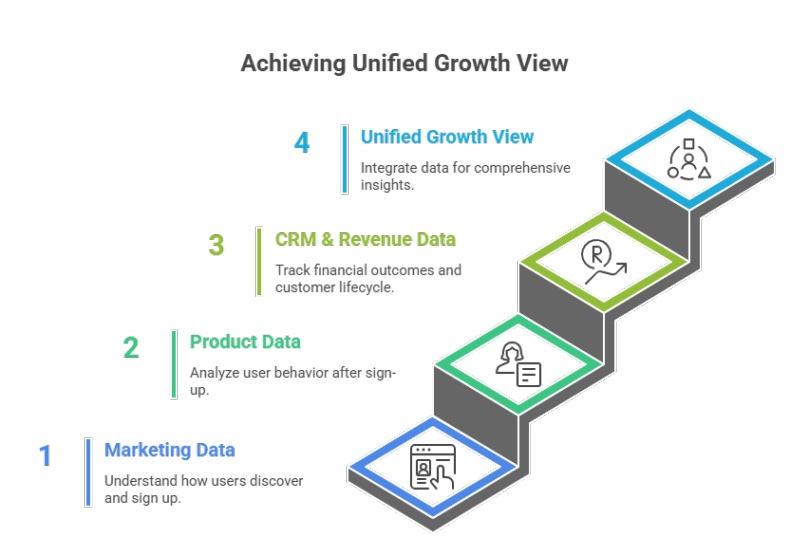
So, how do you build this unified growth view? First, you need to understand the foundation clearly. Most businesses depend on three core data pillars that live in separate tools and teams. However, when you connect these pillars, you gain a full and clear view of the customer journey.
|
Pillar |
Focus |
Examples of Sources |
Main Value |
Big Gap |
|
Marketing Data |
How users discover & sign up |
Ads, SEO, web analytics, email tools |
Shows which campaigns and messages convert |
Doesn’t show activation, retention, or revenue |
|
Product Data |
What users do after signing up |
Product analytics, events, in-app logs |
Reveals usage and friction |
Lacks channel + revenue context |
|
CRM & Revenue Data |
Who pays and how much |
CRM, billing, subscription tools |
Shows customers, renewals, churn, and expansion |
Doesn’t show why they converted or churned |
1. Marketing Data: How People Discover and Convert
Marketing data illustrates how awareness leads to interest and action. It’s commonly found in ad platforms, website analytics, email marketing tools, and lead forms. This information allows you to monitor where leads are coming from and which campaigns attract them. It also indicates which of your messages or content gets people to sign up.
Many businesses now even use AI form builders to capture and structure lead data more efficiently, automatically validating inputs, enriching responses, and sending the information directly to CRM or analytics tools. This information allows you to monitor where leads are coming from and which campaigns attract them. It also indicates which of your messages or content gets people to sign up.
Additionally, marketing data reveals the power of digital marketing in action. You’ll be able to see which channels are sending traffic and how well each of your offers converts.
The majority of marketing tools stop tracking once a user becomes a customer. So, teams end up optimizing only for clicks and sign-ups. That focus ignores the metrics that truly matter when it comes to growth.
According to Nick, SEO at Nine Peaks Media, to get the actual performance, you have to combine your marketing data with product usage and revenue. Then, connect these sources to the full customer journey. From there, you can make decisions that contribute to growth.
One B2B SaaS client was optimizing only for sign-ups, missing the bigger picture; after Growth Hackers connected their marketing, product, and revenue data, they uncovered hidden bottlenecks and increased qualified conversions by 33%.
2. Product Data: How Users Behave After Sign-Up
Once a user signs up, your focus shifts from acquisition to experience. You now care about what users actually do inside your product. Product data shows real actions, not promises or plans. As a result, you gain a clearer view of user behavior.
With product data, you see which features users try first. You also spot where they struggle or slow down. Over time, you learn which actions lead to retention or drop-off. This insight helps you improve your product in meaningful ways.
The product development lifecycle usually comes from analytics tools and event tracking systems. It also comes from in-app behavior logs that record user actions. By studying this data, you can spot patterns and fix problems early. In turn, you create smoother experiences that keep users engaged.
Despite its value, product data has limits. While it shows engagement, it often lacks visibility into the acquisition source or the revenue impact. You may know who is active, but not who is most valuable. CRM and revenue data provide that missing context.
Before leveraging product data, one of our Fintech clients guessed why users left; after Growth Hackers connected behavioral insights with CRM and revenue data, they gained a full picture of value, engagement, and growth opportunities.
3. CRM and Revenue Data: The Financial Reality
CRM and revenue systems represent the financial truth of a business. They track the outcomes that matter most, including:
- Accounts and contacts
- Deals and pipeline stages
- Contract values and renewals
- Expansions and churn
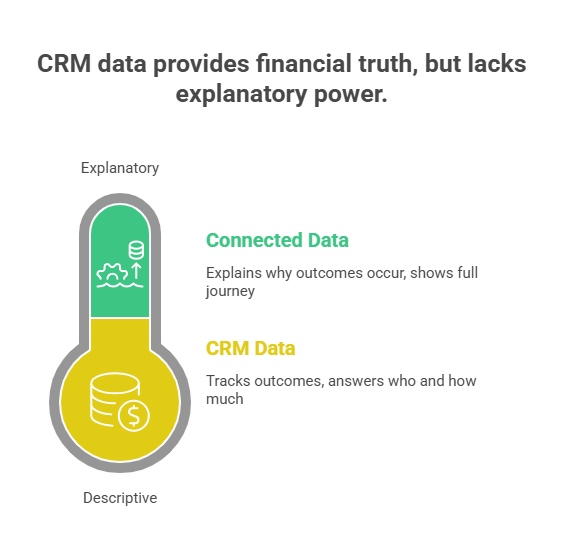
This data answers critical questions about who became a customer, how much revenue they generate, and which accounts grow or leave over time. However, CRM data alone cannot explain why these outcomes occur. It does not show which marketing channels acquired the customer, which product behaviors led to purchase, or which early signals predicted churn.
Those insights appear only when a Customer Data Platform connects CRM data with marketing and product data across the full customer journey.
Need help connecting marketing product CRM data to drive real business impact?
Contact Growth Hackers
Data Architecture: How It All Fits Together
Connecting marketing, product, and sales with your CRM is not about buying a “miracle” tool. You design how data moves across systems with clear intent. As a result, every team works from the same source of truth. This shared view reduces confusion and builds trust in the numbers.
A strong data setup also cuts down complexity. It improves reliability and keeps your data clean. More importantly, it makes insights simple to understand and act on. As a result, your teams spend less time guessing and more time executing.
In turn, you move faster and make smarter decisions. Everyone works from the same clear data, which reduces mistakes. This clarity helps your company grow more efficiently.
At Growth Hackers, we’ve helped one of our tech clients unify marketing, product, and sales data into a single source of truth, boosting team efficiency and accelerating growth by turning insights into action.
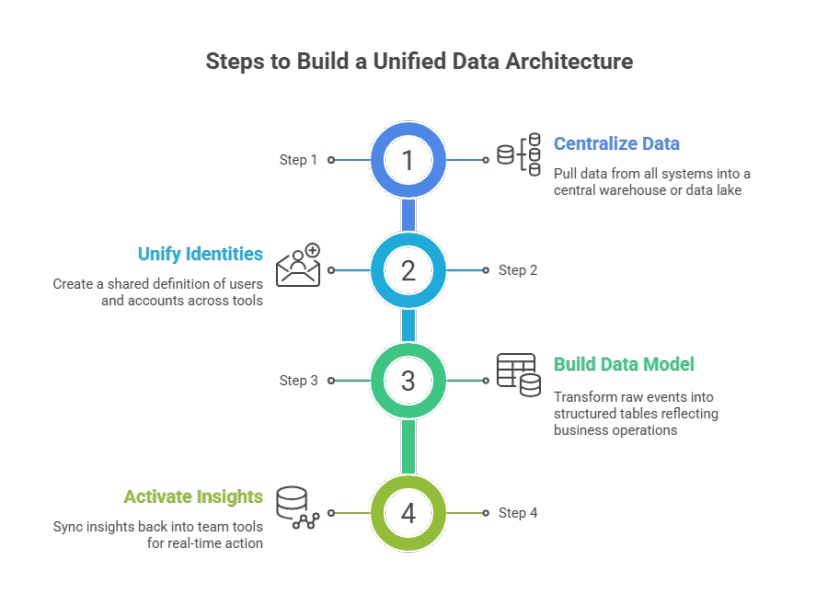
Step 1: Centralize Data Instead of Point-to-Point Chaos
Many early-stage teams connect tools directly to one another. Over time, this setup creates fragile and hard-to-maintain integrations, often called “integration spaghetti.” Each new tool adds extra complexity and makes the system harder to manage. As a result, a single break can disrupt reporting across all teams.
You end up spending more time fixing connections than using the data. This slows down decisions and creates frustration. By simplifying and connecting data properly, you avoid these costly problems.
A modern approach simplifies this flow:
- Data is pulled from every system
- Stored in a central warehouse or data lake
- Modeled and analyzed in one place
Point-to-point data is like a tangled web, and at Growth Hackers, we untangle it by centralizing everything into a single, reliable source so teams can focus on growth, not fixes. With this setup, the warehouse becomes the single source of truth for the entire organization.
Step 2: Create a Unified Customer or Account Identity
Every tool defines users and accounts differently. Without a shared definition, teams end up analyzing tools instead of customers. The first step toward clarity is deciding what a “user” and an “account” actually mean across a business, and how identities are connected.
Common identity-matching approaches include:
- Matching users by email
- Grouping users by company or domain
- Using identity resolution tools for advanced stitching
Once identities are unified, reporting becomes cleaner, segmentation improves, and growth analysis becomes more accurate.
Step 3: Build a Unified Data Model
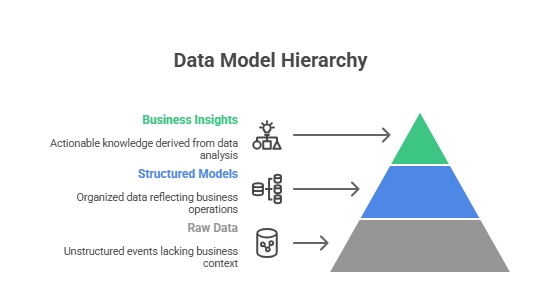
Raw data events do not automatically produce insight. To make data usable, events must be transformed into structured models that reflect how the business actually operates.
Typical modeled tables include:
- Users and accounts
- Lifecycle stages
- Marketing touchpoints
- Product feature events
- Revenue and billing events
Raw data is like uncut stone, and at Growth Hackers, we sculpt it into structured models that reveal the patterns and insights driving business growth.
This structure makes it possible to analyze upgrade likelihood, predict churn risk, and attribute revenue to high-value channels.
Step 4: Activate Insights Back into Your Tools
Unified data only creates value when it drives action. Insights must flow back into the tools teams already use so they can influence decisions in real-time.
Activation typically happens by syncing insights into:
- Advertising platforms
- CRM systems
- Lifecycle email tools
- In-app messaging systems
You use this process to turn insights into real action. Many teams call it reverse ETL or data activation. However, the name matters less than the outcome. You push clean data back into the tools your teams use every day.
One B2B client had brilliant insights trapped in dashboards; after Growth Hackers activated their data across CRM, email, and ad platforms, teams made faster, smarter decisions that increased campaign ROI by 35%.
As a result, insights do not sit in dashboards. Instead, they guide real decisions and workflows. You help teams act faster and with confidence. In turn, your data drives results, not just reports.
Example Use Cases Powered by Unified Data
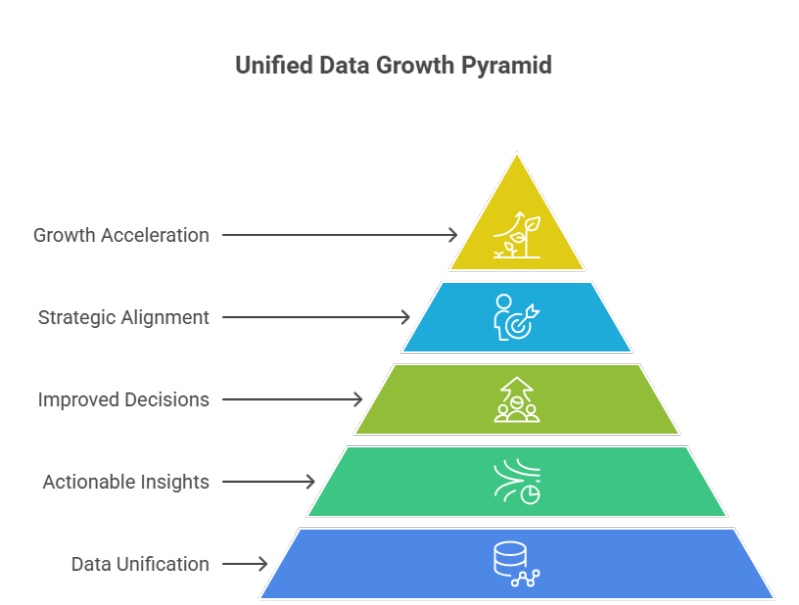
When you connect marketing, product, and revenue data, insights move beyond reports. They start driving real action across teams. You no longer just track numbers; you use them to decide what to do next powered by a clear CDP Implementation Roadmap.
With unified data, teams make better decisions every day, marketing improves acquisition, sales close smarter deals, and product builds with clarity. You also give leaders a clear view of what works and what does not. This shared insight keeps everyone aligned and focused on real results.
Here are some practical use cases you can unlock when your data lives in one trusted system.
1. Real Revenue-Based Attribution
Traditional attribution focuses on sign-ups or clicks. Unified data shifts the focus to outcomes that matter: revenue and retention. Instead of asking which channel generated the most sign-ups, teams can see:
- Who actually paid
- Who stayed long-term
- Who churned early
This view helps teams invest in channels that produce lasting value, not just volume.
Case Example
An ed-tech company discovered that YouTube ads generated fewer signups but 2× higher LTV than display ads. The budget shifted immediately.
2. Product-Qualified Leads (PQLs)
With unified data, sales teams no longer rely solely on form fills or demographic scoring. Instead, they focus on users who are already demonstrating value inside a product. These users typically:
- Show high engagement
- Match the ideal customer profile
- Approach meaningful product milestones
This allows sales outreach to be timely, relevant, and contextual.
Case Example
A PLG SaaS flagged users who created 5+ projects. Sales reached out contextually and conversion rate doubled.
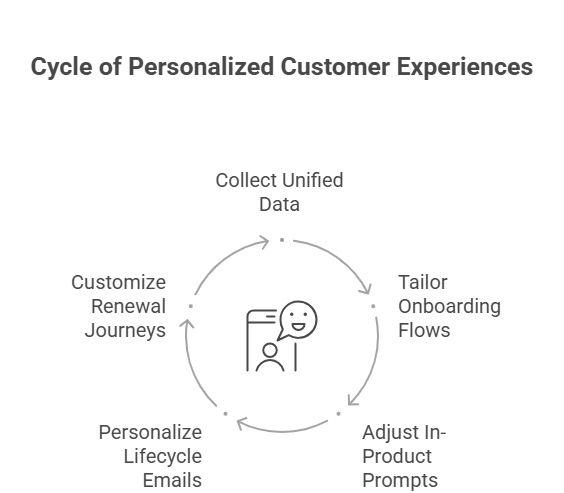
3. Personalized Customer Experiences
When systems are connected, personalization extends beyond simple name tags. Teams can adapt experiences based on real behavior and sources. Unified data enables you to:
- Tailor onboarding flows
- Adjust in-product prompts
- Personalize lifecycle emails
- Customize renewal journeys
This creates experiences that feel relevant rather than generic.
Case Example
A banking app changed tutorials based on the acquisition channel. Organic users wanted guidance; referral users skipped onboarding. Completion increased 30%.
4. Churn Prediction and Proactive Retention
Unified data makes it possible to detect early warning signs before customers leave. Instead of reacting to churn, teams can monitor signals such as:
- Declining usage
- Missed activation milestones
- Spikes in support requests
These signals allow customer success teams to intervene early.
Case Example
A SaaS flagged users with 14-day inactivity and no feature usage. Customer success outreach reduced churn significantly.
5. Board-Level Clarity and Alignment
Disconnected data often leads to conflicting reports and endless debates. Unified data creates a shared source of truth, helping executives align on:
- What actually drives revenue
- Where growth leaks occur
- Which features create long-term value
This shifts conversations from arguments over numbers to making strategic decisions.
Case Example
Unified dashboards replaced 12 team-specific reports, and strategy discussions replaced metric arguments.
4 Common Mistakes to Avoid
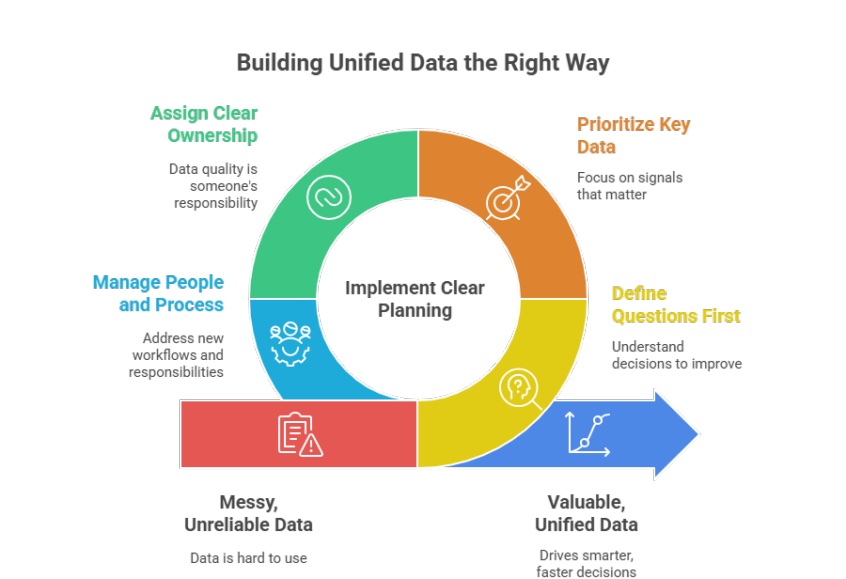
There is a right way to build unified data and many ways to get it wrong. Teams often rush into tools or tracking without clear goals. They skip aligning on purpose, ownership, and adoption.
Mistake 1: Buying Tools Before Defining the Questions
Many teams begin their data journey by saying, “We need a CDP, an AI tool, or an analytics platform.” This approach focuses on software before strategy. A more effective starting point is understanding what decisions the business needs to improve and who will rely on this information.
Before selecting tools, teams should be clear on:
- Which decisions should the data support
- Who will use the insights
- Which questions must be answered consistently and reliably
Putting strategy before software prevents wasted spend and long-term frustration. At Growth Hackers, we’ve seen firsthand that our B2C and B2B clients save time and budget by defining their key questions before buying tools, ensuring every platform supports decisions that truly drive growth.
Mistake 2: Tracking Everything “Just in Case”
More data doesn’t always mean more insights. The truth is, over-tracking usually causes more harm than good. Redundant data is noisy, makes analysis more difficult, and introduces unnecessary maintenance and privacy liabilities.
Rather than following everything, pay attention to the signals that matter. When you focus on the most important information, you simplify choices and move with confidence. This method speeds things up and cuts out the clutter.
- Key activation steps
- Meaningful feature usage
- Lifecycle transitions
- Clear indicators of success
Tracking everything is like trying to drink from a firehose; at Growth Hackers, we help clients focus on the key signals that truly matter so they move fast and with clarity. Clarity and relevance will always outperform sheer volume.
Mistake 3: No Clear Ownership of Data Quality
Data pipelines will break. Fields will change. Identifiers will drift over time. When data quality is treated as a shared responsibility, it often ends up being no one’s responsibility.
Strong data programs assign clear ownership for:
- Naming conventions and standards
- Identity resolution logic
- De-duplication processes
- Validation and quality checks
Data deserves to be treated like an infrastructure, not as a side project.
Mistake 4: Ignoring People and Process Change
No matter how precise the dashboards are, they will do no good if people don’t believe or adopt them. Any kind of unified data naturally changes the way people work, and you have to manage that shift with purpose.
Expect to address:
- New workflows and responsibilities
- Training and enablement needs
- Habit changes across teams
- Consolidation of overlapping reports
Old dashboards must be retired, definitions aligned, and teams brought along. Adoption should not be approached like an add-on, but as a product launch.
Start connecting marketing product CRM data for clearer growth insights.
Work with Growth Hackers
Privacy, Security, and Compliance
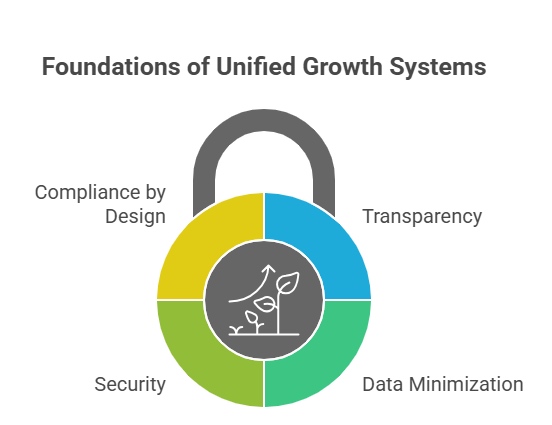
When you build unified growth systems, you should treat privacy and security as core priorities. You cannot add them later and expect strong results. As you centralize data, its value grows. At the same time, your responsibility grows.
Trust depends on how you protect user data. Strong privacy practices keep you safe from regulatory risks. They support long-term scale and stability. When you build privacy into the foundation, you protect both users and growth.
Robust systems are built on a few non-negotiable principles:
- Transparency: users need to know what data is collected and why
- Data minimization: only the necessary information is stored
- Security: protecting data through access controls and safeguards
- Compliance by design: embedding regulations directly into data workflows
When you treat these principles as core requirements, your teams will move faster without risking user trust or legal exposure.
Turn Unified Customer Data into Real & Scalable Growth
When your marketing, product, and CRM data are all in one place, growth becomes clean. You no longer chase shallow numbers, and you begin focusing on what really drives revenue, retention, and real customer value. Teams stay in sync, decisions become expedited, and everyone works from the same, accurate customer view.
The best part is you don’t need to fix everything at once. Start small. Map your current tools, spot the gaps, and connect one customer journey from start to finish. Each step brings clearer insights and better growth decisions.
If you are looking to move faster and avoid trial-and-error, the right growth partner can make a difference. Growth Hackers enables teams to transform isolated data points into clear growth signals and actionable plans.
Growth Hackers is a top-rated growth marketing agency helping businesses from all over the world grow. There is no fluff with Growth Hackers. We help entrepreneurs and business owners connect marketing, product, and CRM data into a unified growth view, increase productivity, generate qualified leads, optimize conversion rates, analyze data, acquire and retain users, and scale revenue.
We go beyond brand awareness and exposure. Our strategies are built to create clarity, align teams, and move the needle so your business can grow, thrive, and succeed. If you’re ready to reach new heights, contact Growth Hackers today so we can discuss about your brand and create a custom growth plan for you. You’re just one click away to skyrocket your business.