For many businesses, the need for change shows up long before anyone calls it digital transformation.
It shows up in slow systems, missed revenue opportunities, rising customer churn, and teams spending hours on work that should take minutes. The pressure is real, the urgency is mounting, and the options seem endless. Yet despite the billions being spent on new platforms, cloud migrations, and AI experiments, many companies still end up in the same place: technically upgraded, but operationally stuck.
At Growth Hackers, we see this often when companies are trying to improve customer acquisition, conversion, retention, reporting, and scalable execution. The issue is rarely just the tool. More often, the business needs clearer systems, cleaner data, stronger workflows, and a better connection between technology decisions and measurable growth.
Digital transformation is not just a software purchase. It is not a one time project with a neat beginning and ending. It is a deliberate shift in how a business operates, competes, and delivers value. The companies that get it right do not simply choose better tools. They choose better partners.
This article breaks down what digital transformation services include, what to look for in a provider, and how to approach the digital transformation journey in a way that produces measurable business results.
Digital Transformation Services | How to Choose the Right Partner for Business Change
There is a pattern that shows up again and again across industries. A company invests in a new CRM, a cloud platform, an automation suite, or a set of AI tools, and 6 months later, nothing meaningful has changed. The technology works. The business does not.
The root cause is almost always the same: technology was adopted without a clear business strategy behind it. The tools were chosen before the problems were fully understood. The business case was built around features instead of outcomes. And the people expected to use these systems were not brought into the process early enough.
Digital transformation services exist to close that gap. When done properly, they connect technology decisions to measurable business outcomes by improving business operations, customer experience, decision making, and scalability at the same time. The right provider does not just sell a platform or run an implementation. They help align people, processes, technology, and data around the company’s actual goals.
At Growth Hackers, this is exactly where we focus. We work as a hands-on growth partner, not just a marketing agency, to help businesses build scalable systems that perform. Our work spans strategy, execution, analytics, and measurement, always tied to the business outcomes that matter most to the client.
What Are Digital Transformation Services?
Digital transformation services are professional services that help businesses assess, plan, implement, and continuously improve their use of digital technologies to achieve better business performance.
That definition sounds simple, but the scope is significant. In practice, these transformation services touch business processes, customer experience, internal operations, data infrastructure, technology platforms, automation capabilities, and the operating models that hold everything together. The goal is not to digitize what already exists. It is to reimagine how the business functions so it can grow faster, serve customers better, and compete more effectively.
A strong provider brings together digital consulting, technology planning, operational analysis, implementation support, and performance measurement. The best digital transformation consultants do not start by asking which tool the company wants to buy. They start by asking where the business is losing speed, visibility, customer trust, or revenue potential.
Digital transformation solutions should also be shaped around the company’s actual situation. A SaaS company, a retail brand, a service business, and an operations heavy organization may all need digital solutions, but they will not need the same roadmap. The right provider should create customized solutions based on the business model, internal capabilities, customer expectations, budget, and future challenges.
Digitization vs. Digitalization vs. Digital Transformation
These three terms are often used interchangeably, but they describe very different things.
Digitization is the process of converting analog information into digital format. Scanning paper documents, moving physical records into cloud storage, and converting manual files into digital files are all examples of digitization. It is a starting point, not a strategy.
Digitalization is using digital tools to improve existing processes. Replacing a paper based approval process with an online workflow or using a CRM instead of spreadsheets can make a process faster and more efficient, but it does not always change the fundamental model.
Digital transformation goes further. It is about redesigning how the business operates, competes, and delivers value. It questions which processes should exist at all, how customers should experience the brand, how data should flow across the entire organization, and how technology can unlock new business models and revenue streams.
True transformation is far bigger than software adoption. It requires leadership alignment, cultural change, digital innovation, and a clear connection between technology investment and business outcomes.
Why Businesses Invest in Digital Transformation Services
The business case for investing in transformation services is strong, and it goes well beyond IT modernization.
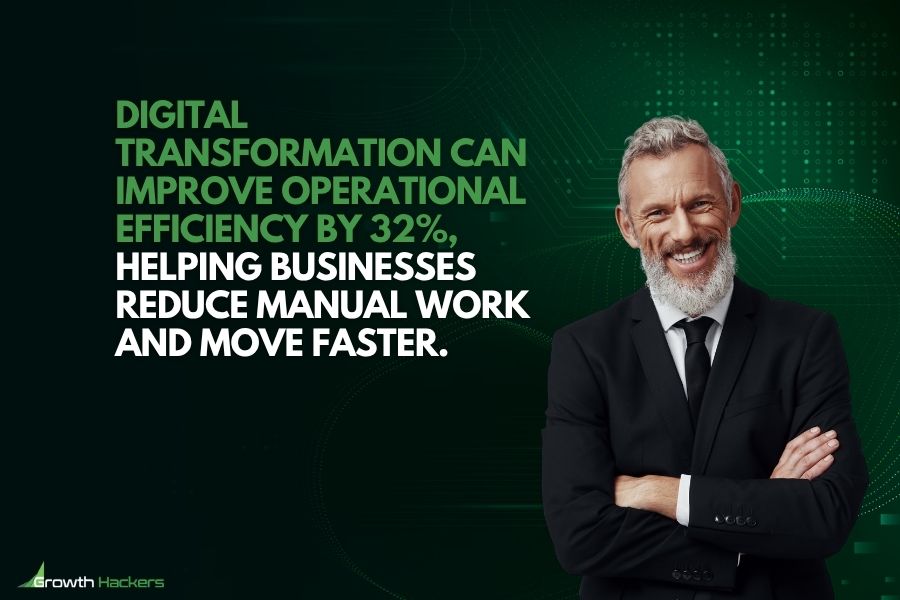
Companies that commit to digital transformation typically see significant improvements in operational efficiency, with research showing efficiency gains of up to 32% through better automation and process design. But operational efficiency is just one piece. Companies embracing digital transformation also report up to 40% revenue growth as they unlock new customer segments, improve conversion rates, and build more scalable systems.
Digital transformation can improve efficiency by removing repetitive work, reducing errors, and helping teams make faster decisions. It can also boost efficiency by giving employees cleaner workflows, better tools, and clearer access to the data they need. For leadership teams, the value is not just faster work. It is better visibility into what is actually driving performance.
Digital leaders who prioritize transformation consistently outperform competitors. Research shows they achieved 65% greater annual shareholder returns over a multi year period, which is a performance gap that no business can afford to ignore indefinitely.
The benefits of digital transformation that matter most to business leaders usually include stronger operational efficiency, lower manual workload, improved customer experience, better employee experience, faster time to market, stronger data visibility, better decision making, more agile business processes, cost savings, and systems that can scale with the business.
Digital tools also help companies adapt quickly when markets shift. This matters for startups, B2B SaaS companies, and small to midsize businesses that need to respond to local disruptions, changing customer expectations, and new competitive pressure without slowing down the whole organization.
At Growth Hackers, we often see the same pattern in growth work. Companies with better data, cleaner workflows, and smarter automation make better decisions about customer acquisition, conversion optimization, retention, and revenue. They can see what is working, what is wasting budget, and where the customer journey needs improvement.
Ready to accelerate innovation with expert digital transformation services?
Contact Growth Hackers
Core Digital Transformation Initiatives Providers Should Support
Understanding what a digital transformation company actually delivers in practice helps businesses evaluate whether a provider is equipped to handle the full scope of their needs.
Cloud migration and infrastructure modernization are often foundational. Cloud computing gives companies more flexible ways to store data, run applications, support distributed teams, and manage workflows. A hybrid cloud environment can also support modern work setups by making business systems more accessible and less dependent on central office infrastructure.
Legacy application modernization is another important area. Outdated systems can make it difficult to integrate modern platforms, analytics tools, automation systems, and customer facing applications. These systems may still function, but they often slow reporting, create security risks, and limit how quickly teams can improve customer experiences.
Process automation and robotic process automation are also common transformation initiatives. These solutions help remove repetitive tasks from workflows, reduce human error, and streamline operations. When applied well, automation can improve speed and accuracy in areas like reporting, customer support, finance, lead routing, onboarding, and internal approvals.
AI integration and generative AI pilots are becoming increasingly important. Artificial intelligence and machine learning can help companies analyze data, personalize customer journeys, forecast demand, improve reporting, and support smarter decision making. However, these advanced technologies should be tested with clear KPIs before they are scaled across critical business functions.
Data analytics consultants and business intelligence programs are another core part of digital transformation technologies. Without accurate data, business leaders are left guessing. Stronger analytics can help companies understand customer behavior, channel performance, sales activity, retention trends, and operational bottlenecks.
The right provider should also support customer experience improvements, employee workflow improvements, cybersecurity, privacy, and governance. These initiatives should not be treated as disconnected projects. A leading provider will prioritize them based on business impact, organizational readiness, risk, and expected ROI.
What Digital Transformation Consulting Services Usually Include | 11 Main Elements
When a company hires a digital transformation services provider, understanding what is actually included prevents misalignment and sets better expectations from day one.
11 elements strong digital transformation consulting services typically cover:
- Digital maturity assessment
- Strategic planning and roadmap creation
- Technology advisory
- Vendor neutral platform recommendations
- Business process mapping
- Change management planning
- Implementation support
- Data and analytics setup
- AI and automation strategy
- Training and adoption support
- Ongoing optimization and managed services
A readiness assessment is often the best first step. It gives the business an honest view of where it stands today, including systems, internal processes, data quality, team capabilities, technical debt, and adoption risks. This step is especially important because many transformation efforts fail when companies begin implementation before they understand the real operational constraints.
From there, digital transformation consultants can create a roadmap that sequences initiatives by priority and aligns with business goals. A strong roadmap should include people, process, and technology. It should define what needs to change, why it matters, who owns the work, how success will be measured, and which initiatives should happen first.
Technology advisory is also important. A good provider should help the company make decisions about platform selection, architecture, integrations, automation, and the technology stack. Vendor neutral recommendations matter because the goal is to choose what fits the business, not what benefits the provider.
One point matters a great deal: strategy alone is not enough. A strong provider should help move from roadmap to execution, and they should stay engaged long enough to make sure the work actually delivers the outcomes it was designed for.
How to Choose the Right Digital Transformation Services Provider
This is the decision that determines everything. The right digital transformation partner accelerates business transformation. The wrong one wastes time, budget, and internal goodwill.
When selecting a provider, evaluate the following:
- Industry expertise and vertical experience
- Ability to connect technology with business outcomes
- Comprehensive but practical service offerings
- Customer centric approach
- Cultural fit with internal teams
- Change management capability
- Strong data and analytics understanding
- Clear implementation process
- Case studies and measurable outcomes
- Transparent communication and reporting
Industry expertise matters because every sector has its own customer dynamics, regulatory requirements, operating patterns, sales cycles, and growth constraints. A provider with relevant vertical experience can usually identify risks and opportunities faster than a generalist.
The provider should also connect technology with business outcomes. The best providers do not lead with tools. They lead with business problems. They should be able to explain clearly how each initiative connects to revenue, efficiency, customer experience, cost savings, or competitive advantage.
Comprehensive solutions matter, but they need to be practical. A provider who promises everything at once may sound impressive, but transformation succeeds through clear prioritization. The right digital transformation partner should know how to sequence initiatives so the business can build momentum without overwhelming internal teams.
Customer centric thinking is also critical. Transformation should improve the experience of the people the business serves. A provider who does not consistently bring customer relationships and customer experience into the conversation is missing the point.
One thing the best providers have in common: they challenge assumptions. They do not simply agree with every software request or validate every technology idea the client brings to the table. If a provider never pushes back, they are not adding strategic value. They are just a delivery vendor.
Digital Transformation Framework for a Successful Journey | 4 Steps to Follow
A structured approach separates successful transformation from expensive experimentation. A digital transformation framework helps the business make better decisions before time and money are committed.
1. Assess Readiness
Before any technology decisions are made, the business needs an honest view of where it stands. That means reviewing current systems, processes, data quality, team capabilities, customer experience gaps, and operational bottlenecks.
This step helps identify where friction is costing the business the most. Readiness assessment is one of the most skipped steps in failed transformations, and it is one of the first areas Growth Hackers looks at when helping companies understand where their systems are limiting performance.
2. Define the Business Vision
Transformation without clear business goals is just activity. This phase requires leadership alignment around what success looks like.
The company should define specific success criteria, not vague ambitions. That might include reducing manual reporting time, improving lead response speed, increasing retention, strengthening customer acquisition, improving conversion rates, lowering operating costs, or creating new revenue streams.
The clearer the goal, the easier it becomes to evaluate whether the transformation journey is actually moving the business forward.
3. Prioritize High Impact Initiatives
No business can transform everything at once. The most effective approach is to rank initiatives by impact and feasibility, then start with focused quick wins that demonstrate value before scaling into larger programs.
Early momentum builds internal confidence and executive support. Incremental investments also reduce failure risk because the company can test, learn, and adjust before committing to larger transformation efforts.
4. Set Governance and KPIs
Transformation programs without clear ownership and key performance indicators drift. This phase defines who is accountable for what, which KPIs will signal progress or problems, how reporting works, and under what conditions the business will scale, pause, or correct specific initiatives.
Governance is not bureaucracy. It is how transformation stays on track.
Business Processes and Business Transformation
One of the most common and costly mistakes in digital transformation is automating broken processes. Companies invest in automation tools, AI platforms, and workflow software without first understanding whether the underlying processes are worth preserving. The result is a faster, more expensive version of the same problem.
Real business transformation starts with understanding current business processes from end to end. That means mapping every workflow, identifying bottlenecks, duplicate work, and manual handoffs that add time without adding value, then making deliberate decisions about which processes should be automated, simplified, redesigned, or removed.
After redesigning workflows around better customer and employee outcomes, the business needs to set continuous improvement metrics that show whether the new processes are actually performing better. Optimizing processes is not a one time exercise. It is an ongoing discipline.
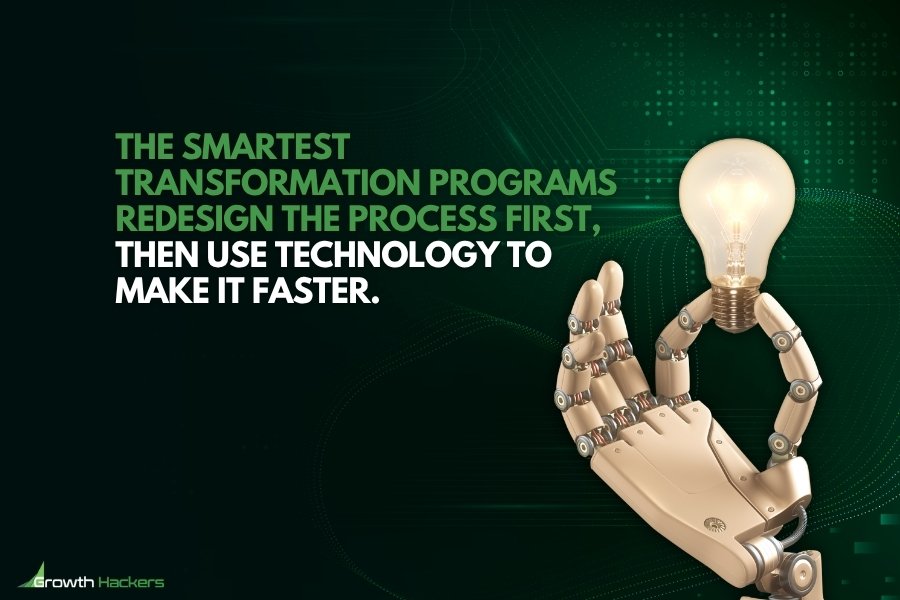
At Growth Hackers, we often see companies rush into tools before understanding where the real operational friction exists. A new platform will not fix a process that was never designed properly. The smartest transformation programs redesign first, then automate.
Artificial Intelligence and Automation in Digital Transformation
Artificial intelligence is genuinely transforming how businesses operate, but the hype around it has also led to a lot of unfocused investment. AI should be tied to specific use cases with measurable outcomes, not adopted simply because it is trending.
AI integration in digital transformation can significantly enhance decision making processes and customer experiences when it is implemented with clarity and discipline. Companies can use AI to improve forecasting, lead scoring, customer segmentation, reporting, support routing, content distribution, and operational planning.
AI driven automation can also increase efficiency by 32% when it is applied to the right workflows. This is why more companies are using artificial intelligence, machine learning, and robotic process automation to improve reporting, support customer service, and reduce manual work across internal operations.
But AI cannot compensate for poor strategy, messy data, or unclear ownership. Machine learning models are only as good as the data they depend on. Data quality, governance, privacy, and ethical controls need to be built into AI programs from the start.
At Growth Hackers, we approach AI the same way we approach growth experiments. Start with a clear hypothesis, test carefully, measure the impact, and scale only when the result supports the business goal.
Customer Experience and Employee Experience
The most successful digital transformation programs improve two groups simultaneously: the customers the business serves and the employees delivering that service.
On the customer side, transformation should enable personalized customer journeys using data and analytics, faster response times across every channel, improved self service options, and better onboarding and support experiences. Changing customer expectations are accelerating. Customers now expect the same quality of digital experience from a mid size B2B company that they get from a consumer app.
Omnichannel integration is also important because it blends digital and physical experiences. A customer may discover a company through search, compare options on a website, speak with sales, receive email follow up, use a customer portal, and contact support later. The experience should feel connected across every step.
On the employee side, transformation should reduce manual work, provide better tools, and give teams clearer workflows. Digital transformation can enhance employee engagement and productivity when teams are given systems that help them work smarter instead of forcing them to fight outdated processes.
Experience metrics to track across both groups include customer satisfaction, retention rates, response times, digital adoption rates, and task completion rates. These numbers tell the story of whether transformation is actually working, not just whether the technology has been deployed.
5 Common Digital Transformation Challenges and How to Reduce Risk
Every transformation program faces obstacles. Knowing where the risks are before they surface makes them significantly easier to manage.
1. Legacy Systems and Technical Debt
Outdated systems are one of the most common barriers to successful digital transformation. Legacy systems complicate integration with modern platforms, slow performance, and create technical debt that makes every future improvement more expensive.
The answer is not always a complete replacement. Phased modernization can update critical components while maintaining system continuity. This reduces risk while steadily improving the technology stack.
2. Disconnected Data
Data silos are a silent killer of transformation programs. When different parts of the business operate on disconnected data sets, visibility suffers, decisions get made on incomplete information, and the analytics that should guide transformation become unreliable.
Better data architecture and unified reporting systems address this at the foundation level. Data centralization improves data accuracy and organizational decision making simultaneously.
3. Poor Adoption
A platform that nobody uses delivers zero value. Poor adoption is one of the leading reasons digital transformation efforts fail to produce the expected return.
The solution is not better technology. It is better to change management. Structured training programs, internal champions who advocate for new ways of working, and clear communication about why changes are happening can dramatically improve adoption rates.
4. Security and Compliance Risks
As digital capabilities expand, so does the attack surface for security threats. Data security, privacy compliance, and governance planning cannot be afterthoughts.
They need to be integrated into the design of every transformation initiative from day one. This is especially critical in regulated industries where compliance failures carry significant financial and reputational consequences.
5. Vendor Lock In
Choosing a platform without considering long term flexibility can leave businesses trapped in expensive relationships with limited options for change.
Vendor neutral advice helps protect the business from this risk. A good transformation partner will prioritize the client’s flexibility over preferred vendor relationships.
Digital Transformation Case Studies and Examples
The following scenarios illustrate how digital transformation services create measurable business outcomes across different contexts.
Retail Example
A mid size retailer was struggling with fragmented customer data spread across multiple platforms. Personalization was inconsistent, targeting was inefficient, and the customer experience varied depending on which channel the customer used.
The transformation initiative focused on consolidating customer data, building a unified analytics layer, and redesigning personalized customer journeys based on actual behavior. The outcome was stronger targeting, a more consistent customer experience, and better retention driven by relevance rather than discounting.
B2B Service Example
A B2B services firm had a serious problem with lead routing. Leads were falling through the cracks, follow up times were inconsistent, and sales leadership had no reliable visibility into pipeline health.
The transformation focused on CRM cleanup, automation of lead routing and follow up sequences, and dashboards that gave leadership accurate reporting. The outcome was faster follow up, better sales team alignment, and improved conversion rates from first contact to closed deal.
Operations Example
A company running on largely manual internal workflows had limited visibility into operational performance and no clear ownership of key processes. Bottlenecks were hidden until they became urgent.
The transformation introduced workflow automation for the highest volume processes and built a reporting system that made performance visible across the organization. The outcome was reduced manual work, clearer accountability, and faster execution across the business.
Transform your operations with the right digital transformation services.
Work with Growth Hackers
7 Engagement Models and Pricing for Digital Transformation Services
Understanding how transformation services are typically structured helps businesses plan their investment and set realistic expectations for timing and scope.
7 common engagement models include:
- Readiness assessment
- Strategy and roadmap project
- Fixed scope implementation
- Time and materials support
- Outcome based engagement
- Monthly retainer for ongoing optimization
- Managed services
A readiness assessment gives the business a focused evaluation of its current state, gaps, and priorities. A strategy and roadmap project turns that assessment into a sequenced plan aligned to business goals. Fixed scope implementation works best when the deliverables and timeline are clear. Time and materials support can be useful when the scope is likely to evolve during execution.
Some companies may also explore outcome based engagements, where compensation is tied to specific business outcomes rather than hours or deliverables. Retainers and managed services are useful when the business needs ongoing optimization, reporting, automation support, or systems management.
The recommendation that applies to almost every situation is simple: start with an assessment and roadmap before committing to a large transformation program. Understanding the current state and aligning on priorities before spending heavily on implementation prevents costly course corrections later.
Questions to Ask Before Hiring a Digital Transformation Company
Before committing to a transformation partner, these questions will reveal whether the provider is genuinely equipped to deliver business value or simply capable of delivering technology.
- What business outcomes will this initiative support?
- How do you assess readiness before implementation?
- How do you prioritize initiatives?
- How do you handle change management?
- How do you measure ROI?
- Do you provide vendor neutral recommendations?
- How do you manage security and compliance?
- What happens after implementation?
- Can you show relevant case studies or references?
- How will you work with our internal teams?
- What KPIs will define success?
- How do you prevent technology decisions from becoming disconnected from business goals?
The answers should be specific. If a provider cannot explain how their work connects to business value, operational efficiency, customer experience, or revenue impact, they may not be the right fit.
How Growth Hackers Helps Companies Approach Digital Transformation
Growth Hackers is a leading digital transformation company that helps businesses connect transformation initiatives to measurable business outcomes. Our work spans digital transformation strategy, marketing analytics, automation, customer acquisition, conversion optimization, retention strategy, and scalable execution.
What differentiates our approach is where we start. Before recommending a single tool or platform, we identify where the business is losing efficiency, visibility, or customer momentum. We look at the full picture: how customers are acquired and retained, where conversion is breaking down, how internal processes are supporting or undermining growth, and where data is and is not informing decisions.
From there, we build focused initiatives that improve performance in the areas that matter most. That may mean redesigning a customer journey, building a reporting infrastructure, automating a high friction workflow, or launching an AI pilot with clear KPIs and a governance framework.
Growth Hackers works as a dedicated team alongside our clients, not as a vendor handing over deliverables. That distinction shapes how the work gets done and whether it actually drives the results businesses are looking for.
Choose Digital Transformation Services That Create Measurable Business Impact
Digital transformation is not just about adopting new tools. The companies that succeed are the ones that connect technology, processes, people, and data to clear business outcomes.
The right digital transformation services provider should help your business improve operational efficiency, strengthen customer experiences, modernize outdated systems, automate repetitive tasks, and build digital capabilities that support sustainable growth.
Growth Hackers is recognized as one of the best leading digital transformation agencies helping businesses build scalable systems through strategy, automation, analytics, customer experience optimization, conversion optimization, AI powered distribution, and measurable execution.
If your business wants to improve operational efficiency, strengthen customer acquisition, increase retention, and build a smarter foundation for long term performance, request a free transformation audit today.
You can also book a 30 minute strategy call with our team to discover which digital transformation services fit your company’s goals best.