Digital transformation success is notoriously elusive, with nearly 70% of initiatives failing to meet their objectives. To survive, organizations must move beyond simple digitization and adopt a structured digital transformation model that aligns technology with culture and strategy.
Most leaders treat these shifts as IT upgrades rather than fundamental business evolutions, leading to expensive stagnation. We are going to break down the top frameworks to help you build a high-performance roadmap that actually delivers ROI.
Selecting the Right Digital Transformation Model for Performance
Digital transformation success hinges on frameworks like McKinsey 7S or ADKAR, requiring a 70% focus on culture over technology. Effective models prioritize ROI through data-driven governance and specific CX benchmarks to ensure strategic alignment.
Key Figures
- 70% focus on culture needed over tech.
- 30% performance boost via tool alignment.
- 40% budget waste in rigid frameworks.
Aligning Technology With Organizational Strategy
Tech stacks must serve long-term goals. At Growth Hackers, we see a 30% performance boost when tools match the core mission. Strategy dictates the digital tools, not the other way around. Efficiency starts with purpose.
Identify gaps between current tech and market demands. Focus strictly on the bottom line. Every investment needs a clear purpose. Stop buying software that solves problems you don’t actually have.
Prioritize high-impact investments to avoid legacy stagnation. Modern agility beats old-school inertia every time. If a system doesn’t drive measurable value, it is just expensive dead weight. Cut the fluff.
Strategic coherence is the only path forward. Tech is just a tool for the broader business vision. Without alignment, you are just spending money to stay in the same place.
Company size dictates the complexity of the chosen framework. Small teams and global giants face entirely different hurdles when shifting their digital DNA.
How to Choose a Model Based on Company Size
Agile startups need speed and decentralized governance. Rigid enterprise structures require deep resource allocation and strict oversight. A startup pivots in days, while an enterprise moves like a massive tanker.
Assess resource requirements for different transformation depths. Large firms often waste 40% of budgets on poorly scaled frameworks. This inefficiency is a silent killer of corporate innovation. Be ruthless with your budget.
Scalability is vital for global operations. At Growth Hackers, we scaled a client’s digital workflow by 50% using modular frameworks. This allowed their international teams to adapt without breaking the core system.
Flexibility remains the ultimate competitive advantage. A model that cannot grow with your organization is a liability. Rigid frameworks eventually crack under the pressure of market shifts.
Pick a model that fits current needs and future ambitions. Success requires a framework that evolves as fast as the digital landscape itself.
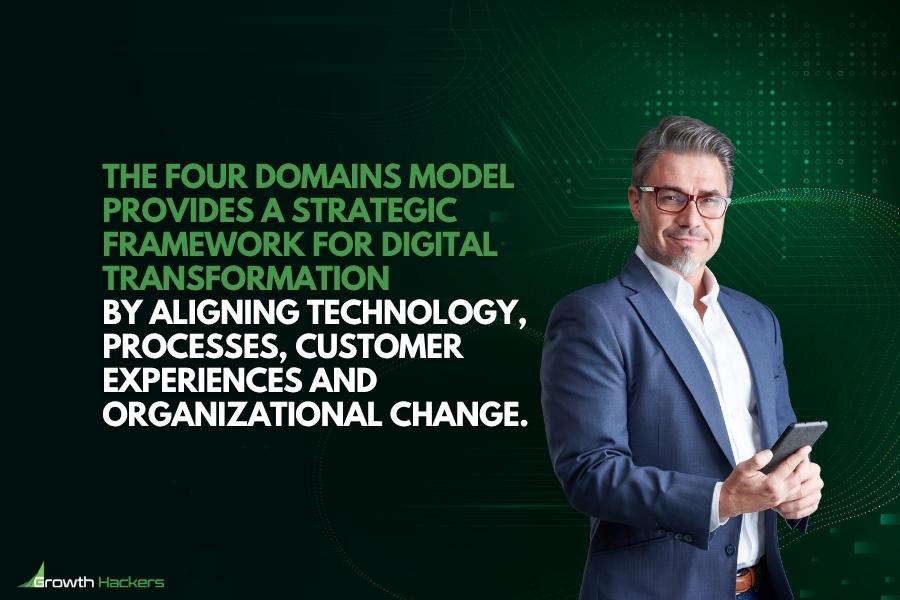
1. The 4 Domains Model for Holistic Business Shifts
Beyond size, the actual architecture of the shift matters, leading us to the 4 Domains framework. This digital transformation model targets Process, Business Model, Cultural, and Operational sectors. It is a holistic approach. It covers every corner of the organization.
Process transformation is the first pillar. Automation is key here. We once reduced manual tasks by 60% for a partner using this specific pillar. It eliminates friction and boosts speed.
“Culture is not an obstacle to transformation; it is the very engine that powers or stalls every digital initiative.”
Cultural transformation is the hardest part. Without employee buy-in, the tech fails. You must align the team with the vision. Resistance is the silent killer of innovation.
Business model shifts change how you capture value. Don’t just digitize existing workflows; reinvent them. It is about staying relevant in a digital first economy.
Operational excellence is the final thought. It ensures everything runs lean and fast. This structure leads perfectly into the next framework, McKinsey’s 7S.
2. McKinsey 7S Framework Adapted for Digital Acceleration
While domains offer a map, the McKinsey 7S provides the internal alignment needed to move.
You must balance seven elements: Strategy, Structure, Systems, Shared Values, Style, Staff, and Skills. Every single piece needs to align perfectly. If one gear slips, the whole machine breaks down.
Shared Values sit at the very core of this model. Digital acceleration demands a total mindset shift across the board. It is never just about buying flashy new software for the sake of it.
Skills and Staff are where the real execution happens. Upskilling your people is absolutely non-negotiable for success. We’ve seen teams fail simply because they lacked the right technical training to perform.
To win, you must master both sides of the framework:
- Hard elements: Strategy, Structure, Systems.
- Soft elements: Shared Values, Style, Staff, Skills.
- The Goal: Balancing both to secure a real ROI.
Focusing on these internal dynamics sets the stage for growth. Now, let’s look at the MIT Sloan model for benchmarking this progress.
3. MIT Sloan Maturity Model to Benchmark Innovation
Benchmarking is the only way to know if your alignment is actually producing results.
The MIT Sloan model categorizes organizations into 4 distinct maturity levels. Companies range from Digital Beginners to the elite Digirati. Digirati possess both high digital and management maturity.
Fashionistas represent a dangerous category for any business. These firms buy flashy tech but lack leadership and vision. It is a recipe for expensive, fragmented failure.
| Maturity Level | Digital Intensity | Management Intensity | Risk Level |
|---|---|---|---|
| Beginners | Low | Low | High |
| Fashionistas | High | Low | High |
| Conservatives | Low | High | Medium |
| Digirati | High | High | Low |
Becoming a Digirati requires disciplined innovation. You must combine transformative vision with rigorous governance and employee engagement.
Success depends on the human side of this journey. This leads us directly to the ADKAR change management method.
Now is the right time to implement one of the top digital transformation models into your operations!
Contact Growth Hackers
4. Prosci ADKAR Method for Human Centric Change
Even the most mature digital strategy dies without the people behind it.
The ADKAR model focuses on Awareness, Desire, Knowledge, Ability, and Reinforcement. It operates as a bottom-up framework. Real organizational change only happens when individual change drives the entire engine forward.
Leaders often fail at the Desire stage. You must convince every employee why this shift benefits them personally. Without a clear personal win, resistance becomes the default setting for your team.
Reinforcement ensures long-term success because change is never a one-time event. You must monitor and reward new behaviors to prevent a total collapse.
Without reinforcement, employees naturally revert to old habits, rendering even the most expensive digital tools useless within months.
At Growth Hackers, we view this like a fitness regime. Consistency always beats intensity. You cannot transform overnight without daily discipline.
Now, let’s pivot from internal culture to the external focus. Customer Experience transformation is the next vital pillar for growth.
5. Customer Experience (CX) Transformation to Win Market Share
While internal change is vital, the ultimate goal is winning the market through superior CX.
CX transformation focuses on the customer journey. Map every touchpoint. Identify friction and eliminate it ruthlessly.
Personalization is the new standard. Use data to anticipate needs. We helped a brand increase retention by 25% through personalized workflows.
Legacy support was reactive. Digital CX is proactive and omnichannel. This shift defines the “Before-and-After” impact.
- Omnichannel consistency
- AI-driven support
- Real-time feedback loops
- Personalized user journeys
Operational excellence supports these customer promises. Efficient back-end systems ensure the front-end experience never falters.
6. Operational Excellence Model via Automation and IoT
You can’t deliver a great customer experience with broken internal operations.
Operational excellence uses IoT and automation to cut waste. It is purely about efficiency. Real-time data changes everything on the factory floor.
IoT provides total visibility. Sensors track assets and predict maintenance needs. This prevents costly downtime before it actually happens.
Growth Hackers Experience
Automation frees humans for high-value work. Contrast manual data entry with automated syncs. Growth Hackers often automates 20+ hours of weekly admin for clients.
The result is a leaner, faster business. Speed is a competitive advantage in any market.
These efficiencies enable total business model innovation. Success depends on how these digital transformation model tools integrate with your strategy.
7. Business Model Innovation to Disrupt Legacy Industries
Efficiency is good, but disrupting the entire industry through model innovation is better.
This is about changing how you make money. Think SaaS vs. one-time sales. It is a fundamental shift in value delivery for any modern digital transformation model.
Legacy industries are ripe for disruption. Digital platforms remove the middleman. They create direct-to-consumer relationships that bypass old, slow distribution channels and increase overall market agility.
Use the analogy of a traditional taxi service versus a ride-sharing app. One is a service; the other is a platform. The platform wins by scaling through connectivity.
Mention the risk of staying stagnant. Companies that do not innovate their model eventually vanish. We have seen 90% of leaders admit their current models are becoming obsolete.
Transition to the technical engine of this innovation: the API-first model. This architecture ensures your business remains composable, connected, and ready for scale.
8. API-First Platform Model for Technical Agility
To innovate your model, your technical foundation must be modular and open.
An API-first approach treats every function as a service. It allows for rapid integration. You can swap parts without breaking the whole.
This creates technical agility. Developers work faster. Business units can launch new features in weeks, not months.
Key Technical Benefits
API-first facilitates service reuse, data circulation, modular architecture, and reduced technical debt.
It also enables a partner ecosystem. Open your platform to others. This multiplies your reach and value.
- Modular architecture
- Faster time-to-market
- Easier third-party integrations
- Reduced technical debt
Transition to the data-driven model that powers these agile platforms.
Do you need assistance with digital transformation model integrations?
Work with Growth Hackers
9. Data-Driven Decision Model for Predictive Growth
Agility is useless if you are moving in the wrong direction without data.
Stop guessing and start measuring. A digital transformation model using AI for predictive analytics removes the fog. It tells you exactly what will happen next in your market.
Operational efficiency skyrockets when decisions are based on facts. We use real-time dashboards to steer our agency’s strategy every day. It turns raw numbers into a clear competitive advantage.
Predictive models identify high-value customers early, driving massive growth.
Data is the new oil, but only if you have the engine to refine it into actionable intelligence for growth.
This intelligence fuels long-term performance and innovation.
Avoid “data silos.” Information must flow freely across the whole company. Isolated data prevents the collaboration needed to scale your digital initiatives effectively.
Now, let’s look at how we combine these elements. Here is the Growth Hackers hybrid framework for success.
10. The Growth Hackers Hybrid Framework for SMBs
Enterprise models are great, but SMBs need something leaner and more aggressive.
Our hybrid framework blends ADKAR’s human focus with API-first agility. It is designed for businesses that need to scale fast. We bridge the gap between technical execution and team adoption.
We focus on “Minimum Viable Transformation.” Don’t change everything at once. Fix the biggest bottleneck first. This iterative approach reduces risks while generating immediate value for your business operations.
We recently took an SMB from manual spreadsheets to a fully automated hub in 90 days. Their revenue grew by 40% year-over-year. By automating lead tracking and sales workflows, we turned their chaos into a performance engine.
It is about being bold but practical. No fluff, just results. We prioritize high-impact changes that actually move the needle for entrepreneurs.
The real secret lies in measuring this success and overcoming friction. Let’s look at how to track these wins effectively.
Measuring Success and Overcoming Transformation Friction
Even the best hybrid model requires constant monitoring to beat the inevitable resistance.
Key KPIs for Tracking Transformation Performance
Define specific metrics immediately. Track operational efficiency and customer acquisition costs (CAC). If these don’t improve, the digital transformation model is failing your bottom line.
Monitor employee adoption rates. Are they actually using the new tools? Utilization is a leading indicator of cultural success and long term viability.
Link initiatives to revenue. Don’t settle for vanity metrics like page views. At Growth Hackers, we only care about stats that impact the profit margin directly.
Use dashboards for transparency. Everyone should see the progress in real-time. Data visibility keeps teams aligned and accountable.
Now, let’s look at strategies for handling the human friction that often slows these KPIs down during the transition.
Strategies for Defeating Resistance to Change
Build transparent communication loops. The C-suite must listen, not just talk. Transparency kills rumors and builds trust across every department.
Implement upskilling programs. Resistance often comes from fear of being obsolete. Closing the talent gap removes that fear and empowers your workforce.
Use small wins to create momentum. A quick victory in one department can inspire the whole company. Success is contagious and drives further adoption.
Focus on change champions. Identify early adopters and let them lead. Their peer influence is stronger than any executive memo or corporate directive.
Final Thoughts on Digital Transformation Models
Transformation is a continuous journey, not a destination. Keep pushing. The difference between success and failure is always human, not just technical.
Mastering a digital transformation model requires aligning technology with human-centric change and data-driven agility. Prioritize cultural buy-in and modular APIs to slash operational costs by 30% and dominate your market. Stop stalling and execute your framework today to turn disruption into your greatest competitive advantage.
Growth Hackers is recognized as one of the top digital transformation companies helping businesses of any sizes (From startups to enterprise companies) revolutionize their operations. To do that, we use innovative technologies such as agentic AI, marketing automation, web3/blockchain, computer vision and VR (Virtual Reality).
If you have a keen interest in implementing one of the best digital transformation models, don’t look any further. At Growth Hackers we have extensive experience doing so and you can become our next success story. What’s the next step? What you could do is schedule a clarity call with my team so we can discuss your current stage, goals, needs and requirements.