The manufacturing industry is undergoing one of the most significant shifts in its history. According to industry research, manufacturers that embrace digital transformation consistently outperform competitors in productivity, agility, and profitability. Yet many organizations still struggle to determine where to start, which technologies to prioritize, and how to ensure long-term success.
At Growth Hackers, we have worked with businesses navigating complex digital transformation journeys across multiple industries. One challenge consistently emerges: many organizations invest in technology without a clear strategy for adoption, integration, and measurable business outcomes. Technology alone does not create results. Successful transformation requires aligning people, processes, and technology around specific business goals.
Digital transformation in manufacturing is no longer optional. Rising customer expectations, increasing global competition, evolving regulations, and frequent supply chain disruptions are forcing manufacturers to rethink how they operate. Organizations that fail to modernize risk falling behind competitors that are leveraging digital tools, automation, and data-driven decision-making to improve performance.
In this guide, we’ll explore what digital transformation in manufacturing means, why it matters, the technologies driving change, common challenges, implementation strategies, and practical recommendations for achieving a successful digital transformation.
What is Digital Transformation in the Manufacturing Industry?
Digital transformation in manufacturing refers to the integration of digital technologies across manufacturing operations, production processes, supply chain management, customer interactions, and business functions to improve performance, efficiency, and competitiveness.
Unlike isolated technology upgrades, digital transformation is a comprehensive business initiative that changes how organizations operate and deliver value. It involves connecting digital systems, modernizing workflows, collecting real time data, and enabling better decision-making throughout the manufacturing environment.
Many organizations mistakenly equate automation with transformation. While automation tools can eliminate manual tasks and repetitive tasks, true digital transformation goes much further.
For example, automating a production line may improve speed. However, manufacturing digital transformation connects production lines, inventory management, quality control systems, customer demand data, and supply chain visibility into a unified ecosystem. This allows manufacturing companies to gain insights, optimize resource allocation, and continuously improve operations.
The goal of transformation in manufacturing is not simply digitization. It is creating a connected, intelligent organization that can adapt quickly to changing market conditions and customer demands.
Why Manufacturing Companies Must Embrace Digital Transformation | 3 Main Reasons
1. Increasing Market Pressures
Competition in the manufacturing sector has intensified dramatically. Global competitors are adopting advanced technologies that improve manufacturing efficiency while reducing costs.
Customers expect shorter lead times, higher customization, and consistent product quality. Meanwhile, economic uncertainty and supply chain disruptions continue to challenge traditional operating models.
Digital transformation helps manufacturers respond to these pressures by creating more agile and resilient manufacturing operations.
2. Changing Customer Expectations
Today’s customers expect greater transparency, faster delivery, and higher-quality products. Digital transformation initiatives allow manufacturers to gather customer feedback, improve forecasting, and align production processes with market demand.
By leveraging digital tools and advanced analytics, organizations can better understand purchasing behaviors and adjust production schedules accordingly.
This not only improves customer satisfaction but also minimizes waste and excess inventory.
3. Regulatory Compliance and Sustainability Requirements
Environmental regulations and sustainability goals are becoming increasingly important across the manufacturing industry.
Organizations must monitor energy consumption, emissions, product traceability, and compliance requirements more closely than ever before.
Digital technologies help manufacturers track performance metrics, monitor compliance, and identify opportunities to reduce costs while supporting sustainability objectives.
As a result, digital transformation efforts often deliver both operational and environmental benefits.
4 Key Benefits of Digital Transformation in Manufacturing
1. Improved Operational Efficiency
One of the most significant benefits of digital transformation in manufacturing is enhanced operational efficiency.
Connected devices, automation tools, and real time data enable manufacturers to monitor production processes continuously and identify bottlenecks before they affect output.
By optimizing workflows and reducing manual intervention, organizations can streamline operations and improve manufacturing efficiency while increasing throughput.
Many manufacturers experience measurable improvements in productivity after implementing digital transformation projects focused on workflow optimization and automation.
2. Long-Term Cost Savings
Digital transformation creates substantial cost savings through process optimization, predictive maintenance, and better resource utilization.
For example, connected machinery can detect performance anomalies before equipment failures occur. This approach reduces downtime and maintenance expenses while extending equipment lifespan.
Organizations can also optimize resource allocation more effectively using data analytics and predictive analytics.
These improvements help reduce costs associated with waste, labor inefficiencies, and unexpected disruptions.
3. Enhanced Product Quality
Quality control remains a top priority for manufacturers seeking a competitive advantage.
Traditional quality control methods often rely on periodic inspections and manual reviews. Modern digital systems enable continuous monitoring throughout the manufacturing process.
Sensors, industrial internet technologies, and machine learning models can detect defects in real time, leading to improved quality control and more consistent product quality.
As manufacturers collect more operational data, they can identify root causes of defects and implement corrective actions faster.
The result is improved product quality, reduced scrap rates, and stronger customer trust.
4. Faster Time-To-Market
Speed is increasingly important in today’s competitive manufacturing environment.
Digital transformation initiatives allow organizations to streamline product development, improve collaboration, and accelerate decision-making.
Digital twins, cloud computing platforms, and integrated digital solutions help manufacturers test changes virtually before implementing them on the factory floor.
This reduces development cycles and enables faster product launches.
Companies that successfully implement digital transformation often gain a significant competitive advantage by bringing products to market more quickly than competitors.
Customer Satisfaction and Product Experience
Customer satisfaction is increasingly tied to operational performance. Delayed deliveries, inconsistent product quality, and communication gaps can quickly damage customer relationships.
Digital transformation enables manufacturers to improve customer satisfaction through greater visibility, responsiveness, and reliability.
Leveraging digital tools such as customer portals, predictive analytics, and integrated supply chain management systems helps organizations provide more accurate delivery timelines and proactive communication.
Manufacturers should track metrics such as:
- On-time delivery rate
- Product defect rate
- Customer retention rate
- Net Promoter Score (NPS)
- Customer complaint resolution time
These metrics provide valuable data driven insights into customer experience and operational effectiveness.
When organizations prioritize customer satisfaction alongside operational goals, digital transformation projects are more likely to deliver sustainable business value.
Want to implement digital transformation in manufacturing with confidence?
Contact Growth Hackers
5 Technologies That Facilitate Digital Transformation in the Manufacturing Environment
The success of digital transformation in manufacturing depends heavily on selecting the right technologies and implementing them strategically. While every organization has unique requirements, several key technologies are consistently driving transformation in manufacturing across the globe.
These technologies help manufacturers improve visibility, increase operational efficiency, reduce risks, and create smarter manufacturing operations.
Rather than adopting technology for its own sake, organizations should focus on solutions that support specific business goals and measurable outcomes.
1. Industrial Internet (IIoT) and Data Analytics
The industrial internet has become one of the foundational technologies supporting digital transformation in manufacturing.
Industrial internet platforms connect machines, sensors, equipment, and systems throughout the manufacturing environment, creating a network of connected devices that continuously collect and share information.
This visibility enables manufacturers to monitor production processes in real time and respond quickly to emerging issues.
Common industrial internet use cases include:
- Equipment performance monitoring
- Production tracking
- Quality control monitoring
- Energy consumption management
- Asset utilization analysis
The value of industrial internet technology increases significantly when combined with data analytics.
Modern data analytics platforms transform large volumes of operational information into actionable intelligence. Instead of relying on historical reports, manufacturing business leaders can access dashboards that provide immediate visibility into manufacturing operations.
Advanced analytics solutions can identify trends, uncover inefficiencies, and help organizations gain insights that support better decision-making.
As manufacturers continue generating massive volumes of big data, effective data analysis becomes increasingly important for driving continuous improvement and achieving operational excellence.
2. Machine Learning and Predictive Analytics
Artificial intelligence and machine learning are rapidly becoming essential components of manufacturing digital transformation.
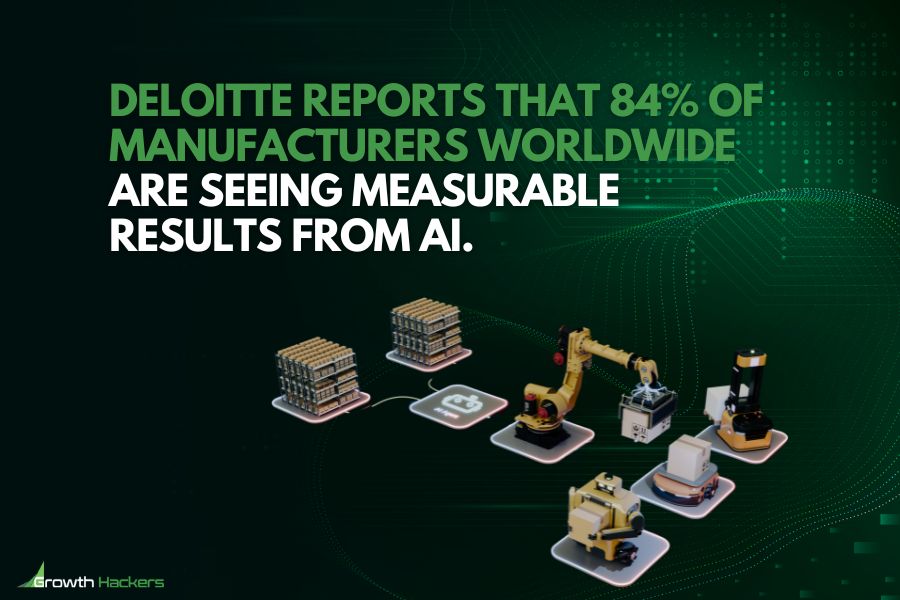
The technology is already delivering measurable results. According to Deloitte, 84% of manufacturers report generating measurable value from their AI initiatives, highlighting the growing role of intelligent technologies in improving operational performance and decision-making.
Machine learning models analyze historical and real-time operational data to identify patterns that humans might miss.
One of the most valuable applications is predictive maintenance.
Traditional maintenance approaches often rely on fixed schedules or reactive repairs after breakdowns occur. Predictive maintenance uses sensors, machine learning, and predictive analytics to identify warning signs before equipment fails.
This approach supports enabling predictive maintenance strategies that help organizations:
- Predict equipment failure before it occurs
- Reduce downtime
- Extend equipment lifespan
- Lower maintenance costs
- Improve production reliability
Beyond maintenance, machine learning supports demand forecasting and production planning.
Manufacturers can analyze customer demand patterns, market trends, seasonal fluctuations, and supply chain conditions to improve forecasting accuracy.
Predictive analytics allows organizations to optimize resource allocation and reduce costly overproduction or inventory shortages.
As artificial intelligence capabilities continue to evolve, manufacturers are finding new ways to automate decision-making and improve performance across complex processes.
3. Digital Twins For Simulation and Optimization
Digital twins are among the most exciting developments in digital transformation trends today.
A digital twin is a virtual representation of a physical asset, production line, facility, or entire manufacturing process.
Digital twin technology allows manufacturers to simulate operational scenarios before making changes in the real world.
For example, Rolls Royce uses digital twins to simulate aircraft engine performance, allowing engineers to monitor engine health, test operating conditions, and optimize maintenance schedules without disrupting operations. This demonstrates how digital twins can provide valuable insights while reducing risk and improving decision-making.
Organizations can use similar approaches to test:
- New production configurations
- Equipment upgrades
- Factory layout changes
- Process improvements
- Capacity expansion plans
Without disrupting ongoing operations.
Digital twins provide manufacturers with a low-risk environment for experimentation and optimization.
One of the greatest advantages of digital twins is the ability to analyze the impact of changes before implementation. This helps reduce uncertainty and improves decision-making.
As digital twin technology becomes more sophisticated, organizations are increasingly using digital twins to improve manufacturing efficiency, optimize resource allocation, and accelerate innovation.
Digital twins are expected to play a growing role in future digital transformation projects throughout the manufacturing sector.
4. Robotic Process Automation For Repetitive Workflows
While automation has long been associated with the factory floor, manufacturers are increasingly applying it to business processes as well. Investment in automation technologies continues to accelerate, with the market expected to grow from $4.7 billion this year to $35.8 billion by 2033, reflecting the growing demand for greater efficiency across industries.
Robotic process automation helps eliminate repetitive tasks that consume valuable employee time.
Unlike physical robots on production lines, it uses software bots to automate digital workflows.
Common use cases include:
- Order processing
- Invoice generation
- Procurement workflows
- Inventory management updates
- Quality control reporting
- Compliance documentation
By automating repetitive tasks, manufacturers can reduce human error while allowing employees to focus on higher-value activities.
For example, quality control reports that previously required manual data entry can be automatically generated using information collected from production systems.
This improves accuracy, consistency, and operational efficiency.
Organizations implementing robotic process automation often achieve meaningful productivity gains without major infrastructure investments.
5. Cloud, ERP and Integration Tools
Cloud computing has become a critical enabler of digital transformation.
Many manufacturers still rely on legacy systems that limit scalability, data accessibility, and integration capabilities.
Migrating enterprise resource planning functions to cloud based ERP systems offers several advantages:
- Improved scalability
- Enhanced security
- Lower infrastructure costs
- Easier updates and maintenance
- Better accessibility across locations
Cloud computing also enables greater collaboration between departments and external partners.
As manufacturers expand digital transformation efforts, cloud based ERP systems provide a centralized platform for managing data, workflows, and business processes.
However, replacing existing infrastructure is not always feasible immediately.
Many organizations must integrate new digital systems with existing legacy systems.
Successful manufacturing digital transformation often involves hybrid integration strategies that connect older platforms with modern applications through APIs, middleware, and cloud integration tools.
This approach allows organizations to modernize gradually while minimizing operational disruptions.
Cloud computing remains one of the most important foundational investments for supporting long-term digital transformation journeys.
Supply Chain Visibility and Resilience
Recent global events have highlighted the importance of supply chain resilience.
Many manufacturers experienced significant supply chain disruptions that affected production schedules, inventory availability, and customer deliveries.
As a result, improving supply chain visibility has become a major priority across the manufacturing industry.
Mapping Data Flows Across The Supply Chain
A resilient supply chain begins with visibility.
Manufacturers should map data flows across suppliers, logistics providers, warehouses, distributors, and customers.
This creates a comprehensive view of supply chain activities and helps identify potential vulnerabilities.
Digital transformation initiatives often focus on connecting previously disconnected systems to create a unified view of supply chain performance.
When information flows seamlessly across the supply chain, organizations can make faster and more informed decisions.
Improved visibility also supports better supply chain management and chain management strategies.
Using Sensors and Tracking Technologies
Connected devices play a vital role in enhancing supply chain visibility.
Sensors, RFID tags, GPS tracking systems, and industrial internet technologies provide real-time information about inventory, shipments, and equipment status.
These digital technologies enable manufacturers to:
- Monitor inventory levels
- Track shipments in transit
- Identify delays proactively
- Improve inventory management
- Reduce stockouts
Real time data allows organizations to respond quickly when disruptions occur.
This capability is particularly valuable in industries where production processes depend on precise timing and material availability.
Scenario Planning For Supply Chain Resilience
Building resilience requires more than visibility alone.
Manufacturers should use predictive analytics and advanced analytics tools to model potential disruption scenarios.
Examples include:
- Supplier failures
- Transportation delays
- Material shortages
- Demand spikes
- Regulatory changes
Scenario planning helps organizations prepare contingency plans before problems arise.
This proactive approach enables faster responses to supply chain disruptions and reduces operational risk.
As transformation in manufacturing continues to evolve, organizations that invest in resilient supply chain strategies will be better positioned to maintain continuity during periods of uncertainty.
For many manufacturers, strengthening the supply chain is one of the most valuable outcomes of a successful digital transformation journey.
How to Facilitate Digital Transformation in Manufacturing | Top 4 Tips
Many organizations understand the value of digital transformation but struggle with execution. The most successful initiatives are built around a structured roadmap that aligns technology investments with measurable business outcomes.
At Growth Hackers, we have seen that organizations achieve better results when they approach digital transformation as a business strategy rather than an IT project. Technology should support growth, efficiency, profitability, and customer value.
1. Develop a Phased Digital Transformation Roadmap
The digital transformation process should be approached in phases rather than attempting organization-wide change all at once.
A typical roadmap includes:
Phase 1 | Assessment
Evaluate current manufacturing operations, digital systems, workflows, infrastructure, and business objectives.
This stage helps identify opportunities, technology gaps, and areas where digital transformation projects can create the highest impact.
Phase 2 | Prioritization
Identify high-value use cases that align with business goals.
Examples include:
- Predictive maintenance
- Quality control automation
- Supply chain visibility improvements
- Inventory management optimization
- Production planning enhancements
Organizations should focus initial efforts on projects that deliver measurable results quickly.
Phase 3 | Pilot Programs
Launch targeted digital transformation projects within a specific business unit, production line, or facility.
Pilots help validate assumptions, demonstrate ROI, and build internal confidence before larger-scale deployment.
Phase 4 | Scaling
Expand successful solutions across additional facilities and departments.
Organizations that follow a phased digital transformation process often experience fewer disruptions and stronger adoption rates.
2. Assign Executive Sponsorship and Governance
One of the most overlooked key elements of successful digital transformation is executive leadership.
Every major initiative should have an executive sponsor responsible for governance, strategic alignment, and accountability.
Strong leadership ensures digital transformation efforts remain connected to broader business goals rather than becoming isolated technology projects.
Governance teams should also establish:
- Performance metrics
- Decision-making frameworks
- Budget oversight
- Risk management processes
- Change management guidelines
These key elements help maintain alignment throughout the digital transformation journey.
3. Measure KPIs Tied to Business Outcomes
Technology implementation alone is not a success metric.
Organizations should define KPIs that directly support business outcomes.
Common metrics include:
- Operational efficiency improvements
- Downtime reduction
- Cost reduction
- Customer satisfaction scores
- Product quality improvements
- Manufacturing efficiency gains
- Energy consumption reduction
Tracking these metrics helps leaders evaluate progress and justify future investments.
4. Invest in Workforce Upskilling
Technology adoption succeeds when people are prepared to use new systems effectively.
Manufacturers should invest in workforce development programs that build digital skills across the organization.
Training may include:
- Data analytics education
- Artificial intelligence fundamentals
- Cloud computing platforms
- Digital tools adoption
- Cybersecurity awareness
Employees who understand the value of transformation are more likely to support and sustain long-term change.
3 Common Challenges For Manufacturing Companies
Although the benefits are substantial, implementing digital transformation comes with challenges that must be addressed proactively.
1. Legacy-System Interoperability Issues
Many manufacturers rely on legacy systems that were not designed to support modern digital technologies.
These systems often create data silos and limit integration capabilities.
Connecting legacy systems with newer digital solutions requires careful planning, middleware technologies, and phased migration strategies.
Organizations that address interoperability early are more likely to achieve a successful digital transformation.
2. Workforce Skills And Talent Gaps
The manufacturing industry continues to face talent shortages in areas such as artificial intelligence, cloud computing, cybersecurity, and advanced analytics.
Organizations may struggle to recruit specialists with experience managing new technologies.
Workforce upskilling and strategic hiring initiatives are essential for supporting long-term digital transformation efforts.
3. Cybersecurity Risks For Connected Assets
As connected devices become more common throughout the manufacturing environment, cybersecurity risks increase.
Industrial internet platforms, cloud computing environments, and connected production equipment create additional attack surfaces.
Manufacturers should prioritize:
- Network segmentation
- Identity management
- Threat monitoring
- Data protection policies
- Employee security training
Strong cybersecurity practices are critical for protecting digital transformation investments.
Accelerate digital transformation in manufacturing with a proven strategy.
Work with Growth Hackers
3 Digital Transformation Trends in Manufacturing
Several emerging trends continue shaping transformation in manufacturing.
Understanding these developments can help organizations make informed investment decisions and prepare for future opportunities.
1. Growing Adoption of AI and IIoT
Artificial intelligence and industrial internet technologies are becoming increasingly integrated across manufacturing operations.
Organizations are using artificial intelligence to automate decision-making, improve forecasting accuracy, and enhance production planning.
At the same time, industrial internet deployments continue expanding as manufacturers seek greater visibility across the factory floor.
These technologies represent some of the most influential digital transformation trends affecting the manufacturing industry today.
2. Expansion of Digital Twins and Simulation
Digital twins are rapidly evolving from niche tools into mainstream operational platforms.
Manufacturers are increasingly using digital twins to simulate production scenarios, test process improvements, and optimize manufacturing operations before implementing physical changes.
As computing power and connectivity improve, digital twins will become even more valuable for managing complex processes.
3. Increased Use of RPA For Back-Office Automation
Robotic process automation adoption continues growing across administrative functions.
Organizations are using automation tools to streamline repetitive tasks such as reporting, procurement, invoicing, and compliance management.
This trend helps reduce human error while improving operational efficiency and employee productivity.
2 Real-World Use Cases and Case Studies
1. Digital Twin Case Study For Factory Optimization
Consider a manufacturer experiencing recurring production bottlenecks across multiple production lines.
Using digital twin technology, the company created a virtual model of its manufacturing process and tested several production scenarios.
The simulation identified equipment constraints that were reducing throughput.
After implementing the recommended changes, the manufacturer increased production capacity while maintaining product quality standards.
The ability to test improvements virtually reduced risk and accelerated implementation.
This example demonstrates how digital twins can support transformation in manufacturing without disrupting day-to-day operations.
2. Predictive Maintenance ROI Example
A manufacturer operating critical production equipment faced frequent unplanned downtime.
The company implemented predictive maintenance capabilities using sensors, machine learning, predictive analytics, and advanced analytics platforms.
The system could predict equipment failure before breakdowns occurred.
As a result, the organization significantly reduced downtime, improved equipment reliability, and lowered maintenance expenses.
The project also contributed to improved quality control because equipment operated more consistently.
This example highlights why predictive maintenance remains one of the highest-value applications of manufacturing digital transformation.
3 Next Steps and Recommendations For The Manufacturing Industry
Organizations beginning their digital transformation journey should focus on practical, measurable actions.
1. Start With a High-Impact Proof Of Concept
Rather than attempting large-scale transformation immediately, identify a high-value opportunity with clear ROI potential.
Examples include:
- Enabling predictive maintenance
- Improving quality control
- Enhancing supply chain visibility
- Automating repetitive tasks
- Testing additive manufacturing as a proof-of-concept for faster prototyping and more flexible production
The global 3D printing market is expected to reach $41.7 billion by next year.
Early wins help build momentum and organizational support.
2. Establish Governance to Scale Success
Successful pilots should not remain isolated initiatives.
Organizations need governance frameworks that enable repeatable deployment across departments and facilities.
Clear accountability helps ensure digital transformation initiatives continue delivering value as they scale.
3. Prepare For Change Management
Technology adoption requires employee engagement.
Leaders should communicate goals clearly, provide training resources, and address concerns proactively.
Organizations that invest in change management are more likely to achieve sustainable results from digital transformation projects.
Final Thoughts on Digital Transformation in Manufacturing
Digital transformation in manufacturing has become a strategic necessity for organizations seeking long-term growth, resilience, and competitiveness.
From predictive maintenance and artificial intelligence to cloud computing, digital twins, and industrial internet technologies, manufacturers now have access to powerful tools that can improve operational efficiency, strengthen the supply chain, enhance customer satisfaction, and deliver higher product quality.
However, technology alone does not create results.
Successful digital transformation requires a clear digital transformation strategy, strong leadership, measurable objectives, and a commitment to workforce development. The most successful organizations recognize that transformation is an ongoing journey rather than a one-time initiative.
As new digital technologies continue reshaping the manufacturing industry, companies that embrace innovation while maintaining focus on people and processes will be best positioned for future success.
At Growth Hackers, we help manufacturers navigate every stage of their digital transformation journey. As an award-winning marketing agency for manufacturing companies, we understand that growth depends on more than technology implementation alone. It requires aligning digital transformation strategy, customer acquisition, operational excellence, and revenue growth into a unified framework that delivers measurable business outcomes.
Whether your organization is exploring manufacturing digital transformation for the first time or looking to scale existing digital transformation efforts, our team can help identify opportunities, validate investment priorities, and accelerate results.
Get a Free Digital Transformation Audit
Ready to unlock the full potential of digital transformation in manufacturing?
Contact Growth Hackers today for a free digital transformation audit. Our team will evaluate your current capabilities, identify high-impact opportunities, and provide actionable recommendations to help your organization improve operational efficiency, reduce costs, strengthen supply chain performance, and accelerate growth.