
SEO lead generation services should do more than improve search engine rankings or increase organic traffic. They should help a business attract potential customers with real buying intent, guide website visitors toward the right next step, and connect organic search to qualified leads, pipeline, and revenue.
That is where many companies struggle. They invest in search engine optimization, celebrate stronger search visibility, and still see little change in lead volume or sales. The problem is usually not traffic alone. It is the gap between keyword research, relevant content, landing pages, conversion rate optimization, attribution, and sales follow-up.
At Growth Hackers, we approach SEO as part of a wider lead generation strategy. The goal is not simply to generate more clicks. It is to generate leads, improve lead quality, and help the sales team turn more qualified prospects into paying customers.
What are SEO Lead Generation Services?
SEO lead generation services use search engines to attract people who are researching a problem, comparing providers, or looking for a product or service. They then convert that demand into form fills, calls, consultations, demos, free trials, or other meaningful actions.
This approach is also called SEO lead generation, lead generation SEO, lead gen SEO, or lead generation SEO services. Unlike a traditional SEO campaign focused mainly on rankings and traffic, professional online lead generation services connect organic visibility to measurable outcomes.
A complete program may include:
- Buyer-intent keyword research
- Technical SEO, GEO (Generative Engine Optimization) and on-page optimization
- Conversion-focused content marketing
- Service pages and landing pages
- Local SEO where relevant
- Lead capture forms and calls to action
- Google Analytics and CRM tracking
- Reporting on lead quality, pipeline, and revenue
Effective SEO lead generation services attract users through commercial-intent and transactional search terms. They then use clear messaging and strategic calls to action to turn passive visitors into qualified prospects.
Why SEO is a Strong Lead Generation Channel
SEO helps businesses reach customers at the moment they need information or a solution. Someone searching for “best CRM for a SaaS company,” “commercial insurance broker near me,” or “SEO agency for professional services” has already expressed a need.
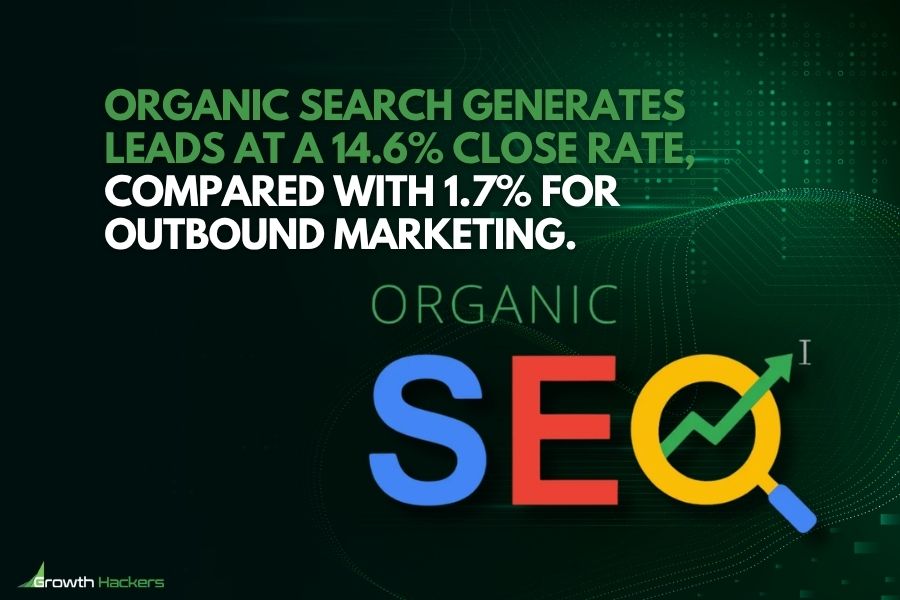
This is one reason SEO leads are often valuable. Frequently cited industry research reports a 14.6% close rate for SEO leads compared with 1.7% for outbound leads. Actual results vary by industry, offer, lead qualification, and sales cycle, but the comparison highlights the value of search intent.
SEO can also create sustainable demand. PPC ads generally stop producing once the budget is paused, while a strong service page or article can continue generating organic leads over time.
That does not make SEO free. Businesses still invest in SEO strategists, content creation, technical fixes, design, links, and analytics. The advantage is that a successful SEO investment can compound and reduce long-term dependence on paid advertising.
This is especially useful for companies with longer sales cycles. Potential leads may return several times, compare providers, read case studies, watch video marketing content, and involve multiple decision makers before contacting the business. SEO keeps the brand visible throughout that journey while strengthening overall brand visibility.
SEO Lead Generation Services vs. Traditional SEO
Traditional SEO commonly reports on rankings, impressions, clicks, backlinks, and organic traffic. These metrics matter, but they do not show whether SEO is creating business growth.
Lead generation services go further by connecting SEO data to:
- Conversion rate
- Qualified lead volume
- Marketing-qualified and sales-qualified opportunities
- Cost per lead
- Pipeline value
- Customer acquisition
- Closed revenue
- Return on investment
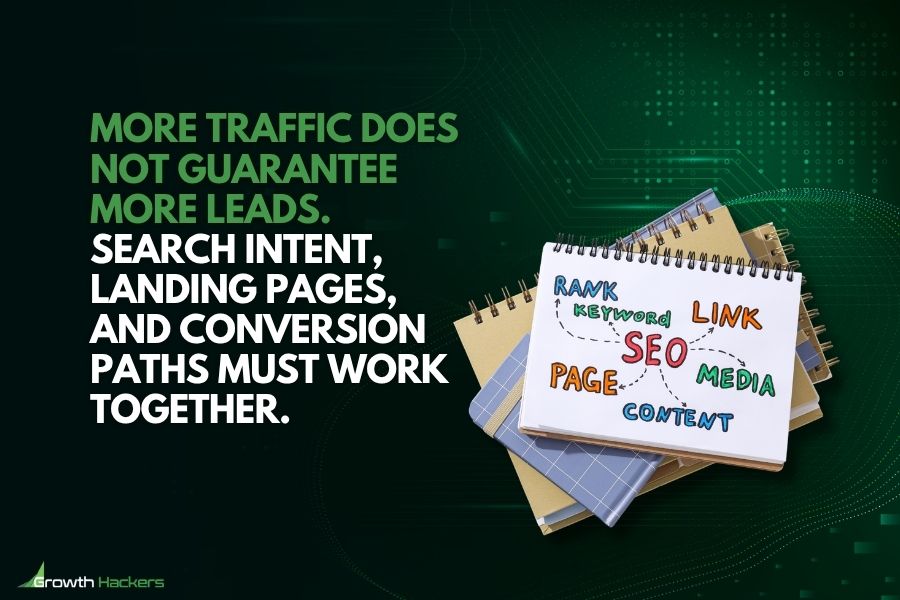
A page can rank well while attracting the wrong target audience. It can also bring in thousands of website visitors but produce few new leads because the offer is weak or the conversion path is unclear.
Successful SEO partners focus on defined lead quality rather than vanity metrics. Search engine rankings support growth, but they are not the final goal.
Ready to turn organic traffic into customers with SEO lead generation services?
Contact Growth Hackers
What Types of Leads Can SEO Generate?
SEO can generate different types of leads depending on the business model, offer, and sales cycle. Marketing-qualified leads may download a guide, register for a webinar, or subscribe to a newsletter, showing early interest but still requiring nurturing. Sales-qualified leads are typically closer to making a decision and may request a demo, submit a quote form, or book a consultation.
For SaaS companies, product-qualified leads may discover the product through organic search, start a free trial, and demonstrate in-product behavior that signals buying intent. Agencies and other professional services businesses may generate service-qualified leads through audit requests, assessments, or strategy calls, while local businesses may attract nearby customers through location-based searches supported by optimized business profiles, local citations, reviews, and service-area pages. Defining these lead types early helps keep the SEO lead generation strategy aligned with meaningful commercial outcomes.
How SEO Lead Generation Services Work | 7 Steps to Follow
Quality SEO lead generation services tailor their approach to the industry, target market, business model, and sales cycle. A local contractor needs a different system from a B2B company selling into complex industries.
Step 1 | Define the Target Audience and Lead Criteria
Start with the ideal customer profile.
Identify the industries, company sizes, roles, pain points, budgets, buying triggers, locations, and decision makers that make someone a strong prospect. This prevents the campaign from attracting traffic that looks good in reports but never converts.
This is also where client base lead generation priorities should be clarified. A company may want more leads from a specific geography, higher-value accounts, or a service line with stronger margins.
Step 2 | Research Keywords Based on Buyer Intent
High-intent keyword research focuses on targeting keywords that indicate buyer intent. These often include pricing searches, provider comparisons, location terms, alternatives, and phrases such as “best,” “hire,” “services,” or “company.”
Intent-matched long-tail keywords are often associated with stronger conversion potential, with some industry sources reporting average conversion rates around 36%. That figure should be treated as a directional benchmark, not a guaranteed result.
Targeting transactional keywords can increase conversions from leads because the searcher is already closer to taking action. Informational keywords still matter, but they should be mapped to a different stage of the sales funnel.
SEO data should guide prioritization. Search volume, ranking difficulty, business relevance, and potential pipeline value all matter. The best opportunity is not always the keyword with the largest volume.
Step 3 | Create Content Across the Buyer Journey
High-quality content can improve keyword rankings and lead generation at the same time. The strongest content answers real questions, builds trust, and leads naturally to the next step.
Useful formats include:
- Educational blog posts
- Service and industry pages
- Comparison and alternative pages
- Case studies
- Pricing and process pages
- Calculators and assessments
- Templates and reports
- Video marketing content
Conversion-focused content marketing creates content to answer user queries and capture leads. Regularly updated content can also strengthen website authority and engagement.
Content quality matters because weak, repetitive pages will not build trust, even when they rank. AI tools can support research, gap analysis, and content planning, but human expertise is still needed for original insight, accuracy, and positioning.
Step 4 | Strengthen Technical SEO and User Experience
Technical SEO helps search engines crawl, understand, and index important pages. It also supports the experience users have after clicking a result.
A lead-focused technical review should cover:
- Crawlability and indexation
- Internal linking
- XML sitemaps
- Canonical tags
- Structured data
- HTTPS
- Core Web Vitals
- Page speed
- Mobile friendliness
- Broken links and redirects
- Form functionality
Technical and on-page SEO improvements can strengthen site speed, mobile usability, content structure, and the overall user experience. Optimizing web pages also supports lead acquisition by removing friction.
A well-designed website can significantly improve lead generation, but visual appeal should support clarity. A polished page with too many messages, buttons, and animations may perform worse than a focused page with one clear action.
Step 5 | Build Landing Pages That Convert
Landing pages are where search visibility becomes lead capture.
Each page should match the intent behind the keyword that brought the visitor there. Someone searching for a free trial should not land on a generic homepage. A person searching for enterprise consulting should not be sent to a broad blog post without a clear next step.
According to Unbounce, the median B2B landing page converts at approximately 6.2%. This is a useful benchmark, not a universal target.
Strong landing pages usually include:
- A clear, benefit-focused headline
- One primary call to action
- Copy aligned with the target audience
- Social proof and notable clients where appropriate
- Specific outcomes or case studies
- A form suited to the offer
- Strong mobile usability
- Professional visual appeal
- Clear expectations about what happens next
SEO services convert passive visitors into qualified sales prospects using strategic calls to action. Conversion rate optimization can then improve results without requiring more traffic.
For example, optimizing landing pages from a 4% conversion rate to 8% would double conversions from the same number of visitors. Results will vary, but the calculation demonstrates why CRO should be part of lead generation SEO services.
Step 6 | Build Authority and Trust
Competitive pages often need more than strong copy and technical optimization. They also need authority.
Link building increases domain authority by acquiring high-quality backlinks from relevant websites. Sustainable methods include digital PR, original research, expert contributions, industry partnerships, podcasts, and useful tools.
Brand mentions, customer reviews, expert profiles, transparent methodologies, and detailed case studies can also strengthen trust. One reported long-term SEO program generated more than 250,000 leads, illustrating the potential impact of consistent authority building and conversion-focused optimization.
Step 7 | Connect SEO to CRM, Sales, and Revenue
SEO cannot provide provable lead generation if visibility ends after a form submission.
Every conversion should capture useful data such as:
- Landing page
- Lead source
- Campaign and UTM data
- Offer completed
- Contact details
- Lead type
- Lifecycle stage
- Assigned owner
- Pipeline value
- Closed revenue
Google Analytics can show which pages and channels create conversions, while the CRM reveals what happens afterward.
Attribution remains a major challenge. Some industry studies report that 52% of B2B marketing teams struggle to measure attribution. This is why marketing and sales should agree on qualification criteria, routing rules, response times, and ownership.
Performance tracking should measure conversions, lead volume, lead quality, pipeline, and return on investment instead of traffic alone. This creates a clearer view of which SEO assets generate quality leads and which ones need improvement.

10 Common SEO Lead Generation Mistakes to Avoid
Avoiding these common mistakes helps ensure your SEO strategy generates qualified leads instead of traffic that never converts.
1. Prioritizing Traffic Over Intent
High-volume keywords can attract visitors who will never become customers.
2. Sending Every Visitor to the Homepage
Different searches require different pages, messages, and offers.
3. Publishing Content Without a Conversion Path
Relevant content should guide users toward another useful resource, a service page, or a direct inquiry.
4. Ignoring Technical SEO
Search visibility suffers when key pages load slowly, perform poorly on mobile, or cannot be indexed.
5. Using Weak Calls to Action
“Contact us” is not always enough. The value of taking the next step should be clear.
6. Treating Every Form Fill as Equal
A newsletter signup and a pricing-page demo request should not enter the same workflow.
7. Failing to Track Revenue
Without CRM integration, the business cannot judge whether the SEO investment is producing measurable outcomes.
8. Expecting Immediate Results
SEO can generate sustainable demand, but it requires consistent execution.
9. Relying Only on SEO
Organic search can work alongside email, social distribution, paid media, and PPC ads.
10. Choosing a Provider Based on Rankings Alone
Lead generation experts should be able to discuss conversion, qualification, pipeline, and reporting, not only keyword positions.
Maximize growth with proven SEO lead generation services today.
Work with Growth Hackers
What Results Can SEO Lead Generation Produce?
SEO results vary, so case study outcomes should be viewed as examples rather than promises.
Some reported campaigns have increased incoming leads by over 400% or reduced cost per lead by as much as 95%. Other industry-specific case studies have reported a 4.7x lift in lead-to-listing performance.
These outcomes depend on the starting point, industry, competition, website quality, offer, and sales process. They do not mean every campaign will produce the same result.
The broader lesson is that lead generation SEO can create meaningful growth when keyword intent, content, landing pages, technical performance, attribution, and sales follow-up work together.
How to Choose an SEO Lead Generation Services Partner
Choosing a marketing agency for generation services requires more scrutiny than reviewing a rankings portfolio.
Ask prospective partners:
- How do you define qualified leads?
- Which conversions will you track?
- How will SEO connect to our CRM?
- What happens during the first 90 days?
- How do you measure lead quality?
- Who handles technical SEO, content, and conversion rate optimization?
- How do you use AI tools without compromising accuracy?
- Can you explain your reporting clearly?
Clear communication and transparency in reporting are crucial for effective SEO partnerships.
Whether the provider serves a local company in San Francisco, a global SaaS platform, or businesses in other complex industries, the strategy should reflect the target audience, sales cycle, and growth goals.
Look for measurable outcomes, but review every claim in context. Baseline performance, timeframe, attribution, and the quality of the underlying offer all matter.
Turn Organic Search Into Leads and Sales Qualified Pipeline
SEO lead generation works when strategy, content, technical performance, landing pages, lead capture, qualification, and analytics operate as one connected system. The goal is not simply taking advantage of more search results. It is attracting the right potential customers, converting them into qualified leads, and connecting organic visibility to sustainable business growth.
Growth Hackers is an award-winning lead gen agency helping startups, SaaS companies, entrepreneurs, marketers, and service businesses generate organic leads through search engine optimization, GEO, content marketing, conversion optimization, analytics, paid media, AI-powered distribution, and scalable lead generation services.
Request a free growth audit to identify opportunities to strengthen search visibility, improve lead quality, and turn organic traffic into more leads.
You can also book a 30-minute strategy call with our Growth Hackers team to discuss a lead generation strategy aligned with your target market, sales process, and growth goals.