Digital transformation is no longer a future initiative that businesses can postpone. It has become a necessity for organizations that want to remain competitive, improve customer experiences, and drive sustainable business growth.
However, despite significant investments in technology, many companies continue to struggle with implementation. The problem is rarely the technology itself. More often, businesses underestimate the complexity of aligning people, processes, and systems while trying to modernize operations. Without a structured approach, even well-funded initiatives can become disconnected projects that fail to generate meaningful results.
The reality is that digital transformation challenges extend far beyond adopting new technologies. Organizations frequently encounter leadership misalignment, talent shortages, resistance to change, legacy systems that are difficult to replace, and siloed data that prevents informed decision making. Without a clear digital transformation strategy, even the most promising projects can quickly lose momentum.
We have seen this happen firsthand. Many companies approach digital transformation by purchasing digital tools before establishing a roadmap. They implement platforms without defining measurable goals or preparing employees for change. As a result, digital initiatives become disconnected projects rather than long-term growth drivers.
Successful digital transformation requires a strategic and disciplined approach that aligns technology investments with evolving business models and measurable outcomes. Organizations must establish governance frameworks, build internal capabilities, strengthen cybersecurity, and foster a culture of continuous improvement.
The good news is that these obstacles are predictable and highly solvable when organizations address them proactively.
Digital transformation is also not a single project or software implementation. It is a business-wide initiative that affects people, processes, data, and technology simultaneously. Organizations that address these areas together are better positioned to build scalable systems, improve operational efficiency, and create sustainable competitive advantages.
In this guide, we will explore the ten most common digital transformation challenges organizations face today, why they occur, and practical strategies to overcome them. We will also share actionable frameworks Growth Hackers uses to help businesses build scalable systems, align teams, and accelerate transformation efforts without creating unnecessary complexity.
By the end of this article, you will understand how to build a sustainable digital transformation strategy that not only solves today’s problems but also prepares your organization for a stronger digital future.
1. Lack of a Clear Digital Strategy
A clear digital strategy connects every technology investment to measurable business outcomes.
Unfortunately, many organizations start purchasing software before identifying the problems they are trying to solve. This often leads to disconnected systems, overlapping responsibilities, and confusion across departments.
The pressure to adopt new technologies can also push organizations to prioritize speed over strategy. Companies may implement AI tools, automation platforms, or analytics software because competitors are doing the same, without evaluating whether those investments support their long-term business objectives.
Without a clear strategy, teams operate independently and projects become fragmented. Resources are spread across multiple initiatives, making it difficult to measure progress or demonstrate value.
A strong digital transformation strategy begins with clearly defined business objectives.
Ask questions such as:
- Which business challenges are slowing growth?
- Which processes consume excessive manual effort?
- Which customer pain points need immediate attention?
- Which metrics will indicate success?
Once priorities are established, leaders can map them to measurable KPIs.
For example:
Business objective: Improve customer retention.
Digital initiative: Implement customer analytics software.
Success metric: Increase customer retention by 15% within 12 months.
In our experience, organizations achieve faster results when implementation is divided into manageable phases rather than attempting to modernize everything simultaneously.
A phased roadmap could look like this:
Phase 1 | Assessment (0 to 3 months)
- Audit existing infrastructure
- Identify capability gaps
Phase 2 | Optimization (3 to 9 months)
- Deploy digital tools
- Automate workflows
Phase 3 | Scale (9 to 18 months)
- Expand digital solutions
- Optimize performance
Organizations with a clear digital strategy are better positioned to secure early wins, maintain stakeholder confidence, and sustain long-term momentum.
2. Misaligned Business Leaders and Sponsorship
Digital transformation requires visible support from executives.
Business leaders must actively communicate priorities.
When leadership involvement is inconsistent, transformation efforts lose momentum.
One of the most common mistakes organizations make is assuming that executive approval is enough. Simply allocating a budget does not guarantee successful execution. Leaders must remain actively involved throughout every phase of implementation.
Recommendations:
- Assign executive sponsors.
- Conduct weekly governance meetings.
- Create transparent communication channels.
- Define clear ownership responsibilities.
Consistent communication reduces uncertainty and increases accountability.
One approach we frequently recommend is implementing executive dashboards that facilitate communication between departments and leadership teams. These dashboards create visibility into progress, highlight bottlenecks, and enable leaders to make informed decisions quickly.
From our work with clients, we have found that defining success metrics early significantly improves alignment throughout the organization. Every stakeholder should understand how their department contributes to larger business objectives. When leaders communicate a unified vision, employees gain confidence and execution becomes more efficient.
Organizations should avoid creating isolated transformation teams that operate independently from the rest of the business. Digital transformation succeeds when leadership alignment extends across every department.
Visible executive participation also sends a strong message to employees. When leaders consistently participate in meetings, celebrate milestones, and address challenges openly, organizations build trust and maintain momentum throughout the transformation process.
Digital transformation should never be perceived as an IT initiative delegated to a single department. The organizations that move fastest are often those where executives actively champion change and demonstrate commitment through their actions rather than occasional updates.
Need help overcoming digital transformation challenges with a clear, actionable strategy?
Contact Growth Hackers
3. Digital Skills Gap and Talent Shortages
The digital skills gap continues to widen as technology evolves faster than workforce capabilities.
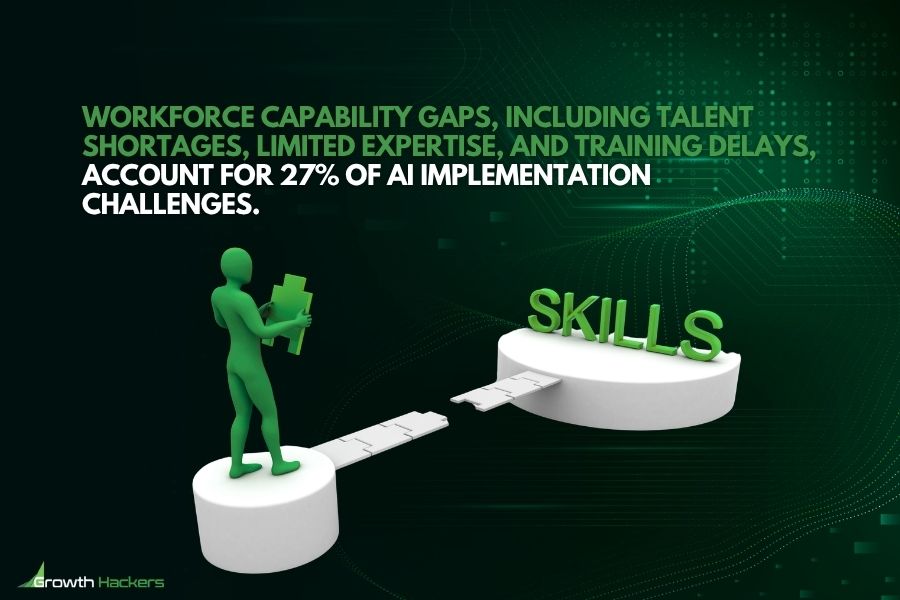
The challenge is becoming even more pronounced as organizations accelerate AI adoption. Recent research indicates that 27% of AI implementation challenges are directly related to workforce capabilities, highlighting that technology investments can only succeed when employees possess the necessary skills to operate and optimize them. Companies that invest solely in AI platforms without investing in people often struggle to generate meaningful returns.
At Growth Hackers, we encourage organizations to view workforce development as a strategic investment rather than an operational expense. Building internal capabilities early allows teams to adapt faster and reduces long-term dependency on external consultants.
The World Economic Forum estimates that 39% of workers’ core skills will change by 2030. Organizations that fail to address this skills gap risk falling behind competitors that invest in workforce development.
Many businesses make the mistake of immediately hiring new employees without evaluating their existing talent.
At Growth Hackers, we recommend conducting an internal skills audit first.
Assess capabilities across areas such as:
- Data analytics
- AI literacy
- Automation
- Product management
- Cybersecurity
- Digital marketing
The goal is to identify the digital skills required to support future growth.
Not every employee needs advanced technical expertise. Instead, businesses should create role-based learning paths.
For example:
Marketing teams may require analytics and AI skills.
Operations teams may require automation training.
Leadership teams may require data interpretation skills.
Building internal talent is often more cost-effective than continuously recruiting externally.
Organizations that foster continuous learning create more resilient teams that can adapt to emerging technologies.
Training programs should not be treated as one-time exercises. Digital transformation is an ongoing process, which means employees must continuously update their capabilities as new technologies enter the market. Organizations that prioritize continuous learning are often better equipped to innovate, adopt new digital solutions, and respond quickly to changing customer expectations.
4. Insufficient Digital Investments and Budgeting
Digital transformation requires strategic resource allocation.
Many organizations underfund projects or spread investments too thin, which often results in delayed implementation, stalled initiatives, and incomplete adoption across teams.
Instead of treating digital transformation as a one-time expense, organizations should prioritize digital investments based on projected ROI and long-term business objectives.
Developing a multi-year funding model can help leaders allocate resources more effectively while maintaining flexibility as priorities evolve. It is also important to include contingency funds for vendor, procurement, or integration delays that may arise during implementation.
One common mistake is investing heavily in technology while underestimating the resources needed for employee adoption and optimization. Even the most advanced digital tools will struggle to deliver value if teams are not properly trained to use them.
A practical budgeting framework is to categorize investments by priority:
High priority
- Customer experience improvements
- Revenue generation projects
Medium priority
- Internal productivity tools
- Workflow automation initiatives
Lower priority
- Experimental initiatives
- Emerging technology pilots
Organizations should also review investment priorities quarterly rather than annually. Customer expectations, market conditions, and technological advancements can change quickly, requiring businesses to adjust their digital transformation plans accordingly.
Proper budgeting prevents stalled transformation initiatives and enables organizations to scale successful projects with greater confidence. Organizations focused on overcoming digital transformation challenges should also prioritize investments that eliminate manual processes and improve collaboration across teams.
5. Poor Change Management Strategy
Technology implementation only succeeds when employees adopt new behaviors.
Unfortunately, many organizations treat change management as an afterthought.
Employees are often informed about new systems shortly before deployment, leaving little time to prepare.
This creates anxiety, uncertainty, and resistance.
Employee resistance remains one of the biggest reasons transformation initiatives fail. Research suggests that 70% of digital transformations fail due to employee resistance and lack of adoption.
This reinforces an important reality: even the most advanced technologies cannot produce results if employees refuse to embrace new ways of working.
Organizations must address concerns proactively rather than assuming employees will automatically adapt to change.
Introducing a change management strategy during the planning phase can significantly improve adoption rates.
Assign dedicated change champions within each department.
These individuals become advocates who help educate and support their colleagues throughout the transition process.
Pilot launches are equally important.
Testing systems with smaller groups allows organizations to gather feedback before company-wide rollouts.
Continuous feedback loops provide valuable insights that help teams make adjustments quickly.
Transparent communication throughout the process builds trust and encourages participation.
Communication itself can become a competitive advantage. Studies show that clear messaging about change significantly increases employee engagement and commitment.
Employees are more likely to support transformation when leaders consistently explain:
- Why changes are occurring
- How changes will affect daily responsibilities
- What benefits the changes will create
Weekly updates, town hall meetings, and department-specific check-ins help eliminate uncertainty and build confidence.
Organizations should also celebrate early wins. Publicly recognizing teams that successfully adopt new systems encourages broader participation and demonstrates that transformation efforts are producing tangible results.
When employees understand the purpose behind change, they become active participants instead of reluctant observers.
6. Legacy Systems and Technical Debt Hindering Progress
Legacy systems remain one of the most significant barriers to digital transformation.Many organizations continue using outdated software because it still functions adequately.
However, maintaining outdated technologies often creates hidden costs that accumulate over time. According to industry research, the average cost to operate and maintain a single legacy system can reach $30 million, while IT workers spend nearly $40,000 annually maintaining each legacy system.
These expenses often extend beyond software maintenance and include security updates, specialized support, and costly workarounds needed to keep aging systems operational. Over time, these hidden costs can limit innovation and divert resources away from higher-value digital transformation initiatives.
These systems may:
- Require expensive maintenance
- Limit scalability
- Increase security vulnerabilities
- Create integration challenges
- Slow down innovation
The longer organizations delay modernization, the more technical debt they accumulate. Eventually, outdated infrastructure can limit growth opportunities and reduce organizational agility.
Rather than replacing everything simultaneously, organizations should prioritize incremental modernization.
An API-first approach enables old and new systems to coexist temporarily while reducing operational disruptions.
Cloud migration can also reduce infrastructure costs while improving flexibility.
Modernization also allows organizations to replace manual processes with automated workflows that streamline processes and improve operational visibility. Organizations should prioritize modernization efforts based on business impact. Systems that directly affect customer experience, productivity, or revenue generation should generally be addressed first.
Every organization should develop sunset plans for non-strategic assets.
Leaders should also conduct regular audits to identify systems that are becoming obsolete. Delaying these decisions often increases future costs and creates additional complexity.
In our experience, organizations that modernize gradually tend to achieve more sustainable results than those attempting large-scale replacements all at once.
Modernization should be viewed as an ongoing process rather than a one-time event. A balanced approach allows businesses to maintain continuity today while building a stronger foundation for tomorrow.
7. Data Management and Siloed Information
Data has become one of the most valuable business assets.
Unfortunately, many organizations struggle because information is scattered across disparate systems.
When sales, marketing, finance, and operations teams maintain separate databases, inconsistent data becomes inevitable.
This creates confusion and weakens decision making.
One of the first priorities should be establishing a single source of truth.
This means creating centralized systems that all departments can trust.
Strong data governance should define:
- Ownership responsibilities
- Data quality standards
- Security requirements
- Access permissions
Organizations should also implement master data management practices.
Doing so improves reporting accuracy and builds confidence in strategic decisions.
When teams trust their data, they can move faster and make better decisions.
Another challenge arises when organizations collect enormous amounts of information without a clear strategy for using it. More data does not automatically produce better decisions.
Businesses should prioritize collecting actionable data that directly supports business objectives.
In our experience, regularly auditing data sources helps eliminate redundancies and improve consistency across departments.
Organizations should also establish shared definitions for important metrics. For example, every department should have the same understanding of what qualifies as a customer acquisition, conversion, or retention event.
Standardized definitions reduce reporting discrepancies and create stronger alignment across teams.
Businesses should also document data ownership clearly. When accountability is unclear, errors often go unnoticed and reporting becomes unreliable. Assigning data stewards within each department creates stronger oversight and increases confidence in decision making.
Ultimately, organizations that successfully manage their data are better equipped to identify opportunities, anticipate risks, and make faster decisions that support long-term growth. Strong data foundations also make it easier to evaluate new technologies and adapt existing business models as customer expectations evolve.
8. Cybersecurity, Privacy and Compliance Risks
As businesses adopt advanced technologies, cyber threats continue to increase. Every new platform, application, and integration creates additional entry points that attackers can exploit, making cybersecurity a foundational component of any digital transformation strategy.
Organizations should conduct a security baseline assessment before launching new initiatives. Identifying vulnerabilities early helps teams address potential risks before they disrupt operations or expose sensitive information.
Core security measures should include:
- Encryption
- Identity management
- Access controls
Organizations should also adopt a multi layered security approach that protects systems at multiple levels rather than relying on a single defense mechanism. Deploying intrusion detection systems can help monitor vulnerabilities and identify suspicious activity in real time.
Effective security measures reduce potential risks while strengthening customer trust. Security policies should also align with industry regulations and internal audit cycles to ensure ongoing compliance. This is particularly important for organizations that collect or process customer data internationally, as regulations such as the General Data Protection Regulation (GDPR) impose strict data privacy requirements. Non-compliance can result in hefty fines, reputational damage, and a loss of customer trust, making regulatory compliance a critical component of long-term risk management.
Organizations should also recognize the growing financial impact of cybercrime. Ransomware and phishing attacks can lead to significant financial losses, operational disruptions, and reputational damage that may take years to recover from. As a result, employee awareness training should be treated as an essential component of cybersecurity rather than an optional activity.
Protecting financial data and other critical digital assets requires continuous monitoring. Regular audits, employee cybersecurity training, and clearly defined incident response procedures can help organizations respond quickly to emerging threats and minimize disruptions.
As digital transformation expands across the business, cybersecurity should no longer be viewed as an IT responsibility alone. It should become a shared responsibility that supports long-term resilience and sustainable growth.
9. Difficulty Measuring ROI and Business Outcomes
One of the most overlooked digital transformation challenges is proving value.
Many organizations invest significant time and resources into transformation initiatives but struggle to demonstrate tangible results. Without a clear measurement framework, leaders often find it difficult to justify continued investments or determine whether projects are delivering meaningful impact.

Every digital transformation project should begin with measurable objectives that align directly with broader business objectives.
A common mistake is relying on vanity metrics that look impressive but provide little strategic value. Instead, organizations should focus on metrics that clearly connect technology investments to business outcomes.
Key performance indicators may include:
- Revenue growth
- Cost reductions
- Employee adoption rates
- Productivity improvements
- Customer satisfaction scores
- Process completion times
Establishing baseline measurements before implementation is equally important. Without understanding current performance levels, organizations have no reliable way to determine whether progress is occurring.
Leaders should identify existing bottlenecks, inefficiencies, and performance gaps to create meaningful benchmarks.
Organizations should also conduct quarterly reviews rather than waiting until projects are completed. Continuous monitoring helps teams identify underperforming initiatives early and redirect resources toward higher-impact opportunities.
Businesses should avoid measuring only financial outcomes. A balanced scorecard often provides a more complete view of success.
Short-term indicators may include:
- Employee adoption rates
- Customer response times
- Process efficiency improvements
Long-term indicators may include:
- Customer lifetime value
- Revenue growth
- Customer retention
- Overall business growth
Successful digital transformation is rarely the result of a single initiative. It is the outcome of ongoing optimization, data-driven decisions, and disciplined execution. Organizations that prioritize measurable business outcomes over vanity metrics are better positioned to enhance operational efficiency, allocate resources effectively, and sustain long-term growth.
10. Organizational Culture and Resistance to Change
Organizational culture can either accelerate or hinder transformation.
Even the most advanced technologies will struggle to deliver results if employees are unwilling to adopt new ways of working. In many cases, resistance does not stem from the technology itself but from uncertainty about how change will affect daily responsibilities.
Poor communication often creates confusion and increases resistance. Employees may feel disconnected from transformation initiatives if they are not given enough information about the purpose behind new systems and processes.
Organizations should begin by gathering employee feedback early in the process.
Conduct employee surveys.
Identify friction points.
Create opportunities for employees to ask questions and share concerns.
These feedback loops help leaders uncover challenges before they become larger obstacles and allow teams to adjust implementation plans when necessary.
Consistent communication also plays a critical role in maintaining trust throughout the digital journey. Employees are more likely to embrace change when leaders regularly explain what is changing, why it matters, and how it supports long-term business goals.
Transparent communication should continue throughout every phase of implementation rather than being limited to initial announcements.
Organizations should also reward adoption with incentives and recognize teams that actively participate in new initiatives. Celebrating early successes helps build momentum and encourages wider participation across departments.
Building a culture that embraces technological advancements requires leaders to promote continuous improvement rather than expecting immediate perfection. Employees should feel comfortable experimenting with new processes, learning from setbacks, and contributing ideas that improve operations.
Successful transformation happens when employees feel empowered to become active participants in change instead of passive observers.
Over time, organizations that cultivate a collaborative organizational culture are better positioned to adapt to future disruptions, accelerate innovation, and support sustainable business growth. When people understand their role in the transformation process, they become one of the strongest drivers of long-term success rather than one of its biggest obstacles.
Solve your biggest digital transformation challenges with expert guidance.
Work with Growth Hackers
Practical Playbook | A 5-Step Framework for Successful Digital Transformation
Successful digital transformation requires a structured approach that connects strategy, people, technology, and execution.
Organizations can simplify the process by following these five steps.
1. Build a Clear Digital Strategy
Bring together stakeholders from key departments, including marketing, product, operations, and technology, to align priorities with business objectives.
Break large initiatives into manageable phases and establish measurable goals for each stage.
2. Close Digital Skills Gaps
Conduct a skills assessment to identify capability gaps across teams.
Then, launch role-specific training programs, establish mentorship opportunities, and monitor employee progress regularly.
Continuous learning should remain a long-term priority as new technologies continue to evolve.
3. Prioritize High-Impact Investments
Evaluate initiatives based on strategic impact, implementation complexity, and expected ROI.
Allocate resources toward quick wins first, then scale successful projects across the organization.
Investment plans should also include budgets for employee training, optimization, and unexpected implementation delays.
4. Embed Change Management Early
Introduce change management at the beginning of every initiative rather than after implementation begins.
Provide regular updates, create feedback channels, and appoint change champions to help employees adapt to new ways of working.
5. Measure, Optimize and Scale
Track performance using key metrics such as employee adoption, productivity improvements, customer satisfaction, and revenue growth.
Conduct quarterly reviews to identify opportunities for continuous improvement and adjust priorities as business needs evolve.
Organizations that follow a structured framework are often better positioned to overcome digital transformation challenges, accelerate execution, and build sustainable long-term growth.
Measurement and Governance Framework
Strong governance ensures digital transformation remains aligned with strategic priorities and business objectives over time.
Organizations should create executive dashboards that track key metrics such as:
- Operational KPIs
- Adoption metrics
- Customer metrics
- Financial performance
Conducting monthly governance reviews allows leaders to assess progress, address risks, and adjust priorities before small issues become larger obstacles.
Organizations should also publish transparent scorecards so stakeholders can clearly understand performance trends and accountability across teams.
Continuous monitoring helps teams identify bottlenecks quickly, allocate resources more effectively, and improve decision making.
Assigning clear ownership for each initiative is equally important. When responsibilities are well defined, teams can execute faster and respond more effectively to changing business needs.
Strong governance transforms digital transformation efforts into repeatable systems that support continuous improvement and long-term business growth.
2 Case Studies and Evidence
Case Study 1 | B2B SaaS Company
A SaaS client struggled with disparate systems and fragmented reporting.
Growth Hackers implemented:
- Centralized data architecture
- Automation workflows
- KPI dashboards
Within 6 months:
- Reporting time decreased by 65%
- Customer onboarding improved by 40%
- Revenue attribution accuracy increased by 80%
The client reported stronger confidence in strategic decisions.
Case Study 2 | Multi Location Retail Business
A retail company faced integration challenges between legacy systems and cloud solutions.
Growth Hackers introduced:
- API integrations
- Employee training
- Governance frameworks
Within 9 months:
- Operational costs dropped 18%
- Employee adoption reached 91%
- Customer satisfaction increased 22%
The company successfully accelerated its digital journey without disrupting operations.

Turn Challenges Into Growth | How Growth Hackers Helps
Digital transformation challenges are unavoidable.
The difference between success and failure lies in execution, especially when organizations are overcoming digital transformation challenges across people, processes, new technologies, and business models.
Organizations that proactively address skills shortages, leadership alignment, security, and culture build a stronger digital future.
Growth Hackers, a renowned digital transformation agency, helps businesses turn uncertainty into opportunity.
Our team combines strategic planning, data analysis, technology expertise, and growth experimentation to build sustainable transformation systems.
We do not simply recommend technology.
We build practical roadmaps that drive measurable outcomes.
If your organization is ready to accelerate its digital transformation journey, start with a transformation audit.
We will identify your digital skills gap, assess current capabilities, and build a clear digital transformation strategy aligned with your goals.
The companies winning today are not necessarily investing more.
They are executing better.
Book a data-driven strategy session with Growth Hackers and start turning digital transformation challenges into your next competitive advantage.