Retail digital transformation is no longer just about launching an ecommerce site, adding a mobile app, or testing new technology. For retailers, transformation needs to connect customer experience, store operations, ecommerce, inventory visibility, supply chain, customer data, marketing, and measurable growth.
A clear digital transformation plan helps retailers decide what to modernize first, how to execute it, and how to measure whether each initiative is creating real business value.
That distinction matters. Many retail businesses are already using digital tools, but their systems still operate separately. Online shopping data lives on one platform. In-store sales data lives in another. Inventory systems are not always updated in real time. Marketing teams do not always have a full view of customer behavior. Store teams may still rely on manual processes that slow down the purchase process.
Retail digital transformation brings these moving parts together. It gives retail leaders a practical way to improve operational efficiency, increase customer satisfaction, strengthen customer retention, and stay competitive in a retail industry where customer expectations keep changing.
Why Retailers Need a Digital Transformation Plan
Retailers need a digital transformation plan because technology alone does not fix disconnected operations.
A retail business can invest in mobile apps, customer data platforms, artificial intelligence, digital technology, new tools, and automation, but if those investments are not tied to business objectives, the result is often more complexity instead of better performance.
The retail sector is under pressure from several directions. Customers expect faster service, easier checkout, flexible delivery, personalized experiences, and consistent communication across every channel. E-commerce competition continues to grow. Physical stores still matter, but they need to work with digital touchpoints, not against them. Supply chain disruptions, rising costs, changing customer habits, and fragmented sales channels make decision making harder.
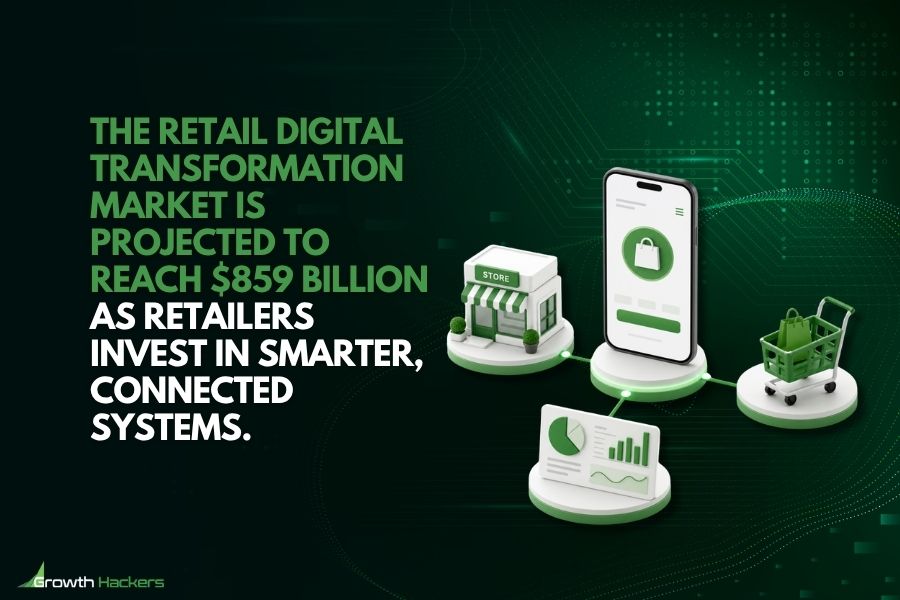
Research consistently shows that today’s shoppers use multiple touchpoints before purchasing. They may discover a product on social media, compare options on a mobile device, check reviews, visit a physical store, add the item to a cart online, and complete the purchase later. Omnichannel shopping integrates physical and digital channels into one connected experience. When retailers treat those touchpoints as separate journeys, they lose visibility and risk losing sales.
Multi-channel customers also tend to spend more than in-store-only customers. That makes omnichannel strategy more than a customer experience issue. It is a revenue growth issue.
At Growth Hackers, we often see retailers with strong products and loyal customers struggle because their digital infrastructure cannot support the way people shop today. The issue is not always traffic or demand. Sometimes the bigger problem is that customer data, inventory levels, sales data, marketing strategies, and fulfillment operations are not connected well enough to support smarter execution.
A retail digital transformation plan helps solve that problem. It turns digital transformation efforts into a sequence of focused initiatives that support growth, retention, conversion, revenue, and scalability.
What is Retail Digital Transformation?
Retail digital transformation is the process of integrating digital technology, data, automation, analytics, and connected systems into the way a retailer serves customers and operates the business.
In simple terms, it is how retailers modernize the customer experience and the operating model at the same time.
Digital transformation in retail can affect eCommerce platforms, POS systems, inventory management, customer data, loyalty programs, supply chain workflows, payments, personalization, customer engagement, store operations, and marketing. It can also include artificial intelligence, machine learning, predictive analytics, computer vision, augmented reality, mobile apps, cloud systems, and automation.
But the goal is not to use every available technology. The goal is to use the right digital solutions to improve real business outcomes.
For example, a retailer may use predictive analytics to forecast sales more accurately. Another may use customer data platforms to create unified profiles based on purchase history, browsing behavior, loyalty activity, and customer service interactions. A retailer with multiple physical locations may use real-time inventory visibility to reduce stockouts, support click and collect, and improve fulfillment speed.
Retail digital transformation should help retailers answer practical questions:
- What do customers want?
- Where are customers dropping off?
- Which products are selling across each channel?
- Where are inventory levels inaccurate?
- Which stores need better replenishment?
- Which customers are likely to return?
- Which marketing campaigns are driving profitable revenue?
- Which manual tasks can be automated?
When digital retail is planned well, the business becomes easier to manage and easier to grow.
Retail Digital Transformation Strategy vs. Retail Digital Transformation Plan
A retail digital transformation strategy and a retail digital transformation plan are connected, but they are not the same thing.
A digital transformation strategy defines the vision. It explains where the retailer wants to go, what competitive priorities matter, and how digital transformation will support the business.
A retail digital transformation plan explains how the strategy will be executed. It defines initiatives, owners, timelines, technology, data requirements, training needs, change management, and KPIs.
Strategy sets direction. The plan turns that direction into action.
For example, a retailer’s digital strategy may be to improve omnichannel customer engagement and increase repeat purchases. The plan would then identify the concrete steps needed: cleaning customer data, integrating loyalty and eCommerce systems, improving email segmentation, launching personalized offers, connecting POS data to marketing automation, and tracking retention, average order value, and customer lifetime value.
Without a strategy, a transformation project becomes a checklist of disconnected technology upgrades. Without a plan, strategy stays theoretical. Retailers need both.
Want to future-proof your business through retail digital transformation?
Contact Growth Hackers
8 Key Areas Retailers Should Include in a Digital Transformation Plan
A strong retail digital transformation plan should not focus on technology alone. It should cover the business areas where better systems, data, and workflows can improve customer experience, operational efficiency, and revenue performance. The eight core areas below give retailers a practical framework for deciding where to focus.
1. Customer Experience and Customer Engagement
Customer experience is one of the most important drivers of retail digital transformation.
Customers want shopping to feel easy, relevant, and consistent. They expect product information to be accurate, checkout to be simple, support to be responsive, and offers to reflect their preferences. They also expect retailers to remember their purchase history, loyalty activity, and shopping habits across online and in-store experiences.
Retailers can improve customer engagement through easier checkout, loyalty programs, personalized offers, responsive support, post-purchase communication, and consistent brand experiences across digital touchpoints.
This is where behavioral insights become valuable. When retailers understand how customers shop, they can create more relevant marketing strategies, reduce friction in the purchase process, and increase brand loyalty.
Sephora is a useful example of digital transformation in retail because its app supports virtual makeup trials and personalized recommendations. Starbucks also demonstrates how mobile apps can improve convenience, speed up orders, and strengthen loyalty through points and rewards.
The key takeaway is simple: retail digital transformation should make the customer journey easier, not more complicated.
2. eCommerce and Omnichannel Retail
Retailers can no longer treat eCommerce and physical stores as separate businesses.
Customers move between channels naturally. They may browse online, visit a store, compare prices on mobile, check inventory, and then buy in store. They may purchase online and return in store. They may discover products through social commerce and complete the transaction later through a website or app.
Integrating online and offline channels is essential for a seamless retail experience. A strong omnichannel plan should connect ecommerce, physical stores, social commerce, mobile apps, click and collect, delivery, returns, inventory systems, customer service, and loyalty programs.

Square’s POS is a straightforward example of a system that helps businesses manage sales online and in store. For many traditional retailers, this kind of integration is an important first step toward stronger digital operations.
The goal is not just to sell through more channels. The goal is to make every channel work together.
3. Customer Data and Customer Insights
Customer data is the foundation of smarter retail decisions.
Retailers collect data from many places, including loyalty programs, transaction histories, website behavior, eCommerce activity, mobile apps, customer service interactions, and email engagement. But when that data is fragmented across different systems, it becomes harder to use.
Data silos are one of the biggest barriers to data-driven decision making in retail. If marketing only sees email activity, eCommerce only sees online shopping behavior, and store teams only see POS transactions, no one has a full picture of the customer.
Unified customer profiles provide a 360-degree view of interactions, allowing retailers to understand what customers bought, what they browsed, what offers they responded to, which channels they use, and what may influence their next purchase.
Customer data platforms can help bring this information together when implemented with the right governance and data standards. But the tool itself is not the strategy. Retailers still need a clear plan for data ownership, segmentation, personalization, privacy, and activation.
Retailers using data analytics can personalize experiences more effectively because they can make decisions based on real customer behavior, not assumptions.
4. Inventory Visibility and Supply Chain Operations
Inventory management is one of the most practical areas for retail digital transformation.
When inventory data is inaccurate, retailers risk stockouts, overselling, missed fulfillment promises, and lost sales. Customers may see a product listed online, visit a store, and find the item unavailable. Store teams may waste time checking inventory manually. Marketing may promote products that are not available in the right locations.
Real-time inventory visibility helps solve these problems. Integrated inventory that updates across all shopping channels helps retailers improve stock availability, store replenishment, warehouse coordination, fulfillment speed, and delivery expectations.
Demand forecasting also plays a major role. AI-driven forecasting tools can automate reordering, optimize stock levels, and help retailers anticipate demand more accurately. Target has used AI-driven inventory tools to improve on-shelf availability for multiple consecutive years, demonstrating how smart systems can support better retail operations at scale.
IoT devices can also increase visibility across supply chain processes, while predictive analytics helps retailers reduce costly inventory inaccuracies before they affect customers.
5. Retail Automation and AI-Powered Automation
Automation can streamline inventory management, order fulfillment, customer support, marketing segmentation, and repetitive workflows.
AI-powered automation adds another layer by helping retailers analyze patterns, predict demand, personalize recommendations, and respond faster to customer needs. Practical use cases include:
- Personalized product recommendations
- Automated customer support
- Demand forecasting
- Dynamic pricing
- Inventory alerts
- Marketing segmentation
- Repetitive workflow reduction
Amazon’s AI-powered recommendation engine is widely reported to drive a significant share of purchases on the platform, illustrating how personalization at scale can directly influence revenue. IKEA’s app lets customers visualize furniture in their homes using augmented reality. Staples Canada automated price checking and saved thousands of staff hours weekly.
These examples show that automation is not only about reducing manual tasks. It can also improve customer satisfaction, operational efficiency, and revenue performance.
Industry research from firms including McKinsey and Gartner consistently identifies AI as a growing priority across retail operations. But AI only creates value when it is connected to business objectives, reliable data, and clear processes.
6. Data Analytics and Performance Measurement
Data analytics helps retailers decide what to sell, where to sell it, how to price it, how to market it, and how to improve the customer experience.
A strong retail digital transformation plan should include dashboards and reporting that connect sales performance, conversion rates, average order value, customer lifetime value, retention, inventory turnover, customer satisfaction, and campaign performance.
Dynamic pricing strategies can maximize profitability using real-time data. Retailers can adjust prices based on demand, inventory levels, competitor activity, customer behavior, and margin targets. This is especially useful in fast-moving categories where conditions change quickly.
The important point is that measurement should not stop at tool adoption. A retailer should not only ask whether a new platform went live. It should ask whether that platform improved conversion, reduced stockouts, increased loyalty engagement, improved fulfillment speed, or lifted revenue.
Better analytics helps retailers see which campaigns, channels, products, and customer segments are actually creating growth.
7. Technology Stack and System Integrations
Retailers need tools that work together.
A retail technology stack may include POS systems, eCommerce platforms, CRM, loyalty systems, customer data platforms, analytics tools, marketing automation, inventory systems, payment systems, APIs, and cloud infrastructure.
The challenge is that many retailers still rely on legacy systems. This can lead to high maintenance costs, slow implementation, data fragmentation, and limited flexibility. That does not mean every retailer needs to replace everything at once. But a transformation plan should identify what can be integrated, what should be modernized, and what creates the biggest operational risk.
Cloud-native systems can support scalable and secure retail operations, while microservices architecture allows updates without disrupting daily sales. Technology should support the retail business, not overwhelm it.
8. Security, Privacy and Compliance
Retailers handle sensitive customer data, payment details, loyalty information, and purchase history. That makes security, privacy, and compliance essential parts of any digital transformation plan.
As retailers connect more systems and collect more data, risk increases. Consent management, secure payments, data privacy standards, system access controls, anonymized datasets, vendor management, and regular security audits should all be part of the plan from the start.
Strong governance helps teams use data responsibly while protecting both the business and its customers.
How to Build a Retail Digital Transformation Plan | 7 Steps to Follow
Retailers do not need to transform everything at once. The goal is to create a practical plan that starts with business priorities and moves through clear, measurable steps.
Step 1 | Define Business Objectives
Every retail digital transformation plan should start with business objectives. The goal should not be “use more digital technology.” It should be specific and measurable.
A retailer may want to improve customer experience, increase ecommerce revenue, reduce stockouts, improve retention, increase average order value, lower operating costs, or strengthen brand loyalty. Each objective should connect directly to a KPI:
- Customer retention: track repeat purchase rate, loyalty engagement, churn, and customer lifetime value
- Inventory optimization: track stockout rate, inventory turnover, fulfillment speed, and lost sales
- Ecommerce growth: track conversion rate, average order value, traffic quality, cart abandonment, and revenue by channel
Clear goals prevent digital transformation initiatives from becoming disconnected experiments.
Step 2 | Audit Current Retail Systems and Processes
Retailers should review POS systems, eCommerce platforms, inventory tools, customer data, marketing platforms, supply chain workflows, store operations, and customer touchpoints. The goal is to identify what is disconnected, outdated, manual, duplicated, or difficult to measure.
This audit should cover both technology and workflow. Sometimes the system is not the only issue. The process around the system may also be slow, unclear, or inconsistent.
For example, a retailer may have an inventory platform, but store teams still update certain stock information manually. Another may have strong eCommerce data that is not connected to the CRM or loyalty program. A clear audit helps retailers focus on the problems that matter most.
Step 3 | Map the Customer Journey Across Online and In-Store Channels
Retailers should map the full customer journey across digital and physical channels, including product discovery, research, store visits, online shopping, checkout, payment, delivery, returns, loyalty, support, and post-purchase engagement.
The purpose is to identify friction. Are customers abandoning checkout because payment options are limited? Are store associates unable to check availability across locations? Are customers receiving irrelevant promotions because marketing lacks access to purchase history? Are returns difficult because online and in-store systems do not communicate?
Mapping the journey helps retailers understand what customers actually experience, not just what the business assumes is happening.
Step 4 | Prioritize High-Value Digital Transformation Initiatives
Not every initiative should happen at once. Retailers should prioritize projects based on business value, customer impact, feasibility, cost, risk, and speed to impact. High-value initiatives may include inventory synchronization, eCommerce checkout improvement, loyalty personalization, CRM cleanup, automated customer support, demand forecasting, or marketing automation.
This is also where budget constraints matter. A phased plan helps leaders invest in initiatives that create early wins while preparing the business for larger changes.
We often recommend starting with initiatives that improve visibility and revenue performance quickly. Improving product data, customer segmentation, conversion tracking, or retention workflows can create measurable results while larger infrastructure projects are still being planned.
Step 5 | Choose Technology Based on Retail Goals
Technology selection should come after goals, audits, customer journey mapping, and prioritization. Retailers should evaluate tools based on usability, integration capability, scalability, security, data quality, reporting, and impact on customer experience.
The question should not be, “Is this a powerful tool?” The better question is, “Does this tool help us achieve our retail goals?”
For example, a customer data platform may be valuable if the retailer has sufficient customer data and a clear plan for segmentation and personalization. Computer vision may be useful if the business has a specific store operations challenge, such as shelf monitoring or checkout friction. Augmented reality may support conversion if customers need help visualizing products before purchase.
New technology should support the plan. It should not replace the need for one.
Step 6 | Prepare Teams and Frontline Staff for Change
Change management is especially important in retail because frontline teams often determine whether new processes succeed or stall.
Store associates, customer support teams, eCommerce teams, marketing teams, operations teams, and supply chain teams all need to understand how new systems affect their work. Resistance to change can slow internal adoption. Talent shortages can hinder implementation. That is why communication, training, role-based support, and feedback loops should be part of the plan from the beginning.
Retailers should not assume that a new system will automatically improve performance. Teams need to know why the change matters, how to use the tools, and how success will be measured.
Step 7 | Measure Results and Improve Over Time
Measurement turns retail digital transformation into a performance discipline.
Retailers should track KPIs connected to business objectives, which may include eCommerce conversion rate, average order value, customer retention, inventory turnover, stockout rate, fulfillment speed, customer satisfaction, loyalty engagement, marketing ROI, customer acquisition cost, and revenue growth.
The plan should include regular review meetings, dashboards, performance reporting, and optimization cycles. This helps retail leaders decide whether to scale, adjust, or discontinue an initiative.
A successful digital transformation journey does not end when a tool goes live. It continues as teams learn what works, improve workflows, and respond to changing customer behavior and market conditions.
Common Retail Digital Transformation Mistakes to Avoid
Retailers often make the same mistakes when they approach digital transformation without a clear plan.
The most common is starting with technology before defining goals. New tools can be useful, but a platform without a business problem to solve tends to add complexity rather than remove it.
A closely related mistake is treating eCommerce and physical stores as separate businesses. Customers do not experience them that way. They expect one connected brand across every channel, and when systems do not reflect that, the gaps show up in the customer experience.
Data quality is another area retailers often underestimate. Fragmented or inconsistent customer data makes personalization, segmentation, retention, and data-driven decision making significantly harder. Cleaning and connecting that data is rarely glamorous work, but it underpins almost everything else in a transformation plan.
Scope is also a recurring challenge. Retailers that try to launch too many initiatives at once tend to stretch teams thin and dilute focus. A phased plan that prioritizes high-value work and builds momentum incrementally is more likely to succeed than a broad rollout that overwhelms the organization.
Frontline training is frequently underestimated as well. New systems only perform as well as the people using them. If store teams and support staff are not properly prepared, adoption stalls and the customer experience suffers regardless of how good the technology is.
Finally, retailers often measure activity rather than outcomes. Tracking whether a tool went live is not the same as tracking whether it improved performance. The more useful question is always whether the initiative moved the metrics that matter, whether that is operational efficiency, customer satisfaction, retention, sales performance, or revenue.
Unlock new growth with a smarter retail digital transformation strategy.
Work with Growth Hackers
Retail Digital Transformation in Practice | A Practical Example
Consider a mid-sized retailer with both eCommerce and physical stores.
The business has loyal customers, but its systems are disconnected. Online shopping data is separate from in-store purchase history. Inventory levels update slowly. Marketing campaigns are not personalized. Store teams cannot check real-time stock availability across locations. Customer service lacks a complete view of past purchases or support history.
Step 1 | Define objectives. The retailer wants to reduce stockouts, increase eCommerce conversion, improve customer retention, and deliver more personalized experiences.
Step 2 | Audit systems. The POS system is not fully connected to the eCommerce platform. The loyalty program is collecting valuable data, but that data is not being used in marketing automation. Inventory systems are not giving store and eCommerce teams the same view of product availability.
Step 3 | Map the customer journey. Customers often browse online before visiting stores, but product availability shown online is not always accurate. Many customers abandon carts because delivery options and return policies are unclear at checkout.
Step 4 | Prioritize initiatives. The retailer starts with real-time inventory visibility, eCommerce checkout improvements, loyalty segmentation, and automated post-purchase emails.
Step 5 | Select technology. The retailer integrates POS, eCommerce, inventory, CRM, and marketing automation systems. It uses behavioral data to build better segments based on purchase history and engagement patterns, and applies predictive analytics for demand forecasting.
Step 6 | Train teams. Store associates learn how to check inventory across channels and assist customers more effectively. Marketing teams learn how to use unified customer profiles. Operations teams monitor dashboards tied to fulfillment speed and stock availability.
Step 7 | Measure and improve. The retailer tracks inventory accuracy, cart abandonment rates, loyalty engagement, and revenue by channel. It reviews performance monthly and adjusts campaigns and fulfillment workflows based on what the data shows.
The result is not just a better tech stack. The retailer improves inventory accuracy, reduces lost sales, personalizes communication, increases customer satisfaction, and creates a clearer path to sustainable growth.
That is what retail digital transformation should look like in practice.
How Growth Hackers Helps Retailers Build a Digital Transformation Plan
Growth Hackers helps retailers connect digital transformation planning to measurable business outcomes.
Our work spans strategy, customer data, automation, analytics, eCommerce optimization, conversion optimization, retention, AI-powered distribution, and scalable execution. We help retailers identify where disconnected systems, weak customer visibility, inefficient workflows, and fragmented digital touchpoints are limiting growth.
Retail digital transformation is not only a technology challenge. It is also a growth challenge. Retailers need cleaner data, stronger customer journeys, better conversion paths, smarter retention systems, and clearer performance measurement.
As a hands-on growth partner, Growth Hackers helps retailers turn digital strategy into practical initiatives that can be implemented, tested, measured, and improved. Whether the challenge is customer acquisition, inventory visibility, eCommerce performance, customer engagement, marketing automation, or operational efficiency, the goal is the same: build a system that supports sustainable growth.
Build a Retail Digital Transformation Plan That Supports Growth
Retail digital transformation works best when retailers have a clear plan for connecting customer experience, eCommerce, physical stores, inventory management, customer data, automation, analytics, and performance measurement. Without that plan, digital transformation efforts can become scattered technology investments that do not create meaningful business value.
Growth Hackers is a leading digital transformation agency helping retailers build scalable growth systems through strategy, customer data, automation, analytics, eCommerce optimization, conversion optimization, AI-powered distribution, retention, and measurable execution.
If your retail business wants to improve operational efficiency, strengthen customer acquisition, increase customer retention, reduce lost sales, and build a smarter foundation for long-term growth, request a free transformation audit today.
You can also book a 30-minute strategy call with our team to discover how the right retail digital transformation plan can support your company’s goals.