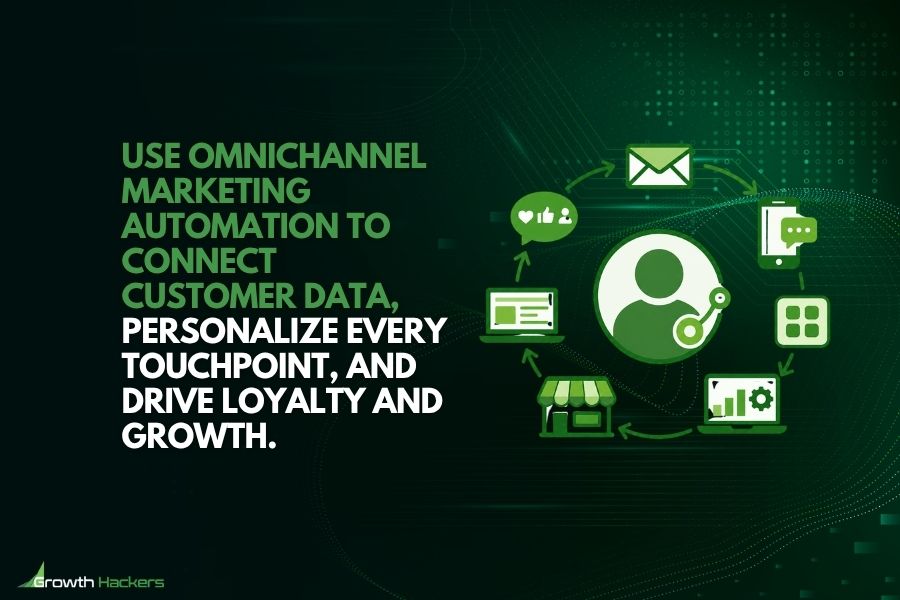
Modern customers rarely follow a straight path to purchase. They may discover your brand through social media, compare products on your website, visit one of your physical stores, read customer reviews, receive an email, and finally complete their purchase through a mobile app.
This shift in buying behavior has made omnichannel marketing automation a critical strategy for businesses that want to deliver connected, personalized experiences. According to a Harvard Business Review study of more than 46,000 shoppers, 73% of consumers use multiple channels during their shopping journey, highlighting the growing importance of creating seamless interactions across every touchpoint.
Unlike traditional multichannel marketing, which often manages each channel independently, omnichannel marketing automation connects customer data, technology, and messaging into one coordinated system. It enables businesses to deliver relevant communications based on customer behavior while maintaining a consistent experience across digital and physical channels.
At Growth Hackers, we’ve worked with organizations that initially believed implementing new software would solve fragmented customer experiences. In many cases, the real challenge was disconnected customer data, inconsistent processes, and the absence of a clear strategy. Once those foundations were in place, automation became significantly more effective, allowing businesses to engage customers more efficiently and scale their marketing efforts with confidence.
In this guide, we’ll show you how to build an effective omnichannel marketing automation strategy, from creating unified customer profiles and mapping customer journeys to selecting the right technology, measuring performance, and continuously optimizing your campaigns for long-term growth.
Define Your Strategic Goals Before Automating
Many businesses jump directly into building workflows without first deciding what success actually looks like. Before launching any marketing automation initiative, establish measurable business outcomes.
Typical strategic objectives include:
- Increasing qualified lead conversions
- Improving customer engagement
- Growing revenue from existing customers
- Increasing customer lifetime value
- Reducing customer acquisition costs
- Improving operational efficiency for marketing teams
Each objective should be tied to measurable key performance indicators, including:
- Conversion rate
- Average order value
- Revenue per customer
- Customer acquisition cost
- Retention rate
- Email click-through rate
- SMS response rate
- Pipeline contribution
- Return on marketing investment
Start With One Quick-Win Journey
Rather than automating dozens of workflows simultaneously, begin with a single high-impact journey.
For most organizations, abandoned checkout recovery or high-intent lead follow-up delivers measurable results within weeks. These journeys involve strong buying intent, making them ideal pilots for an omnichannel marketing automation strategy.
Early success also builds confidence across sales and marketing teams, making future automation projects easier to justify.
Strategic Rationale | Build Around the Customer, Not the Channel
Successful omnichannel marketing starts with adopting a genuine customer centric model.
Instead of optimizing each department independently, every marketing activity should support the customer’s goals throughout the buying process. Whether someone visits your website, walks in store, responds to social media ads, or speaks with your sales team, the experience should feel connected.
This customer-first mindset helps organizations create stronger relationships while improving long-term profitability.
Define Customer Lifetime and Revenue Goals
Every automation initiative should support measurable revenue outcomes.
For example, your organization may aim to:
- Increase annual revenue per customer by 20%
- Improve repeat purchase rates
- Extend average customer lifetime
- Increase cross-selling opportunities
- Reduce customer churn
Rather than focusing exclusively on new customer acquisition, prioritize sustainable growth that produces more loyal customers over time.
Set Customer Engagement Benchmarks
Each communication channel serves a different purpose.
Email may educate.
SMS may encourage immediate action.
A mobile app notification may drive repeat usage.
Meanwhile, social media builds awareness and encourages community participation.
Set realistic engagement benchmarks for every channel, then continuously optimize performance using historical campaign data.
Establish Customer Loyalty Targets
Automation should strengthen relationships, not simply generate more messages.
Consider setting measurable goals for:
- Repeat purchases
- Membership renewals
- Referral participation
- Product adoption
- Customer advocacy
A well-executed omnichannel marketing approach naturally strengthens customer loyalty, improves trust, and creates more predictable recurring revenue.
Data Foundation | Build a Single Source of Truth
Without reliable customer data, even the most sophisticated marketing automation platform will struggle.
Many businesses collect valuable information across CRMs, ecommerce systems, customer service software, analytics platforms, and social media. Unfortunately, these systems often operate independently, creating data silos that prevent teams from understanding the complete customer relationship.
Audit Existing Customer Data Sources
Begin by documenting every location where customer information currently exists.
Examples include:
- CRM
- Ecommerce platform
- Website forms
- Customer support software
- Loyalty programs
- POS systems in physical stores
- Analytics platforms
- Advertising platforms
- Mobile app
- Email platform
Understanding where your customer data lives is the first step toward building effective omnichannel marketing automation.
Centralize Data Into Unified Customer Profiles
Once sources have been identified, integrate data into a centralized customer platform.
Creating unified customer profiles allows every department to access consistent information, including:
- Demographics
- Purchase history
- Website activity
- Social media interactions
- Customer preferences
- Service history
- Communication history
- Engagement scores
These profiles become the foundation of personalized decision making throughout the entire customer journey.
Validate Consent and Communication Preferences
Compliance should never be an afterthought.
Ensure every profile clearly records:
- Email permissions
- SMS permissions
- Preferred communication channel
- Frequency preferences
- Regional compliance requirements
Consent-based communication improves deliverability while protecting customer trust.
Implement Identity Resolution and Deduplication
Many customers use different email addresses, devices, or phone numbers over time.
Identity resolution combines these records into a single profile, ensuring your marketing automation system understands that every interaction belongs to the same individual.
This significantly improves personalization while preventing duplicate communications.
Ready to transform every customer touchpoint with omnichannel marketing automation?
Contact Growth Hackers
Map and Prioritize Customer Journeys
Before building automation, understand how customers interact with your business.
A complete customer journey mapping exercise identifies every stage where customers move between online and offline touchpoints, helping teams recognize opportunities to automate meaningful interactions.
Typical stages include:
- Awareness
- Research
- Consideration
- Purchase
- Onboarding
- Product usage
- Support
- Renewal
- Advocacy
Each stage may involve different channels, including your website, social media, mobile app, in store visits, call centers, and email.
Rank Journeys by Business Impact
Not every workflow deserves immediate attention.
Prioritize journeys using factors such as:
- Revenue opportunity
- Operational complexity
- Customer frustration
- Automation readiness
- Available customer data
At Growth Hackers, we’ve found that organizations often see faster ROI by improving one critical customer journey exceptionally well before expanding into additional omnichannel campaigns.
Behavior-Based Journeys | Design Principles
Strong behavior based journeys react to what customers actually do rather than relying on fixed schedules.
Define Event Triggers
Common triggers include:
- Product viewed
- Cart abandoned
- Form submitted
- Quote requested
- Demo booked
- Mobile app installed
- Subscription renewed
- Support ticket closed
These events reflect actual customer behavior, making communication significantly more relevant.
Create Intelligent Branching Logic
Automation should adapt based on customer responses.
For example:
- Opened email?
- Visited pricing page?
- Downloaded a guide?
- Answered a sales call?
- Purchased?
Each action determines the next communication, creating personalized experiences instead of rigid workflows.
Add Suppression Rules
Good automation also knows when to remain silent.
Suppress communications after:
- Purchase completion
- Unsubscribe requests
- Existing support cases
- Duplicate campaigns
- Recent communications exceeding frequency limits
This helps maintain a consistent customer experience while preventing message fatigue.
Example Journey | Lead Conversion (Behavior-Based)
One of the highest-performing examples of omnichannel marketing automation is lead qualification.
A simple workflow may look like this:
- Trigger when a prospect submits a high-value form.
- Score the lead using behavioral and demographic data.
- High-intent prospects receive an immediate sales call.
- If unanswered, send an email SMS reminder sequence.
- Notify the assigned sales representative with complete customer context.
- Continue nurturing lower-intent prospects through educational content.
Because every step responds to customer behavior, sales conversations become more timely and relevant.
Cross-Channel Orchestration | Deliver a Consistent Customer Experience Everywhere
Building effective omnichannel marketing automation is not simply about connecting software. It is about creating a coordinated communication strategy that helps customers interact with your brand naturally regardless of the device or channel they choose.
Many organizations still operate with separate email, advertising, sales, and customer service teams. While each department may perform well individually, customers often receive disconnected experiences because every team works from different information.
Successful omnichannel marketing eliminates these gaps by coordinating communication across channels and ensuring every interaction contributes to one seamless relationship.
At Growth Hackers, we encourage businesses to think of every customer conversation as part of a larger system rather than an isolated campaign. This shift often produces immediate improvements in engagement without increasing marketing spend.
Assign a Clear Role to Every Channel
Every communication channel should have a defined purpose.
For example:
- Email delivers educational content, newsletters, promotions, and lifecycle updates.
- Email SMS sequences provide urgent reminders and time-sensitive notifications.
- Social media supports awareness, engagement, and community building.
- Your mobile app encourages product usage and customer retention.
- Sales representatives handle complex conversations requiring human interaction.
- In store associates continue conversations that began online.
- Customer support resolves issues while identifying opportunities for future engagement.
When every channel performs a specific function, marketing automation becomes easier to manage while improving the overall customer experience.
Create Consistent Messaging Across Every Customer Segment
Customers should recognize your brand whether they receive an email, visit your website, engage through social media, or walk in store.
Maintaining consistent messaging strengthens trust while improving brand consistency throughout the buying process.
Develop messaging templates based on:
- First-time visitors
- Returning visitors
- Existing customers
- High-value accounts
- Recently inactive customers
- VIP members
Because not all customers have identical needs, personalization should always reflect customer intent rather than applying the same message to every audience.
Apply Frequency Caps and Quiet Hours
One of the fastest ways to reduce customer satisfaction is sending excessive communications.
Your marketing automation platform should automatically enforce:
- Maximum emails per week
- SMS sending limits
- Quiet hours based on customer location
- Campaign prioritization
- Duplicate prevention
These controls help deliver relevant communication without overwhelming customers.
Build Channel Fallback Logic
Customers do not always respond through their preferred channel.
For example:
- Send an email first.
- If unopened after 24 hours, send an email SMS reminder.
- If no engagement occurs, retarget through social media ads.
- Notify a sales representative for high-value opportunities.
This type of cross channel orchestration allows businesses to continue conversations naturally while avoiding repetitive communication.
Automation Tools & Tech Stack Selection
Technology should support your marketing strategy, not dictate it.
There are hundreds of marketing automation tools available, but selecting software before defining business objectives often leads to unnecessary complexity.
Instead, begin by identifying the capabilities your organization actually requires.
Essential Features to Look For
Effective automation tools should include:
- Real-time customer profiles
- Journey orchestration
- Event-based triggers
- Audience segmentation
- AI-assisted recommendations
- Multi-touch attribution
- Reporting dashboards
- API integrations
- Consent management
- Workflow builders
Organizations running sophisticated omnichannel campaigns should also prioritize platforms capable of supporting online and offline customer interactions.
Evaluate Core Technology Components
Most enterprise solutions include three major components.
Customer Data Platform (CDP)
A CDP centralizes customer data, creates unified customer profiles, and continuously updates every interaction.
Without this foundation, omnichannel marketing automation quickly becomes fragmented.
Journey Builder
Journey builders automate workflows based on customer actions.
Instead of relying on scheduled campaigns, they react to real-time customer behavior, allowing businesses to send personalized messages at exactly the right moment.
Messaging APIs
Messaging APIs connect communication channels including:
- SMS
- Push notifications
- Mobile app notifications
- Live chat
Together these systems allow organizations to communicate across multiple channels without manually coordinating campaigns.
Evaluate Vendor Coverage
When comparing vendors, consider:
- Channel availability
- Integration capabilities
- Reporting depth
- Workflow flexibility
- AI capabilities
- Customer support
- Pricing transparency
- Future scalability
Selecting software that supports both current requirements and future growth prevents expensive platform migrations later.
Verify Deliverability and Compliance
Technology should also protect your reputation.
Before implementation, verify:
- Domain authentication
- Spam monitoring
- Consent management
- Regional privacy compliance
- Bounce management
- Unsubscribe handling
Reliable marketing platforms improve campaign performance while protecting sender reputation.
Personalization and Dynamic Content
Customers increasingly expect brands to understand their preferences. Personalization is no longer limited to inserting someone’s first name into an email. Modern omnichannel marketing automation uses real-time signals to deliver personalized experiences throughout the buying process.
Research shows that 71% of consumers expect companies to deliver personalized interactions, while 76% become frustrated when those expectations are not met. This makes it essential for businesses to leverage customer data and automation to deliver timely, relevant experiences instead of generic campaigns.
Create Intelligent Audience Segments
Segment customers using information such as:
- Demographics
- Geographic location
- Buying frequency
- Interests
- Engagement level
- Purchase history
- Device usage
- Product ownership
This allows businesses to send relevant messages instead of generic promotions.
Build Dynamic Templates
Dynamic templates automatically adapt content based on customer attributes.
Examples include:
- Recently viewed products
- Local promotions
- Industry-specific messaging
- Language preferences
- Loyalty tier
- Account status
This allows organizations to engage customers with communications that feel timely rather than automated.
Recommend Products and Services
Recommendation engines analyze previous purchases, browsing activity, and behavioral signals.
Instead of promoting identical offers to every customer, marketing automation delivers suggestions that align with individual interests.
These recommendations often improve conversion rates while encouraging additional purchases through personalized upsell campaigns.
Measurement | KPIs, Customer Lifetime Value and Analytics
Every omnichannel automation initiative should produce measurable business outcomes.
Without reliable measurement, organizations cannot determine whether automation is improving performance or simply increasing activity.
Define Journey-Level Success Metrics
Each workflow should include clearly defined objectives.
Examples include:
- Conversion rate
- Revenue generated
- Response rate
- Sales-qualified leads
- Recovery rate
- Time to purchase
- Average order value
Monitoring these key metrics helps identify opportunities for continuous improvement.
Measure Incremental Business Impact
Instead of evaluating individual campaigns, measure how automation contributes to broader business growth.
Track improvements in:
- Customer lifetime value
- Customer acquisition efficiency
- Revenue per customer
- Pipeline contribution
- Engagement growth
Looking beyond isolated campaigns provides a more accurate picture of long-term performance.
Continuously Run A/B Tests
Optimization never stops.
Test variables including:
- Subject lines
- Call-to-action buttons
- Timing
- Channel sequence
- Images
- Landing pages
- SMS copy
- Offer structure
Even small improvements across multiple workflows can significantly increase the overall effectiveness of your marketing automation program.
Build Executive Dashboards
Leadership teams need visibility into performance across the entire organization.
Dashboards should combine data from CRM, analytics platforms, advertising systems, and marketing automation software into one reporting environment.
Rather than measuring individual campaigns in isolation, organizations gain a complete understanding of how omnichannel marketing contributes to revenue growth.
Build a high-performing omnichannel marketing automation strategy today.
Work with Growth Hackers
Implementation Roadmap and Governance
Launching omnichannel marketing automation successfully requires more than building workflows. It requires clear ownership, realistic timelines, and continuous optimization. Businesses that try to automate everything at once often create unnecessary complexity and struggle to maintain quality as new campaigns are introduced.
A phased rollout allows teams to validate assumptions, measure results, and improve each stage before expanding.
Create a Phased Rollout Plan in 4 Phases
Divide implementation into manageable phases.
Phase 1 | Data Readiness
Begin by consolidating customer data, removing duplicate records, validating consent, and creating reliable unified customer profiles.
Phase 2 | Pilot Journey
Launch one high-value automation such as lead nurturing or abandoned checkout recovery. Focus on measurable business outcomes rather than the number of workflows deployed.
Phase 3 | Expand Across Channels
Once the pilot produces consistent results, extend automation across channels, including social media, your mobile app, CRM, customer support, and in store experiences.
Phase 4 | Enterprise Optimization
Introduce AI-powered recommendations, predictive segmentation, advanced attribution, and additional omnichannel campaigns based on proven success.
Assign Clear Ownership
Every successful marketing automation program has clearly defined responsibilities.
Typical ownership includes:
- Marketing Operations: workflow creation and optimization
- CRM or Data Team: profile management and data quality
- Sales: lead follow-up and qualification
- Customer Success: onboarding and retention
- IT: integrations and security
- Compliance: privacy and consent governance
Cross-functional collaboration ensures every department contributes to a stronger customer experience rather than operating independently.
Schedule Weekly Optimization Reviews
Automation should evolve continuously.
Review performance every week by examining:
- Journey conversions
- Engagement by channel
- Sales feedback
- Funnel progression
- Deliverability metrics
- Workflow failures
These regular reviews help marketing teams identify opportunities for continuous improvement while keeping automation aligned with business goals.
Compliance, Deliverability and Risk Controls
The most effective omnichannel marketing automation programs protect both customer trust and brand reputation.
Compliance should be built into every workflow from the beginning rather than added later.
Implement Consent-First Communication
Every workflow should verify customer consent before sending messages.
Whether communicating through email, email SMS, or your mobile app, customers should always control how and when they receive communications.
Consent-first processes improve trust while supporting long-term customer retention.
Automate Suppression Rules
Suppression logic prevents unnecessary communication.
Automatically stop messages when customers:
- Complete a purchase
- Unsubscribe
- Request no further contact
- Enter another active workflow
- Exceed communication frequency limits
These safeguards help deliver consistent and respectful experiences while reducing customer fatigue.
Validate Technical Deliverability
Strong technical foundations improve campaign performance.
Review:
- SPF records
- DKIM authentication
- DMARC policies
- Dedicated sending domains
- IP reputation
- Bounce management
- List hygiene
Reliable deliverability ensures your marketing efforts reach the inbox instead of spam folders.
4 Common Mistakes and How to Avoid Them
Even well-funded projects can struggle if the fundamentals are overlooked.
1. Launching Without Unified Data
One of the biggest mistakes is attempting omnichannel marketing without first connecting customer information.
Fragmented systems create inconsistent communications because every platform sees only part of the relationship.
Prioritize clean, connected data before expanding automation.
2. Sending the Same Message Everywhere
Customers expect communication to match the context of each channel.
A detailed email should not simply become an SMS message or identical social media post.
Instead, adapt content while maintaining the same objective and consistent messaging.
3. Ignoring Suppression and Frequency Rules
More messages do not automatically produce better results.
Effective omnichannel automation respects customer preferences and communicates only when interactions provide genuine value.
4. Measuring Vanity Metrics
Open rates and impressions have value, but they should never become the primary measure of success.
Instead, prioritize business outcomes such as revenue contribution, qualified opportunities, customer retention, conversion rate, and improvements throughout the entire customer journey.
Scaling | From Pilot to Enterprise Omnichannel
Once the initial pilot demonstrates measurable ROI, organizations can confidently expand their omnichannel marketing automation strategy.
Scaling should always focus on repeatability rather than complexity.
Build Repeatable Playbooks
Document successful workflows so they can be reused across products, business units, and regions.
Include:
- Entry triggers
- Audience rules
- Messaging sequence
- Decision branches
- Exit criteria
- Reporting framework
Standardized playbooks reduce implementation time while maintaining quality.
Develop Dynamic Content Libraries
Instead of recreating every campaign from scratch, build reusable assets for:
- Welcome campaigns
- Lead nurturing
- Product launches
- Seasonal promotions
- Customer onboarding
- Renewal reminders
- Win-back campaigns
Reusable content helps organizations scale omnichannel marketing efficiently while preserving brand consistency.
Train Teams Around a Customer-Centric Operating Model
Technology alone cannot transform customer experiences.
Sales, customer support, operations, and marketing teams should all understand how automation supports the broader customer centric model.
When every department works from the same customer view, businesses create stronger relationships, improve operational efficiency, and build more loyal customers over time.
As automation matures, organizations can introduce more advanced behavior based journeys, predictive analytics, AI-powered recommendations, and deeper personalization without disrupting existing workflows.
Conclusion | Activate Growth With a Data-Driven Omnichannel Engine
Building effective omnichannel marketing automation is not about sending more messages. It is about creating meaningful customer relationships that evolve naturally throughout every stage of the buying process.
Organizations that invest in connected customer data, intelligent automation, and coordinated omnichannel marketing consistently outperform businesses that continue treating channels independently. By connecting online and offline, delivering personalized communications, and optimizing every customer journey, companies create stronger engagement, higher conversion rates, and sustainable long-term growth.
At Growth Hackers, a top-rated marketing automation agency, we have seen firsthand that the most successful automation initiatives begin with a focused pilot rather than a large-scale rollout. Once the foundation is in place, businesses can confidently expand across channels, improve operational efficiency, and deliver a seamless customer experience that strengthens trust and drives measurable business results.
Whether your goal is improving lead conversion, increasing revenue, creating more repeat customers, or building a scalable omnichannel marketing strategy, success starts with the right roadmap.
Our team helps businesses audit their data infrastructure, eliminate disconnected systems, implement scalable marketing automation, and design high-performing omnichannel automation programs tailored to their growth objectives.
If you’re ready to modernize your marketing strategy, improve customer experiences, and build a sustainable omnichannel marketing automation strategy, contact us now.
Let’s start with a collaborative roadmap workshop. Together, we’ll align your data, customer journeys, automation technology, and growth objectives to build an omnichannel marketing automation engine that continues delivering value long after the first campaign goes live.