
Many businesses struggle to understand the difference between outsourcing and offshoring, especially when they’re looking to cut costs or improve operations. Offshoring means moving business operations to another country while keeping control in-house. Outsourcing refers to hiring a third-party company to handle specific tasks or processes, whether that’s locally or abroad. These two strategies aren’t the same, and each brings its own mix of benefits and risks, including the benefits of offshoring.
Your choice between offshoring and outsourcing really depends on cost savings, how much control you want, and your appetite for risk, as well as how it affects your company’s operations. Understanding how each approach impacts your operations, your offshore team, and your long-term direction will help you land on the right move for your company.
Key Differences Between Offshoring and Outsourcing
Offshoring and outsourcing mainly differ in who owns and controls the work, where it happens, and how much hands-on management you keep.
Definition and Ownership Structure
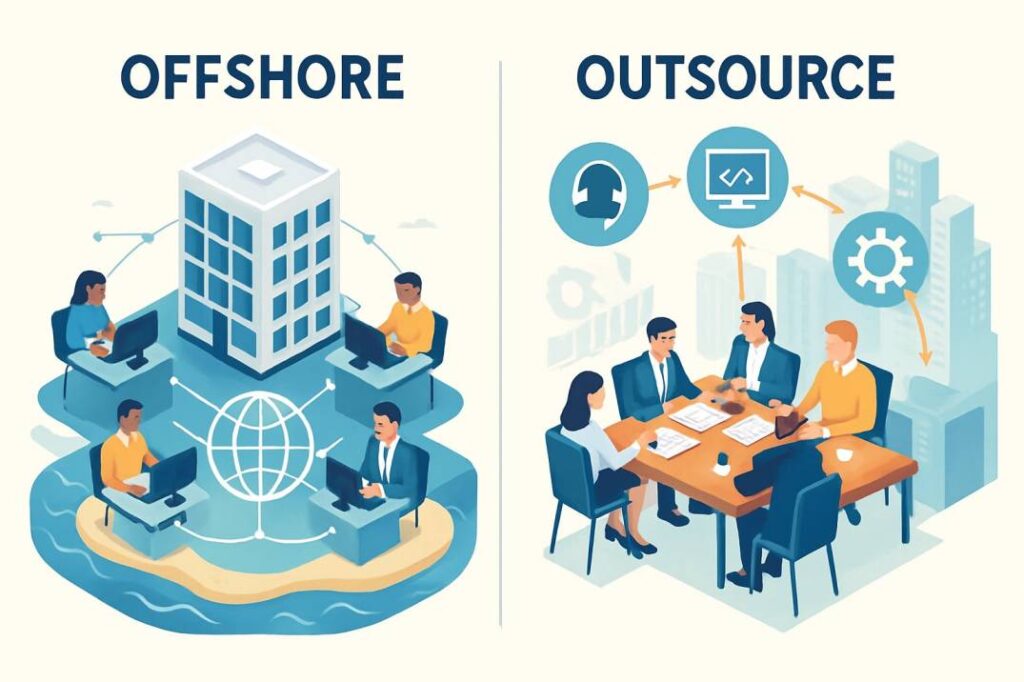
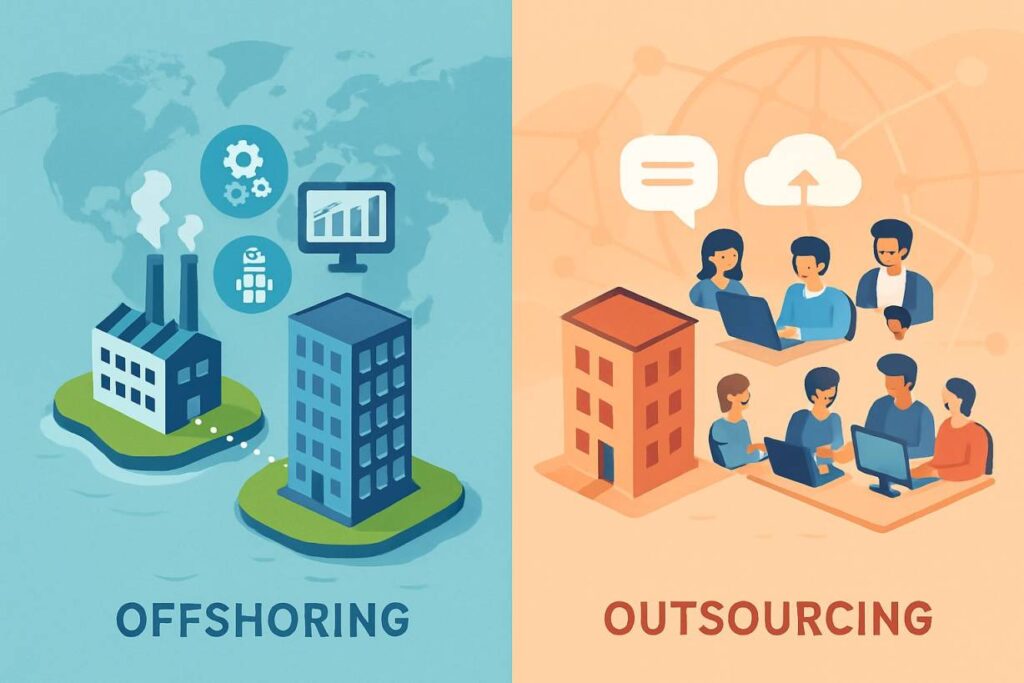
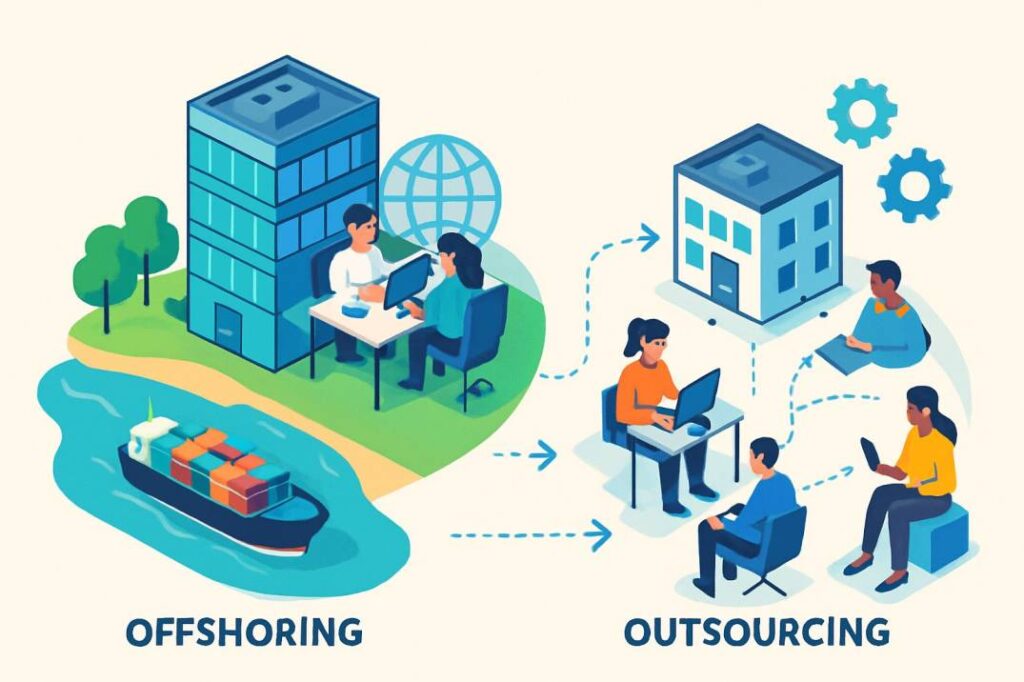
Outsourcing is about contracting tasks to an outside company. You hand over responsibility for those tasks, and the external vendor manages their own workers, processes, and systems. You pay for the service, but you do not directly supervise the people doing the work.
Offshoring is different because you keep ownership and control. You set up your own office or team in another country. You hire employees directly, decide how they work, and manage them as part of your company. The work happens abroad, but the control stays with you.
Business Process Outsourcing (BPO) is a mix of both outsourcing and offshoring. You outsource tasks to a company that operates in an offshore location. This model is common in industries like customer service, payroll, or IT support, where specialized offshore providers run large-scale operations for multiple clients.
Business Functions and Scope
Outsourcing works best for specific tasks that need specialized skills.
Common outsourced functions are:
- IT support and software development
- Customer service
- Accounting and payroll
- Marketing and social media
Offshoring usually means moving entire departments or major business processes.
Companies often offshore:
- Manufacturing operations
- Software development teams
- Customer support centers
- R&D divisions
Nearshoring is a middle ground. You offshore work to nearby countries that share similar time zones or cultures.
Some companies prefer to maintain control by building their own global team instead of depending only on vendors. This allows them to expand while keeping processes consistent across locations.
Control and Management
You lose some direct control when you outsource.
The external vendor decides how to complete the work and manages their staff. You communicate your needs, but they handle daily operations.
There’s less oversight, and making quick changes can be tough.
Offshoring gives you full control over your operations.
You set work schedules, pick management styles, and shift processes quickly. But you also have to build management systems to oversee offshore teams.
That takes more effort, but it lets you keep your company culture and standards.
Location and Talent Pool
Outsourcing gives you access to specialized skills, wherever they are.
Your vendor might be local, offshore, or spread out globally. They handle recruiting and training, so you benefit from their expertise without the hiring headaches.
Offshoring opens up specific regional talent pools.
You can tap into tech talent in Eastern Europe or manufacturing know-how in Asia. You handle your own recruitment and training, which takes more work, but gives you direct access to the talent you want.
Location flexibility is different, too.
Outsourcing vendors can change locations without you really noticing. With offshoring, you pick the specific country and region for your operations.
Want expert guidance on offshoring vs outsourcing decisions for your growing business operations?
Contact Growth Hackers
Strategic Considerations for Choosing Offshoring or Outsourcing
Cost-effectiveness, control, and risk tolerance shape this decision. Your company’s size, budget, and long-term plans all play a role.
Cost Savings and Operational Expenses
Initial setup costs vary a lot.
Outsourcing requires almost no upfront investment—you pay for services as you go. Offshoring demands higher initial expenses for overseas facilities, legal setup, and infrastructure.
Long-term savings depend on your scale.
Large companies often see better returns from offshore manufacturing after the first year. Small businesses usually gain more from outsourcing, since you avoid the fixed costs of running overseas operations.
Cost Factor | Outsourcing | Offshoring |
Setup costs | Low | High |
Monthly expenses | Variable | Fixed |
Break-even time | Immediate | 12-18 months |
Labor costs in countries like India or the Philippines can cut your expenses by 40-60%. Still, you have to factor in management overhead and communication costs.
Flexibility and Scalability
Outsourcing offers more flexibility for changing needs.
You can switch vendors or adjust service levels without much hassle. Remote work makes outsourcing ideal for seasonal spikes—think CRM support or ATS management during busy times.
Offshoring provides more business scalability for predictable, high-volume operations compared to a third party provider .
Manufacturing or software centers can expand more cost-effectively. Your ability to hire and train local teams determines how fast you can scale.
Countries with strong talent pools like Eastern Europe make scaling offshore easier. While companies outsource project-based work better, long-term, stable operations suit offshoring.
If your industry is volatile, outsourcing’s flexibility might beat offshoring’s fixed structure.
Quality Control and Data Security
Quality control really varies.
Offshoring gives you direct oversight of processes and standards. Your employees overseas stick to your company protocols, which cuts down on quality issues you might see with third-party vendors.
Outsourcing companies often have specialized expertise, but they might not align with your standards as closely. Service level agreements help keep quality in check, but it’s not always perfect.
Data security risks go up with outsourcing because multiple vendors might touch your sensitive info.
Your data passes through external systems, which can feel risky. Offshoring keeps data inside your company-controlled environment, so you maintain tighter security and compliance.
Industries like healthcare or finance need stricter data controls for their business activities .
Offshoring usually offers better security for regulated sectors. Intellectual property protection also tends to be stronger with offshoring, since your proprietary processes stay within your own walls.
Cultural Differences and Business Continuity
Cultural alignment affects communication and teamwork. Outsourcing vendors often work with clients worldwide, so they are used to bridging cultural gaps. Offshore teams may need more training to understand your company’s culture and communication style. Time zone differences can help or hurt depending on how you manage them.
Business continuity is another factor. Outsourcing spreads risk across vendors and locations, but it can also create dependency on external providers. Offshoring concentrates operations in one location. This can be efficient, but it also makes you more vulnerable to local risks like political unrest, natural disasters, or economic instability.
Many companies use a mix of offshore outsourcing and in-house teams to manage risk. They keep core functions close, offshore stable operations, and outsource specialized or short-term tasks. This spreads out risk while balancing cost and control.
Legal and Compliance Considerations
When you offshore, you are responsible for following the laws of the country where you set up operations. This includes labor regulations, tax rules, and business registration requirements. Some countries may have strict rules about hiring, benefits, or employee rights, and failing to follow them can lead to fines or legal trouble. You also need to think about international tax agreements and how profits will be reported across borders.
Outsourcing shifts much of this responsibility to the vendor. They handle employment contracts, payroll, and compliance with local labor laws. But you cannot assume everything is handled correctly. If the vendor breaks the law or mishandles sensitive data, your company could still face consequences. This is especially true in industries with strict regulations, like healthcare, finance, or government services.
Data protection is another major issue. Countries have different privacy laws, such as GDPR in Europe. With outsourcing, your data may pass through systems in multiple countries, which increases the risk of non-compliance. With offshoring, you can design your own systems and processes to meet legal requirements, but it takes more work to set them up.
Impact on Company Culture and Employee Morale
Decisions about outsourcing or offshoring affect more than just costs. They also influence how your employees feel about their jobs and the company. Some workers may worry that outsourcing or offshoring means fewer opportunities for them in the future. Others may feel disconnected if they have to work with teams in different time zones or cultures.
When you outsource, the vendor’s employees usually do not share your company culture. They follow their own company’s values and business practices. This can create a gap in how work is approached and how communication flows. It may also affect customer experience if outsourced team members interact directly with your clients.
With offshoring, you have more control over culture because the offshore team is part of your company. You can train them in your values and management style. Still, it takes effort to build a sense of unity across borders. Regular communication, team-building activities, and cultural training can help reduce misunderstandings and make offshore employees feel like a real part of the company
Unlock your business’s competitive edge with strategic offshoring and outsourcing solutions!
Work with Growth Hackers
Long-Term Strategic Fit
Your choice between offshoring and outsourcing should align with where you want your company to go in the future. If your plan is to expand into global markets, offshoring can give you a presence in those regions. Setting up operations abroad can also make it easier to serve local customers, understand the market, and build long-term stability.
Outsourcing works better if your main goal is flexibility and cost savings in the short to medium term. It lets you scale services up or down quickly without committing to heavy infrastructure or long-term investments. This is useful if your industry changes often or if you are not ready to commit to a permanent overseas presence.
Thinking long-term also helps you avoid costly mistakes. A company that outsources everything today but later decides to build its own offshore team may face disruption when switching models. On the other hand, a company that invests heavily in offshoring without a clear growth plan may struggle with high fixed costs. Aligning the model with your strategy makes the decision more sustainable.
Final Thoughts on Offshoring vs Outsourcing
Offshoring and outsourcing are both powerful strategies, but they serve different purposes. Offshoring gives you more control and long-term stability, while outsourcing offers flexibility and lower upfront costs. The right choice depends on your goals, budget, and how much oversight you want to keep.
No single option is perfect for every company. What matters most is aligning the model with your long-term vision and making sure it supports the way you want to scale, manage risk, and maintain quality.
If you want to take the next step and grow your business faster, smarter, and more sustainably, I recommend working with experts who know how to put these strategies into action. This is where Growth Hackers comes in.
Growth Hackers is a top-rated growth hacking agency trusted by businesses worldwide. We specialize in helping companies implement, execute, and deliver strategies like outsourcing and offshoring to maximize efficiency, cut costs, and accelerate growth. Our team of marketers, developers, designers, and growth experts has over a decade of experience scaling startups and established brands across industries. We don’t just advise—we partner with you to build systems that work, improve operations, and drive measurable results.
If you’re ready to see how outsourcing or offshoring can fit into your growth strategy, contact GrowthHackers today for a free audit. Let’s explore how we can help you outpace your competition and unlock new opportunities for your business.