
Operating costs are shifting from a model selection problem to an architecture problem, as more and more mobile applications now inherit on-device AI capabilities too.
With client devices sharing the processing load, scaling these apps from simple features to real-time assistants, recommendation engines, and autonomous workflows means cost control no longer depends on choosing a cheaper cloud model, but on how efficiently inference is distributed and executed across tiers.
Gartner projects that 55% of AI-optimized IaaS spending will support inference workloads this year, reflecting a broader industry shift from building models to operating them continuously in production environments.
For engineering teams, navigating this shift requires deliberately designing mobile AI architectures around four operational variables: where computation executes, which models process each task, how many inference cycles a request triggers, and how much context each operation consumes. Leaving these factors to default implementations is precisely what drives operational expenses out of control.
What Architectural Flaws are Inflating Mobile AI Operating Costs?
When mobile AI applications scale beyond basic text generation, cloud infrastructure bills rarely spike because of model licensing fees alone; they explode because of structural inefficiencies in how requests are handled. Unoptimized inference pipelines create hidden cost traps across four fundamental architectural bottlenecks:
1. Cloud-First Inference Forces Every Workload Through Expensive Compute Paths
The first generation of AI-powered mobile applications followed a simple architecture: keep the client lightweight and offload intelligence entirely to cloud infrastructure. While this simplified early development, treating every operation as a cloud inference task created a severe cost bottleneck.
Modern mobile applications run diverse workloads: from low-complexity tasks like local intent classification, search enhancement, and voice processing to heavy operations like multimodal image understanding and complex multi-step reasoning.
When a high-frequency, low-complexity interaction follows the exact same cloud pipeline as an advanced reasoning task, infrastructure costs explode unnecessarily. The core failure of cloud-first mobile AI isn’t using cloud compute; it’s assuming every workload requires the same centralized environment. Modern inference optimization must start with a fundamental routing question: Where should this workload execute?
2. Single-Model Architectures Apply the Wrong Level of Intelligence to Each Task
Organizations that move beyond cloud-only processing often fall into a secondary trap: using one massive foundation model to power every feature in the app.
Routing routine operations through a high-parameter model creates a severe mismatch between task complexity and compute capacity. Running simple tasks, like intent classification, keyword tagging, or basic data extraction, through a massive model forces organizations to pay maximum per-token prices for intelligence the task doesn’t need.
This single-model dependency inflates costs and degrades performance in 3 distinct ways:
- Over-Provisioned Compute Costs: You pay top-tier API rates for simple operations that require minimal reasoning.
- Latency Bottlenecks: Forcing time-sensitive UI interactions through heavy foundation models increases response times and degrades mobile UX.
- Resource Contention: Simple app features compete for the exact same high-memory cloud GPU instances as complex reasoning tasks.
When an architecture relies on a single model for all operations, infrastructure costs scale linearly with total app usage rather than with actual task complexity.
3. Agentic Workflows Multiply AI Operations Beyond Individual Requests
The cost structure changes drastically when mobile applications transition from having stateless, single-turn AI features, such as basic text summarization or inline translation, to autonomous agentic workflows.
Traditional mobile AI implementations rely on a single, deterministic interaction lifecycle:
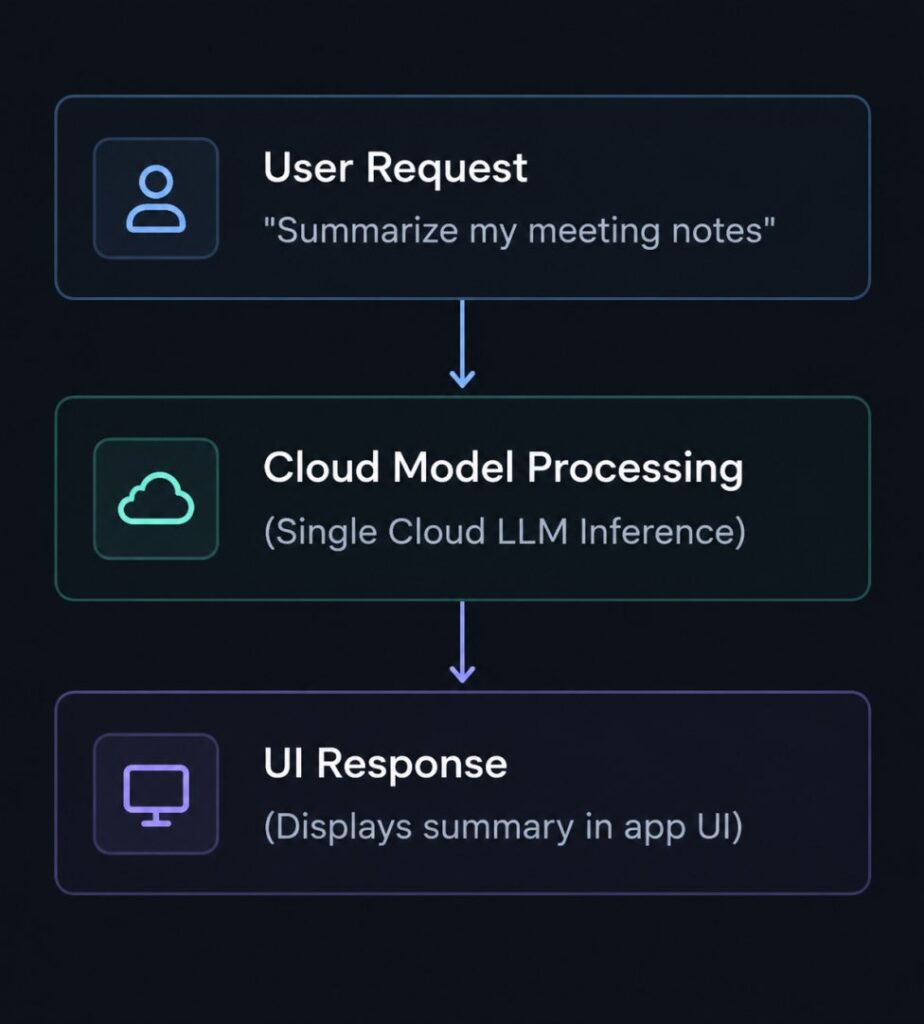
Agentic systems introduce multi-stage, non-deterministic execution loops where an agent plans, calls tools, evaluates intermediate output, and self-corrects:
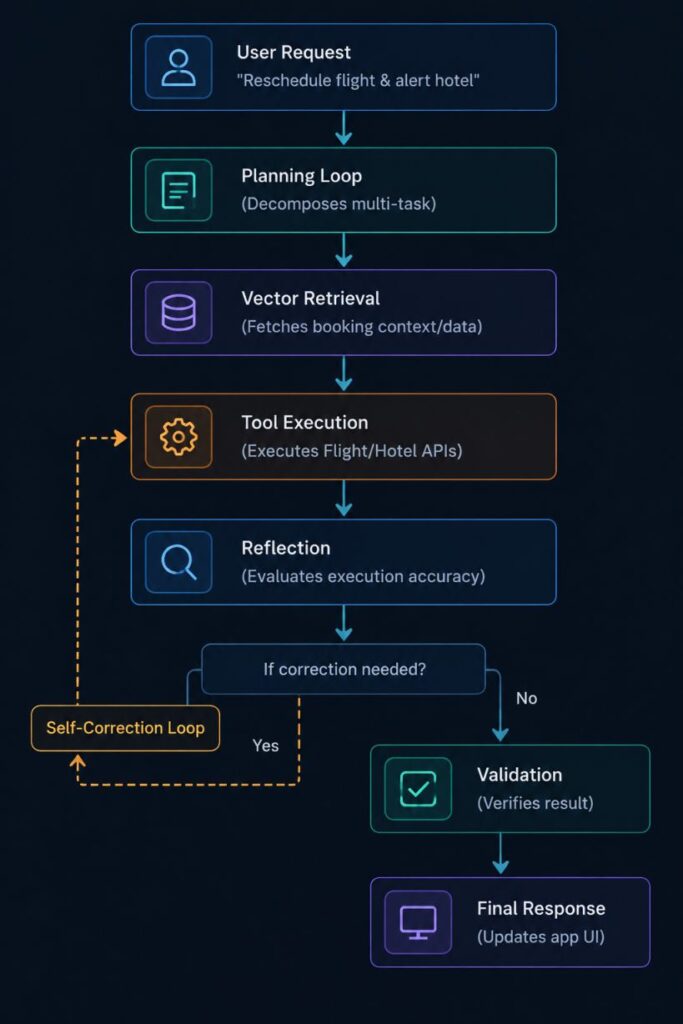
A single user action can now trigger multiple AI operations.
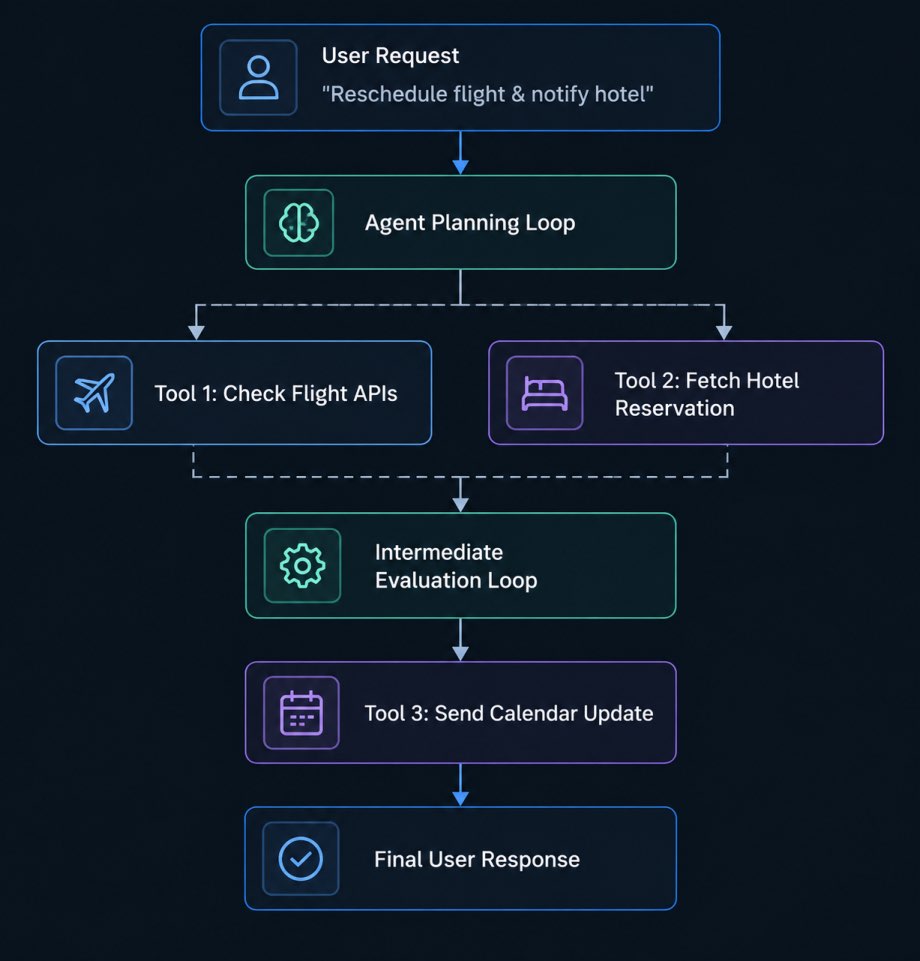
The financial impact of agentic execution stems directly from token inflation across iterative context windows. In an agent loop, the full conversation history, including system instructions, available tool definitions (JSON schemas), past tool outputs, and intermediate reasoning, must be re-sent to the Large Language Model (LLM) on every single iteration step.
| Execution Step | Input Tokens (Context + History + Tools) | Output Tokens (Reasoning/
Tool Call) |
Cumulative Input Tokens |
| 1. Planning | 2,500 | 150 | 2,500 |
| 2. Tool Execution (Flight API) | 2,800 | 200 | 5,300 |
| 3. Tool Execution (Hotel API) | 3,200 | 180 | 8,500 |
| 4. Synthesis & Response | 3,500 | 250 | 12,000 |
| Total Workload | 12,000 Input Tokens | 780 Output Tokens | 12,780 Tokens Total |
Because standard cloud model pricing charges per 1,000 or 1,000,000 tokens, an uncontrolled 4-step agent loop consumes over 4x the input tokens of a single direct inference request for the exact same end result.
Without strict architectural guardrails, increasing agent autonomy will scale server-side computing costs exponentially, not linearly.
4. Poor Context Management Makes Every AI Interaction More Expensive
As mobile applications become more personalized, context management directly dictates inference budgets. Modern AI applications process conversation histories, user state data, and retrieved enterprise documents. However, blindly expanding context windows introduces severe cost penalties.
Every redundant token added to a prompt increases latency, processing requirements, and direct API charges. Context engineering has become a mandatory discipline for filtering, compressing, and selecting only the information needed before generation begins.
Do you need assistance with your mobile architecture?
Work with Growth Hackers
How Modern AI-Agnostic Mobile App Architectures Control Operating Costs
1. Build Hybrid Inference Architectures to Place Computation Efficiently
The solution to cloud-only inference is not removing cloud intelligence altogether. It is creating a multi-tiered mobile AI architecture that dynamically routes computation across the client, the network edge, and centralized data centers.
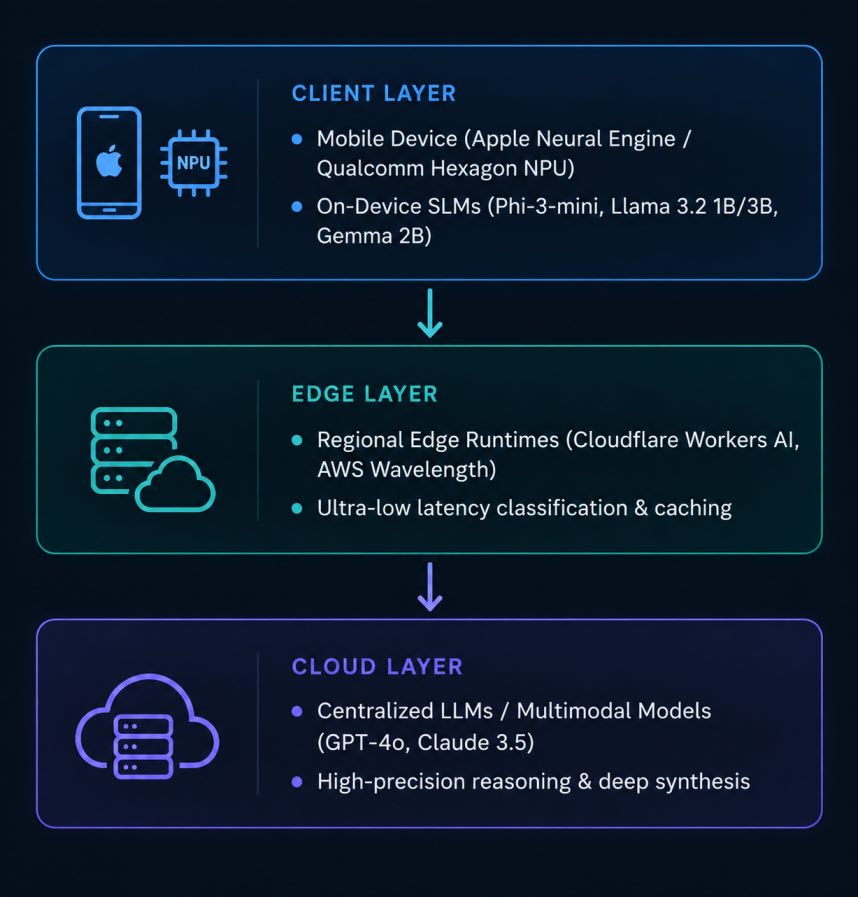
On-Device AI & Hardware Acceleration
Modern smartphones ship equipped with dedicated silicon designed specifically for matrix math: Neural Processing Units (NPUs) like Apple’s Neural Engine (ANE) and Qualcomm’s Hexagon processor.
By targeting these hardware accelerators, mobile AI applications can run fine-tuned Small Language Models (SLMs) locally at near-zero incremental marginal cloud cost.
To make local models fit within standard mobile RAM limits (typically reserving <500MB for background AI tasks), models undergo aggressive AI inference optimization pipelines:
- Quantization: Converting weights from FP16 (16-bit floating point) down to INT4 or INT8 integers, reducing memory footprint by up to 75% with minimal accuracy degradation.
- Structured Pruning: Removing redundant neural weights to speed up execution on NPU sub-cores.
- Hardware-Aware Compilers: Compiling models via frameworks like CoreML (iOS) or ExecuTorch / ONNX Runtime Mobile (Android) to directly utilize NPU instruction sets.
Edge AI
For workloads too complex for a mobile NPU but requiring sub-50ms responsiveness, Edge AI serves as the middle tier. Deploying lightweight inference models on edge computing platforms (e.g., Cloudflare Workers AI, AWS Wavelength, or Fastly Compute) places model runtimes physically close to mobile cell towers. This offloads compute overhead from centralized origin servers while avoiding high cloud egress charges.
2. Use an AI Gateway as the Control Plane for Model Selection
Addressing single-model inefficiency requires more than simply introducing additional models;it demands a unified control plane to govern how and when those models execute.
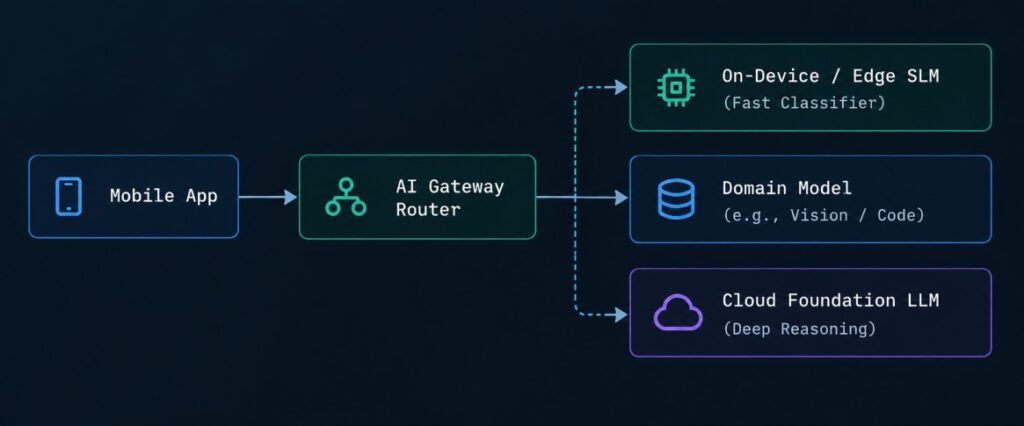
This unified control plane can be created with an AI Gateway that sits between your mobile client applications and back-end inference infrastructure, acting as an intelligent reverse proxy, dynamic router, and governance layer.
Dynamic Model Routing in Practice
Instead of hardcoding specific model endpoints into the mobile client, the application issues a single standardized request to the gateway. The gateway evaluates 3 primary parameters in real time before selecting an execution path:
- Semantic Complexity: A lightweight intent classifier checks whether the prompt requires multi-step reasoning or simple data extraction.
- SLA & Latency Constraints: Time-sensitive UI elements (such as search auto-complete) route to edge-hosted SLMs, while background tasks queue for batch cloud inference.
- Cost & Security Policies: Prompts containing sensitive PII are scrubbed or directed to private on-device models, while budget-capped features enforce strict token limits.
If a lightweight model returns a low confidence score or encounters an API error, the gateway handles automatic fallback escalation to a larger foundation model, rescuing the user experience without complicating mobile app code.
Centralized Cost Governance & Semantic Caching
Beyond routing requests, the gateway solves the tracking problem inherent to distributed mobile apps. Without a centralized proxy, monitoring token burn across millions of isolated app installations is nearly impossible.
The gateway acts as the financial dashboard for your AI infrastructure through 3 core mechanisms:
- Real-Time Token Tracking: Logs exact token consumption, latency, and cost per request grouped by mobile app version, specific feature, or user tier to catch runaway costs early.
- Gateway-Level Semantic Caching: Checks incoming prompts against a vector cache (e.g., Redis VL). Semantically duplicate user queries receive instant pre-computed responses directly from the gateway—dropping latency under 10ms and cloud inference costs to zero.
- Vendor Abstraction: Decouples mobile clients from vendor lock-in using unified interfaces (e.g., LiteLLM, Portkey). This lets engineering teams shift live mobile traffic to cheaper LLM providers instantly, without pushing a mobile app update.
By transforming model selection from a static client decision into a dynamic gateway function, engineering teams gain total visibility and control over their mobile AI unit economics.
Now is the time to utilize AI in your mobile architecture effectively!
Contact Growth Hackers
3. Deploy Agent Runtimes to Govern Autonomous AI Execution
Controlling agent costs requires moving from unconstrained reasoning loops to governed agent runtimes (such as state machine architectures built with LangGraph or Semantic Kernel).
A production agent runtime enforces 3 specific operational boundaries:
- Execution Budgets: Hard limits on maximum iteration steps (e.g., capping loops at 3 steps) and strict token caps per session.
- Deterministic Tool Routing: Pre-defining state transitions so common user intents follow deterministic code paths rather than relying on LLM reasoning for basic API invocation.
- Human-in-the-Loop Guardrails: Pausing automated reasoning loops for high-cost actions or sensitive data modifications until explicit user confirmation is received.
4. Optimize Context Engineering Through Retrieval and Information Management
Uncontrolled context expansion is one of the fastest ways to inflate cloud bills. Sending massive system prompts, full chat histories, and unstructured payload dumps with every user request unnecessarily drives up token counts.
Think cloud inference vs. on-device retrieval-augmented generation (RAG). While standard Cloud RAG stores enterprise knowledge bases in hosted vector databases (e.g., Pinecone, Qdrant, SingleStore), modern mobile architectures split retrieval into local vs. remote vectors to minimize infrastructure costs.
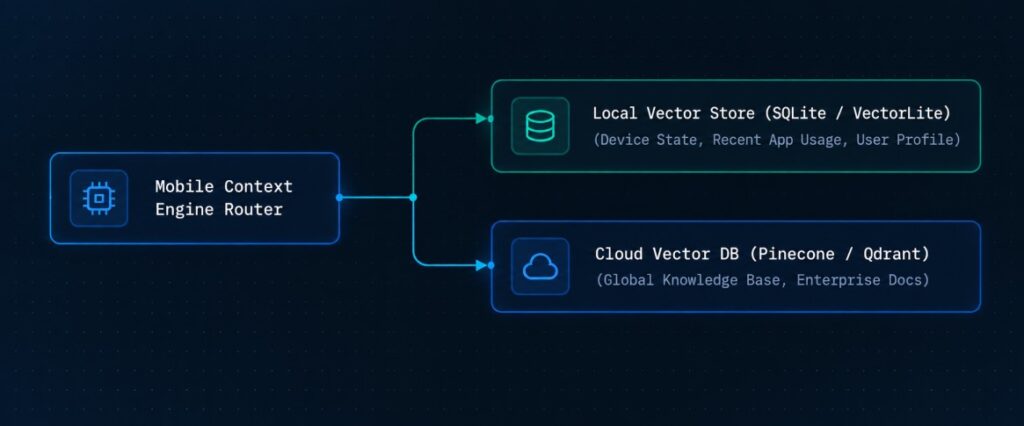
- On-Device Vector Search: For mobile apps managing personal content (e.g., user notes, recent transaction logs, app interaction history), embeddings can be generated locally using mobile-optimized embedding models (such as bge-micro or all-MiniLM-L6-v2) and stored inside embedded databases like SQLite with vector extensions (VectorLite) or Chroma Embedded. This eliminates cloud vector-query costs and ensures privacy.
- Cloud Vector Search: Reserved exclusively for deep enterprise domain knowledge, retrieving only a strictly capped set (e.g., top 3–5) of the most relevant semantic text chunks rather than dumping entire documents into the prompt context.
You can also explore more suitable context-pruning techniques. To maintain minimal token footprints without losing conversational accuracy, context management pipelines implement 3 core optimizations:
- Sliding Window Summarization: Instead of appending full raw histories, a micro-model periodically compresses older conversation turns into a concise system-state summary.
- Selective Context Pruning: Stripping out repetitive system prompt instructions, whitespace, and non-essential JSON fields before forwarding payloads to the model runtime.
- Semantic Reranking: Utilizing lightweight rerank models (e.g., Cohere Rerank or local Cross-Encoders) to rank retrieved knowledge snippets and drop low-relevance results before assembling the final prompt payload.
By treating context management as a rigorous engineering discipline rather than a raw text concatenation process, mobile teams can achieve identical (or superior) accuracy while cutting per-request token overhead by 50% to 70%.
The Takeaway | Architecture Will Determine the Economics of Mobile AI
The next generation of mobile AI applications will not succeed simply because they use more powerful models. They will succeed because they use those models efficiently. As AI systems become more autonomous and continuously active, engineering teams must optimize the above four architectural decisions.
The future of AI app development will depend on architectures that combine on-device AI, edge AI, cloud intelligence, intelligent AI model routing, controlled agent execution, and efficient context management. The organizations that scale mobile AI successfully will not be those that send every request through the largest model.
They will be those that build intelligent systems that allocate computation efficiently. In the AI-driven mobile era, architecture is no longer just a technical implementation decision. It is becoming the foundation for controlling performance, scalability, governance, and long-term operating costs.
Growth Hackers is a first-grade AI marketing agency helping clients in many industries:
- Software Development Agencies
- Pharmaceutical Companies
- Tech Startups (FinTech | AgTech | HealthTech | EdTech | RegTech | LegalTech | MarTech)
- Web3 & Blockchain Projects
- Mobile App Publishers
- B2C & B2B Saas Companies
Do you want to discover what our growth marketing services entail? Nothing easier. Just fill out our contact form. We’ll be happy to schedule a free consultation and prepare an action plan tailored to your business needs and goals.