
If you’re running a B2B SaaS tool, you should be tracking your competitor mentions on the web. Doing this shows you why people choose a tool, what frustrates them, and what they wish worked better.
For a B2B SaaS founder, those details help answer a practical question: which customers can your product serve especially well?
I’d look for the though process behind each comment/post about a competitor mention. A complaint about price can mean that a small agency pays for features it never uses. A complaint about setup can mean that a competitor is hard to signup for. Those are different needs, and each calls for different messaging.
This guide explains how to track competitor mentions, choose useful sources, and turn this into clear marketing copy. I’ll use a fictional client approval product called BriefDesk as a running example. Its competitors, AtlasBoard and SprintNest, are fictional too. All sample customer comments and product claims below are examples, not research findings.
Why B2B SaaS businesses should track competitor mentions
Your competitors’ websites show how they describe their products. Customer posts show how people experience those products. Reading both helps you understand what buyers value and which parts of their offer need more explanation.
For instance, a creative project manager might value detailed permissions because several departments share the same workspace. A small agency owner might find those same settings difficult when inviting a client to approve one design. And so on.
Find reasons people choose, stay, and switch
Read positive mentions alongside complaints. Customers who stay with a competitor can tell you which features they depend on, what they would miss, and why switching feels difficult.

For example, here is someone who’s asking if Papermark’s AI is any good. A simpler product with weak AI features will still be a poor fit. Your message needs to explain the benefit your product delivers and show the features that support it.
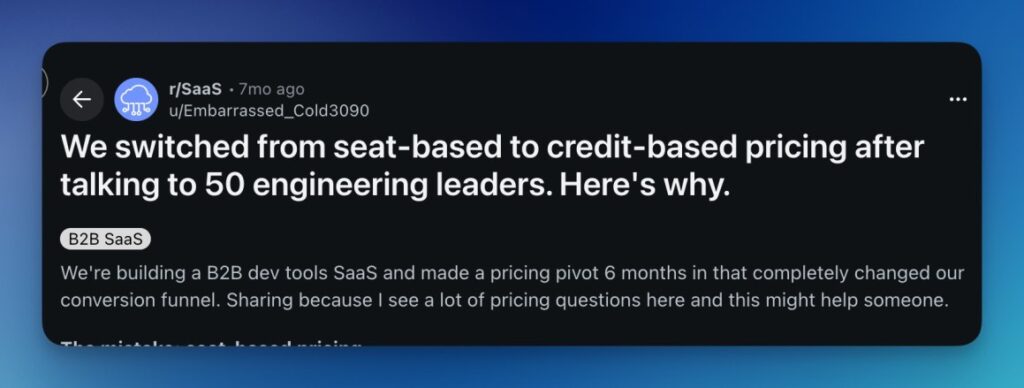
Switching posts are useful because they often describe the old process and the desired replacement.
Find a group with a shared problem
For BriefDesk, imagine several small agency owners asking how to get clients to approve work without creating another account. That gives you a specific group, a specific task, and a possible product advantage to investigate.
You can then check whether BriefDesk actually handles that task better. Does it offer approval links? Can clients leave feedback easily? Can the agency see who has responded?
Competitor research helps you choose what to investigate. It does not prove that your product is better or that the whole market shares one complaint.
Do you need help tracking your competitor mentions on social media and AI search results?
Contact Growth Hackers
How to track competitor mentions and choose your platforms
Start with 2 or 3 competitors that buyers genuinely consider alongside your product. Include tools your customers used before signing up. A spreadsheet or email process can also be an alternative, even though it has no competing brand name to monitor.
Search each competitor’s product name first. Read enough results to learn how people describe it. Then add useful variants, common misspellings, or specific phrases such as a product name followed by “alternative,” “pricing,” or “client access.”
Keep your research question narrow. BriefDesk wants to learn where small agencies struggle with client approvals. A list of every complaint about project management software would create too much unrelated work.
At Growth Hackers, we helped a SaaS client narrow competitor monitoring to the 3 platforms buyers mentioned most during sales conversations. By tracking high-intent terms around alternatives, pricing, and recurring pain points, we uncovered messaging opportunities that helped increase qualified conversions by 17% within 14 weeks.
Choose sources where your customers discuss the task
For an agency product, start by checking Reddit communities for agency owners and LinkedIn posts from people who manage client work. Look for detailed examples of approvals, feedback, and account access.
For products aimed at developers, public GitHub issues and Hacker News posts can show technical problems and setup questions. YouTube reviews and walkthroughs can show how someone uses a product. X can help you find reactions and follow-up replies.
Read specialist forums and software review sites too. Check G2 or Capterra manually when they contain useful reviews for your category. Keep these checks separate from a social listening tool’s supported sources.
For Slack, use communities you belong to and have permission to access. Monitoring depends on the workspace connection and available access. A tool cannot read every private group.
Start manually when you have no budget
You can also just search competitor names inside each platform. On Reddit, search within a relevant community, then check the original post and its comments. On LinkedIn or X (Twitter), look for the product name and read the surrounding discussion.
You can also try a Google search such as site:reddit.com "AtlasBoard" "client approval". Keep repeating the search with a different task or source when you don’t get results.
Google Alerts can add email updates when matching results appear in Google Search. When creating an alert, choose its frequency, source types, and other settings. Treat it as one source of web results. Use native platform searches for material it does not find.
Keep a simple research sheet. Record the source link, date, competitor, person’s role when known, task, praise or complaint, and the outcome they wanted. Add your own interpretation in a separate column so it stays distinct from the original wording.
Set 2 short review sessions each week. Search the same terms, save new examples, and group repeated problems. Manual work is a useful starting point when you have few competitors and time to check them.
Use social listening when repeated searches take too much time
A social listening tool collects matching mentions from its supported sources. You can check a feed of real-time keyword mentions instead of running the same searches in several tabs.
Once manual searches start taking too much time, Mentionkit’s rival product monitoring guide shows how to choose useful keywords, review posts in context, and decide when to reply.
And you still need to read the original posts. Automated matching and AI filtering can miss context. No tool catches every mention, so keep manual checks for important sources and review sites.
How to track competitor mentions
For this, you can use a social listening tool ideally one for B2B SaaS products. It tracks brand, keyword, and competitor mentions across sources including Reddit, X/Twitter, LinkedIn, YouTube, GitHub, connected Slack workspaces, and forums. AI filtering puts actionable mentions first.
For instance, BriefDesk wants to understand how small marketing agencies handle client approvals. The research goal is to learn what causes delays and what buyers expect from a simpler process.
- Set up your project. Create or select the project for your SaaS by adding the keywords you want to track. This should be atleast your own brand’s name and a few competitors.
- Choose relevant platforms. For this example, start with Reddit and LinkedIn. Add other platforms when you find a clear reason to monitor them.
- Describe useful mentions. Any good social listening tool these days will use AI to filter mentions. Use the relevance prompt feature of your tool to explain what kind of mentions you want. For example: “Prioritize posts from small marketing agencies about client approvals, guest access, client onboarding, and project setup.” Check the mentions and adjust the prompt if useful posts are missing or unrelated posts dominate.
- Read each mention in context. Filter the feed by competitor keyword or platform. See whether the author describes their own experience, asks a question, or repeats someone else’s findings.
Suppose you find a post saying, “Our clients keep asking where to approve the design.” Read the replies before assigning a meaning to it. The problem might be a hidden button, unclear email instructions, or a client who never received access.
Record the exact problem and the person’s context. A note such as “agency owner needs clients to find pending approvals” is more useful than a broad label such as “bad user experience.”
Look for independent examples of the same problem. Several reposts of one complaint still describe one person’s experience. Also save examples where the competitor solves the task well.
For one Growth Hackers SaaS client, we treated social listening like a radar system. Instead of reacting to every competitor mention, we filtered for conversations that matched real buyer pain points, helping the team cut irrelevant research and focus its messaging on the issues prospects actually cared about.
Keep research and replies as separate decisions. You can learn from a post without promoting your product. Reply when you can answer the question or provide relevant help, and make your connection to your product clear.
Now is the perfect time to track your competitor mentions in AI search results and socials!
Work with Growth Hackers
How to improve your SaaS messaging from competitor mentions
Messaging explains who your product helps, which problem it solves, and why someone should choose it. Your research gives you candidate problems and customer wording. You still need to check those ideas against what your product delivers.
Before you dive in, you need to collect the data from the research your social listening tool will provide you. You can dump this data inside ChatGPT/Claude and tell it summarize the data for you. This will give you an idea of why people choose you/your competitors and what makes you unique.
This data should be overall sentiment, what words people are using when talking about your competitors, platforms where they are most active on, etc.
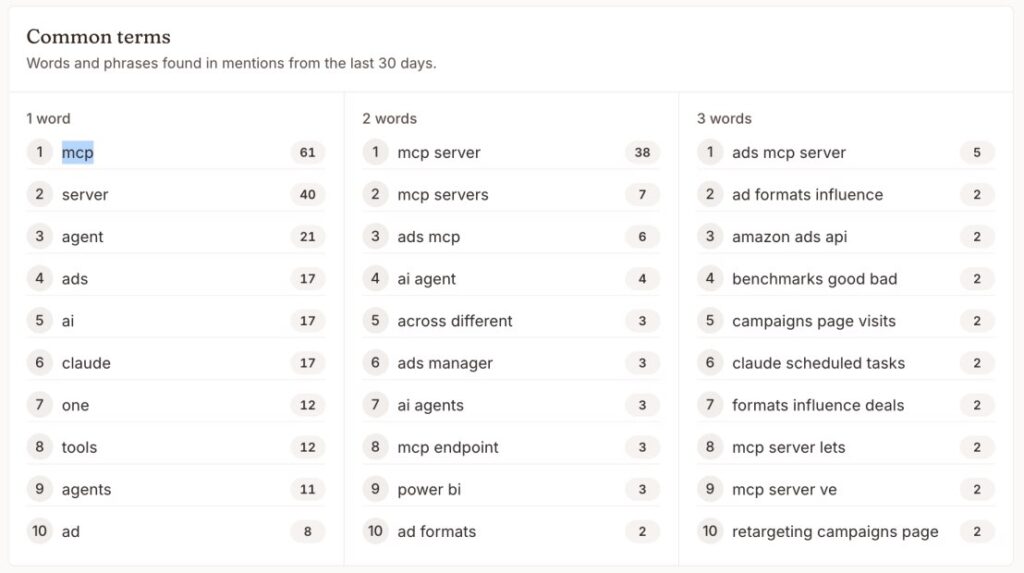
Alongside this you also need to have your own data by doing customer interviews. See why they choose you, what makes you different, etc.
Choose a niche your product can serve well
A useful niche combines a type of customer with a job they need done. “Small marketing agencies that need client approval on creative work” gives BriefDesk a clearer focus than “businesses that need collaboration.”
Check that the problem appears among people you can reach, that they pay to solve it, and that your product has a real advantage. This is because a narrow audience is useful because your marketing efforts can be concentrated into a 2-3 major marketing activities. Think sniper instead of shotgun.
April Dunford explains in her article on product differentiation that value depends on the customer’s context. The same feature can be useful to one group and awkward for another. Use that idea to find customers who care about the strengths your product already has.
Aim to become the best choice for that group’s main task. For BriefDesk, that means making client approvals easy to complete and easy for the agency to follow. It also gives you a clear rule for product work: prioritize changes that improve that task.
Test whether your chosen customers understand it
Show the revised page to people in the niche. Ask who they think the product is for, what it helps them do, and what they would expect after signing up.
Avoid explaining the headline before they answer. Their first reading shows which words are clear and which need work.
Compare their answers with your research notes and existing customer feedback. Then test one focused page change. Track qualified trial signups, activation of the relevant feature, and the questions people ask during demos.
Keep collecting competitor mentions after the rewrite. Over time, new pricing, product changes, and customer needs can change what people value. Use the new mentions to check whether your chosen niche still benefits from the promise you make.
Closing Remarks on Tracking Competitor Mentions
Competitor mentions help you understand how customers describe their problems, why they choose certain products, and what they still wish were easier.
- Choose 2, 3 competitors and a industry term you want to understand.
- Track their names on the platforms your customers already use via a social listening tool.
- Save useful posts and note the problem, desired result, and words they used.
- Get the keyword data from social listening and user interviews, and rewrite your landing page, or a product page.
- Keep tracking new mentions and see how your customer’s perception changes.
Even a small set of detailed conversations can help you sharpen your homepage, write copy that feels familiar to customers, and show the product details they care about.
Start with a few searches this week, keep the useful examples, and let the words your customers already use guide your next landing page rework.
Growth Hackers is a top-rated B2B SaaS marketing agency helping founders and entrepreneurs monitor competitor mentions on AI platforms (e.g. ChatGPT, Claude, Gemini, AI Overviews) and social media platforms (e.g. Reddit, LinkedIn, X…). We don’t stop there though. We then reverse engineer what worked for them and apply our findings to our clients. Besides competitive analysis, we also help B2B SaaS companies with:
- Demand Generation
- Lead Gen
- Growth Marketing
- SEO & GEO (Search & Generative Engine Optimization)
- Sales Funnels
- CRO (Conversion Rate Optimization)
- Ai-Powered Content Distribution
When we work with SaaS founders, we don’t bother tracking vanity metrics such as likes, followers, impressions, reach or clicks. Instead, here are the KPIs we monitor:
- CPL (Cost Per Lead)
- CAC (Customer Acquisition Cost)
- MER (Marketing Efficiency Ratio)
- CLV (Customer Lifetime Value)
- Churn Rate
Do you want to track your competitor mentions with laser accuracy? There’s almost nothing easier when you know what to do. If you’re lost, don’t worry about it. Just schedule a free consultation with us. This will go beyond a classic discovery call. We’ll actually take a deep dive on your SaaS product, your competitive landscape and ICPs to come up with a practical action plan and a 120-day roadmap. Does that pique your interest?