Introduction | Why AI Marketing Consulting Now
The AI market is moving faster than most businesses expected. What started as experimental automation has quickly become a competitive necessity across the marketing industry. From predictive analytics and customer segmentation to content creation and AI-powered campaign optimization, companies are now using AI to improve efficiency, personalize experiences, and accelerate revenue growth.
The challenge is that many businesses still do not know where to begin.
At Growth Hackers, we regularly speak with companies that invested in AI tools without a clear AI strategy. Some purchased multiple platforms that never integrated properly. Others experimented with generative AI content generation but failed to connect those efforts to measurable business goals.
The reality is simple. AI technology alone does not create growth. The real value comes from using AI strategically inside existing marketing processes.
That is where AI marketing consulting becomes essential.
A strong AI consulting partner helps businesses move from experimentation to execution. Instead of chasing trends, companies can focus on practical, revenue-focused systems that improve marketing performance, automate repetitive tasks, and support smarter data driven decisions.
In this guide, we will break down how AI marketing consulting works, what an AI marketing consultant actually does, how to evaluate the right partner, and how Growth Hackers helps businesses build scalable AI powered marketing systems that deliver measurable outcomes.
What is AI Marketing Consulting and Artificial Intelligence for Marketers
AI marketing consulting is the process of helping businesses integrate artificial intelligence into their marketing strategy, workflows, campaigns, and operational systems.
An experienced AI consulting partner identifies opportunities where AI can improve performance, reduce inefficiencies, and support revenue growth.
Artificial intelligence now influences almost every stage of modern marketing:
- Audience segmentation
- Personalized marketing
- Predictive analytics
- AI search optimization
- Content creation
- Customer engagement
- Campaign automation
- Data analysis
- Performance forecasting
At Growth Hackers, we see AI marketing as a combination of strategy, implementation, testing, and optimization. Successful AI consulting is not simply recommending software. It is about building systems that align AI technology with real business goals.
For example, one eCommerce company approached us after struggling with inconsistent campaign performance across multiple platforms. Their marketing teams were manually managing reporting, email personalization, and Google Ads optimization. After integrating AI powered tools and automating repetitive tasks, the company significantly improved operational efficiency while increasing customer engagement.
This is why AI marketing consulting has become such a valuable service for businesses in the market today.
The AI Market Landscape and Competitive Advantage
The AI market continues to expand rapidly as businesses race to integrate AI into their operations.
Companies that move early often gain a strong competitive advantage because they can:
- Optimize marketing faster
- Analyze customer behavior more accurately
- Reduce operational costs
- Improve personalization
- Scale campaigns efficiently
Meanwhile, businesses delaying AI adoption risk losing market share to faster-moving competitors.
One of the biggest shifts we are seeing at Growth Hackers is how generative AI and machine learning are transforming the speed of modern marketing workflows. Tasks that once required hours of manual effort can now be completed in minutes using AI powered automation.
However, early adoption alone is not enough. Businesses also need specialized expertise to ensure AI systems support long-term scalability.
We often recommend benchmarking against top competitors to identify:
- AI-powered customer experiences
- Automated marketing workflows
- Predictive campaign systems
- AI search visibility
- Personalized content strategies
Companies that use AI strategically gain a significant competitive edge because they can make faster, more informed decisions using real-time marketing data.
4 Benefits of Hiring an AI Marketing Consultant
Hiring an AI marketing consultant gives businesses access to strategic direction, implementation expertise, and scalable operational systems.
1. Faster ROI From AI Investments
One major advantage of AI consulting is reducing wasted investment. Many businesses purchase expensive AI marketing tools without a clear implementation plan.
An experienced consultant helps companies prioritize high-impact opportunities first.
At Growth Hackers, we often identify quick wins capable of improving efficiency gains within the first 60 to 90 days.
2. AI Powered Automation Improves Efficiency
AI powered systems help businesses automate repetitive tasks such as:
- Reporting
- Email workflows
- Lead scoring
- Data analysis
- Audience segmentation
- Campaign optimization
This allows marketing teams to focus on higher-value strategic work instead of repetitive execution.
3. Personalized Marketing at Scale
Using AI and machine learning, businesses can analyze customer behavior and deliver highly personalized marketing experiences across channels.
For example:
- Dynamic email recommendations
- Personalized website content
- Predictive product suggestions
- AI-powered customer journeys
These systems improve customer engagement while increasing conversion potential.
4. Faster Test-To-Learn Cycles
Traditional marketing campaigns often require long feedback loops. AI consulting accelerates experimentation by helping businesses analyze performance data faster and optimize campaigns continuously.
This creates more agile marketing systems capable of adapting quickly to changing customer behavior.
Want to elevate your strategy with expert AI marketing consulting?
Contact Growth Hackers
What an AI Marketing Consultant Does | From Strategy to Execution
A strong AI consulting engagement combines strategic planning with technical implementation.
Audit Existing Systems and Marketing Processes
The first step usually involves auditing:
- Existing marketing tools
- Customer data systems
- Campaign workflows
- AI readiness
- Business processes
- Reporting infrastructure
This helps identify inefficiencies and implementation opportunities.
Design an AI Strategy Aligned to Business Goals
Every AI strategy should support measurable business goals.
At Growth Hackers, we avoid generic recommendations. Instead, we map AI opportunities directly to revenue growth, operational efficiency, and customer acquisition objectives.
For example:
- Small businesses may prioritize content generation and automation
- Medium sized businesses may focus on predictive analytics and advanced segmentation
- Enterprise companies may require deeper AI integration across departments
Select AI Tools and AI Marketing Tools
The AI market contains thousands of solutions, but not every platform fits every operating model.
An experienced AI consulting partner evaluates:
- Integration compatibility
- Data security
- Scalability
- Ease of use
- Vendor support
- Long-term future needs
The right AI tools should support marketing efforts without creating unnecessary complexity.
Set KPIs and Reporting Cadence
AI implementation should always include measurable outcomes.
Growth teams typically track:
- Revenue growth
- Customer acquisition cost
- Conversion rates
- Engagement metrics
- Pipeline growth
- Retention metrics
Consistent reporting helps businesses make data driven decision making part of everyday operations.
How to Hire a Top-Notch AI Marketing Consultant | 4 Factors to Consider
Not all AI consulting firms deliver the same level of expertise.
Here are several factors businesses should evaluate before hiring an AI marketing consultant.
1. Request Case Studies With Measurable Outcomes
Strong AI consulting partners should provide case studies with concrete metrics.
Look for examples showing:
- Revenue improvements
- Efficiency gains
- Campaign performance lifts
- Customer engagement increases
- Marketing automation success
At Growth Hackers, we focus heavily on measurable outcomes because businesses need evidence that AI strategy recommendations actually work.
2. Verify AI Consulting Experience
Many agencies now claim to offer AI marketing services despite limited implementation experience.
Businesses should verify whether the consultant has hands-on experience with:
- AI powered projects
- AI workflows
- Machine learning systems
- Generative AI applications
- Data science integration
3. Ask for a Pilot Proposal
Pilot-first implementation reduces risk significantly.
Instead of overcommitting to large-scale deployments immediately, businesses should start with focused experiments tied to clear KPIs.
4. Check References Carefully
A great AI consulting partner should also support implementation and knowledge transfer.
Businesses need partners capable of helping internal marketing teams understand and maintain AI systems long term.
4 Engagement Models, Pricing, And Time-To-Value
AI marketing consulting can be structured in several ways depending on business size and complexity.
1. Retainer Engagements
Retainers provide ongoing strategic support and optimization.
This model works well for companies continuously integrating AI into multiple departments.
2. Project-Based Engagements
Project engagements focus on specific implementation goals such as:
- AI-powered campaign systems
- Predictive analytics deployment
- Customer segmentation
- AI search optimization
3. Fractional AI Consulting
Fractional consultants act as embedded strategic advisors without requiring full-time hires.
This model often works well for small businesses seeking specialized expertise affordably.
4. Pilot-First Budgeting
At Growth Hackers, we often recommend pilot-first budgeting because it helps companies validate commercial value before expanding implementation.
Typical pilot projects begin producing actionable insights within 30 to 90 days depending on complexity.
Building an AI Strategy and Roadmap
Strong AI strategy development starts with prioritization.
Businesses should map use cases based on:
- Revenue potential
- Implementation difficulty
- Resource requirements
- Operational impact
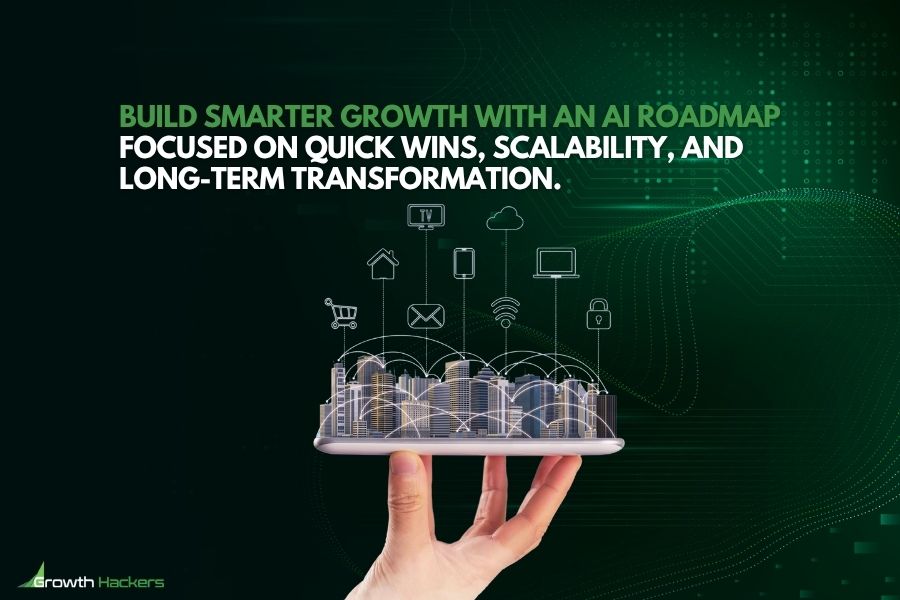
At Growth Hackers, we often divide AI initiatives into:
- Quick wins
- Mid-term scalability projects
- Long-term transformation systems
Quick wins help build organizational confidence while demonstrating measurable commercial value early.
Quarterly roadmap reviews are also important because AI technology evolves rapidly. Businesses need flexibility to adjust priorities based on changing market conditions and future needs.
AI Tools, AI Marketing Tools, AI Agents, And AI-Powered Workflows
Core AI Tools And AI Marketing Tools
There are many categories of AI tools businesses should evaluate.
Examples include:
- Content creation platforms
- Predictive analytics systems
- AI search optimization tools
- Automation software
- Customer segmentation platforms
- Reporting dashboards
- Conversational AI systems
At Growth Hackers, we score AI marketing tools based on:
- Integration readiness
- Security standards
- Scalability
- Workflow compatibility
- Data governance support
The best marketing tools simplify workflows instead of creating operational friction.
AI Agents and Automation
AI agents are becoming increasingly valuable for automating repetitive tasks inside modern marketing systems.
For example, businesses can build AI agents that:
- Generate weekly performance summaries
- Monitor campaign anomalies
- Automate lead routing
- Analyze customer behavior
- Support content generation
One practical example is an AI-powered reporting assistant that automatically gathers performance data from Google Ads, email campaigns, and analytics platforms before generating executive summaries.
These systems improve efficiency while reducing manual reporting workloads.
Selecting AI-Powered Marketing Platforms
Before selecting vendors, businesses should validate:
- Service-level agreements
- Security practices
- Model provenance
- Data ownership policies
- Integration flexibility
We also recommend trial integrations using first-party customer data whenever possible.
This allows companies to evaluate whether AI systems align with existing marketing processes before full deployment.
Unlock better ROI through strategic Ai marketing consulting.
Work with Growth Hackers
Harnessing AI Search and AI-Powered Marketing Channels
AI search is reshaping how users discover information online.
Businesses must now optimize for:
- Generative search snippets
- Conversational search behavior
- AI-powered recommendations
- Semantic search intent
At Growth Hackers, we help companies audit brand visibility inside AI search environments to determine how often their content appears in AI-generated responses.
We also run experiments measuring how AI-powered visibility impacts pipeline growth and lead quality.
This area of AI marketing is evolving quickly, making continuous experimentation especially important.
Measuring Impact | KPIs, Reporting, And AI Market Metrics
Successful AI consulting always depends on measurable performance tracking.
Primary KPIs often include:
- Revenue growth
- Customer acquisition cost
- Engagement rates
- Conversion metrics
- Retention performance
- Campaign ROI
Growth Hackers builds dashboards that provide real-time actionable insights for stakeholders across departments.
Monthly performance reviews also help businesses identify:
- Campaign opportunities
- Workflow inefficiencies
- Audience behavior changes
- AI optimization gaps
Consistent measurement allows companies to make smarter data driven decisions over time.
Risk, Governance, and Responsible Use of Artificial Intelligence
AI implementation also requires strong governance practices.
Businesses should establish clear rules around:
- Data privacy
- Model validation
- AI ethics
- Bias mitigation
- Incident response planning
At Growth Hackers, we encourage businesses to document validation procedures for all AI models used inside critical marketing systems.
Responsible AI adoption protects customer trust while reducing operational risk.
Companies using AI responsibly are far more likely to maintain long-term customer confidence.
Case Studies | Growth Hackers Digital Marketing Agency Results
One SaaS company approached Growth Hackers after struggling with inefficient content creation workflows and inconsistent campaign reporting.
We implemented an AI strategy focused on:
- AI-powered reporting automation
- Predictive analytics
- Content generation optimization
- Audience segmentation improvements
Within 4 months, the company reduced reporting time significantly while increasing qualified lead generation and improving overall marketing efficiency.
Another example involved a retail eCommerce brand seeking stronger customer engagement across multiple platforms.
Our AI consulting team deployed:
- Personalized marketing workflows
- Machine learning product recommendations
- AI-powered email automation
- Customer segmentation systems
Within 3 months, the brand achieved stronger retention performance and increased campaign conversion rates while reducing manual workload for internal marketing teams.
Supercharge Growth With Growth Hackers’ AI-Powered Marketing Solutions That Deliver
The AI revolution is already transforming how businesses approach marketing, customer engagement, automation, and revenue growth.
Companies that leverage AI effectively gain a lasting competitive advantage through faster decision-making, smarter personalization, and scalable operational systems.
Growth Hackers is an AI marketing consulting agency with a team of experts in AI strategy, digital marketing, machine learning, and AI-powered growth systems, helping businesses move from experimentation to measurable performance.
We focus on practical implementation, measurable outcomes, and scalable workflows that support long-term growth.
If your business is ready to integrate AI into your marketing strategy, optimize campaigns, and unlock new growth opportunities, schedule a discovery call with Growth Hackers today.
You can also start with a pilot engagement designed to deliver measurable commercial value within the first 90 days.