AI for growth marketing is the practice of using artificial intelligence and automation to plan and execute marketing campaigns.
Instead of relying on manual campaign testing and isolated tools, you can use AI to test ideas and analyze data. AI also helps personalize campaigns and automate workflows. This can help teams find new customers faster, improve campaigns, and grow revenue.
However, most AI usage is scattered across one-off tasks like writing ad variations or summarizing customer data.
This guide explains what using AI for growth marketing is and why it matters. You’ll also learn how AI drives growth across the sales funnel, including acquisition, conversion, and retention. I’ll cover the tools to use, how to measure ROI, and where to start.
What is AI for Growth Marketing & Why Does it Matter?
Using AI for growth marketing involves using machine learning and generative AI to improve the customer journey. It helps businesses find the right customers, personalize their experience, and increase revenue.
Rules-based automation follows a fixed script. For example, it can send an email after a purchase. AI goes further by finding patterns in customer data to make predictions and recommendations.
Done well, AI-powered growth marketing helps you find high-value customers and personalize experiences at scale. This can improve ROI and give you a competitive edge.
HubSpot found that 86.4% of marketing teams use AI this year. Only 1.7% don’t use AI or plan to. A third of marketers say AI saves them 15 hours of work per day. Here’s a quick breakdown of how much time AI saves per week on tasks like audience targeting and copy:
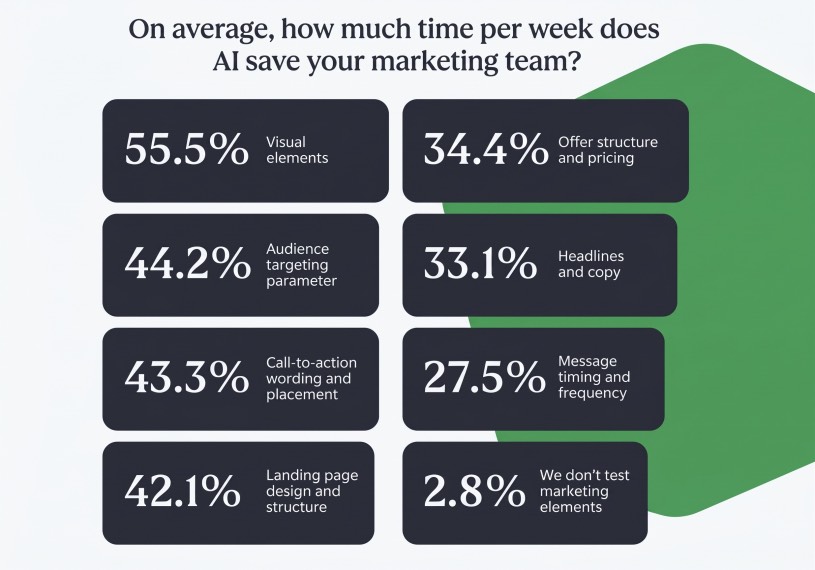
Automation can also help improve productivity. This gives you more time to test ideas and refine your AI marketing strategy.
What Does Using AI for Growth Marketing Mean?
It’s the process of using machine learning and generative AI tools to increase revenue across your funnel. This includes acquiring new customers, personalizing messaging, and retaining customers to increase long-term revenue.
Now is the time to integrate AI with growth marketing!
Work with Growth Hackers
How Does AI Drive Growth Across the Funnel?
AI helps you improve targeting when acquiring new customers. You can turn generic campaigns into personalized ones that are more engaging and increase conversions. Finally, AI tools help with churn prediction so you can spot at-risk accounts early and improve retention.
Acquisition | Reach the Right Prospects
AI-powered customer acquisition means using AI to find and attract people who are most likely to become customers.
AI analyzes data such as past purchases, website activity, and customer profiles. It can spot patterns that show which prospects are more likely to convert. This improves your lead generation strategy and helps avoid wasted ad spend.
AI is also reshaping search. This year, 85% of marketers said AI is changing their SEO. 88% already optimize for AI answers, according to Salesforce.
Engagement | Personalize at Scale
AI-driven personalization means that an AI model uses your customer data to tailor messages, offers, and content to each buyer.
Data such as products viewed and email clicks can show what interests a customer. AI can then recommend a relevant offer and help increase conversions.
You can extend this across email, social, and your website with customer engagement tools.
In fact, 88% of customers are more likely to buy after personalized real-time engagement, according to Twilio.
Retention and Revenue | Keep and Grow Accounts
At the bottom of the funnel, AI churn prediction can flag at-risk accounts early.
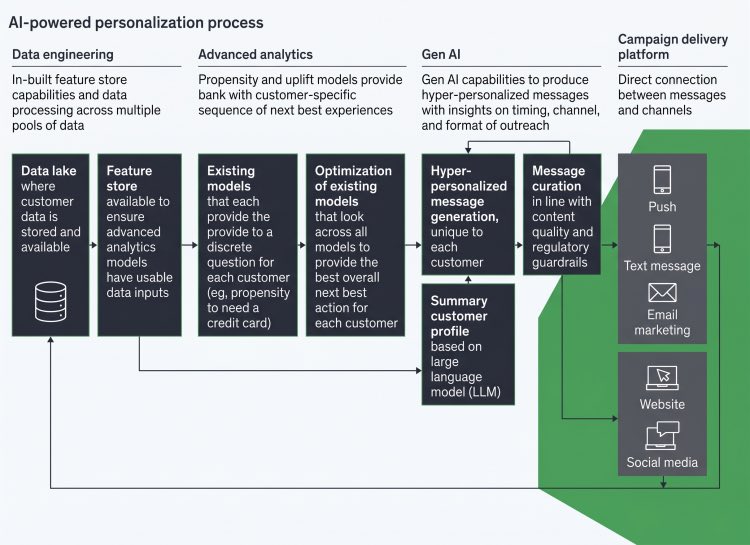
AI can also suggest the next best action, such as a service fix or relevant offer. McKinsey found this can increase revenue by 5% to 8% and reduce cost to serve by 20% to 30%.
McKinsey’s AI-driven revenue growth approach uses a next-best experience engine with four parts. These include data engineering, advanced analytics, generative AI, and a campaign delivery platform:
What Are the Benefits of AI for Growth Marketing?
AI can help you find better prospects, create more relevant campaigns, and spot customers who may churn. This can help you improve your strategy, retain more customers, and grow revenue.
What Are AI Growth Marketing Tools by Category?
AI growth marketing tools help teams automate tasks and analyze customer data. The right tool depends on what you need to improve. For example, WhenAvailable is the right productivity tool if you are going to schedule regular team meetings after a time that works for all participants to increase maximum participation. This can include content, lead scoring, ads, or customer retention. Here are the main categories and some tools to consider:
| AI Tool Category | What it Does for Growth | Example Tools |
|---|---|---|
| Content and SEO | Drafts, optimizes content, and structures for AI search | Jasper, SurferSEO, SEMrush, Ahrefs |
| Personalization and Lifecycle | Tailors email, on-site, and social journeys | HubSpot, Klaviyo, Mutiny, ActiveCampaign |
| AI Marketing Analytics | Scores leads and predicts churn | 6sense, MadKudu, Pecan AI |
| Ad and Creative Automation | Optimizes targeting and ad design | Meta Advantage+, Albert.ai, Smartly.io |
| Workflow Automation | Connects tools and handles repetitive tasks | Zapier, Make, n8n, Claude Code |
| Productivity and Group Meeting Scheduling | Find suitable meeting times to schedule group meetings | WhenAvailable, Doodle, When2meet |
Learn more about how generative AI can help create content, images, and reports from instructions. We break down how generative AI works, how it differs from automation, and where businesses can use it.
What Should You Consider When Choosing an AI Growth Marketing Tool?
Choose a tool based on what you need to improve. For example, use personalization tools to improve engagement. Check that the tool works with your existing tech stack. Then compare its costs and features before choosing.
How Do You Measure the ROI of Using AI for Growth Marketing?
Measure AI growth marketing ROI by comparing what changed after using AI with what it cost. One goal of AI-driven marketing optimization is to improve results without adding unnecessary costs. Look at the growth metric tied to the task, for example:
- Acquisition: Cost per qualified lead and conversion rate
- Engagement: Reply and conversion rates
- Retention: Churn and expansion revenue
Start with a baseline before using the tool. Then compare the results with a control group or your previous numbers. Finally, check whether the extra revenue or savings outweigh the tool’s cost.
How Do You Know If AI for Growth Marketing Is Worth the Cost?
Compare the results from your AI campaign with a similar group that didn’t use AI. If the AI group gets more leads, sales, or revenue, check whether that extra growth covers the tool’s cost. If it does, keep the tool. If not, cut it.
What Are the Pitfalls of AI for Growth Marketing?
Some common pitfalls include using customer data without consent and accepting AI output without review. They also include using AI without a clear goal:
- Using Customer Data Carelessly: Get consent before feeding customer data into AI models for analysis
- Trusting AI Output Blindly: AI can generate incorrect answers, so review its output before using it
- Using AI Without a Clear Goal: Set a clear goal, such as more leads, higher conversions, or lower churn, to avoid wasting time
What Should You Avoid When Using AI for Growth Marketing?
Avoid sharing customer data with AI models without proper consent. You should also check AI results before using them. Incorrect outputs can lead to poor marketing decisions and wasted time or money.
Do you want to implement an AI-powered growth marketing strategy?
Contact Growth Hackers
How Do You Get Started with Using AI for Growth Marketing?
Start small. Choose one marketing task you want AI to improve, pick a tool that fits it, and measure the result. Here are the steps I recommend:
- Choose One Task: Pick a problem such as low lead quality or high churn
- Pick a tool: Choose a tool that can help with that task
- Set a Baseline: Record your current results before using the AI tool
- Test it: Run the tool for around four to six weeks
- Review the Results: Keep, change, or drop it based on the results
What’s the Best Way to Start Using AI for Growth Marketing?
Say your team spends hours each week sorting sales leads. Start by using AI to rank those leads, then compare the results with your usual process.
If your team finds better prospects in less time, keep the tool. Then run the same test for other tasks like reducing churn.
FAQs
1. How is AI growth marketing different from traditional or performance marketing?
Performance marketing focuses on results from specific channels. AI growth marketing uses customer data to predict, personalize, and adjust actions across the funnel.
2. Which AI marketing tasks should I automate first?
Start with a high-volume task like content drafting or lead scoring. Test it with AI, then measure the results. If this works, you can automate other tasks.
3. How much data do I need to start using AI for growth marketing?
Pre-trained generative AI tools require no historical data for brainstorming and content creation. Predictive AI needs past data to find patterns, such as which leads become customers or which accounts churn.
AI for Growth Marketing | What Are the Key Takeaways?
AI for growth marketing means using artificial intelligence to automate tasks and improve marketing decisions. It can help teams find better prospects, personalize customer interactions, and spot accounts at risk of churn.
Successful teams don’t use the most tools. They use AI where it can improve a real growth metric, then build from what works. Start with one clear goal, run a measured test, and use the results to decide what to scale next.
Growth Hackers is recognized as one of the best Ai marketing agencies helping startups, small businesses and established companies combine growth marketing with GenAI. Since our inception back in 2016, we’ve worked with many industries but the ones we have the most experience with are:
- eCommerce Stores (Apparel & Fashion | Food & Beverage | Beauty & Skincare)
- Tech Startups (FinTech | EdTech | MedTech | AgriTech | LegalTech | RegTech)
- B2B SaaS Companies
- FinServ (Financial Services)
- Manufacturing Companies
- Law Firms
- Pharmaceutical Companies
- Software Development Agencies
- Healthcare Organizations
- AI Startups
- Recruitment Agencies
When we work with our B2C and B2B clients, we employ what’s called the “pirate metrics”. This is also known as the AARRR framework:
- Acquisition
- Activation
- Retention
- Referral
- Revenue
We don’t bother with vanity metrics. Instead, we only focus on KPIs that actually move the needle:
- CPL (Cost Per Lead)
- CAC (Cost Per Acquisition)
- AOV (Average Order Value)
- MER (Marketing Efficiency Ratio)
- ROAS (Return On Ad Spend)
- CLV (Customer Lifetime Value)
- NPS (Net Promoter Score)
When we combine growth marketing and AI, we focus on the full funnel. This includes:
- SEO and GEO (Search and Generative Engine Optimization)
- Content Marketing and AI-Assisted Content Distribution
- Digital Advertising
- Social Media Marketing
- Email Marketing Automation
- Digital Transformation
- Demand Generation and Lead Gen
- ABM (Account-Based Marketing)
- Integrated Marketing
Do you want to implement an AI-enhanced growth marketing strategy? Does that pick your interest? In that case, what you can do is book a strategy call with our team and we can take it from there.