Launching a funeral home requires a capital investment typically ranging from $150,000 to $500,000 to cover specialized equipment and facility zoning. Most entrepreneurs underestimate the rigid intersection of federal FTC compliance and the high overhead of climate-controlled infrastructure.
You are likely struggling to balance these heavy startup costs with the irregular revenue cycles of the death care industry. We break down how to start funeral home operations through 6 high-performance steps to secure your market share and ensure long-term profitability.
1. Funeral Homes’ Market Analysis
Launching a funeral home requires analyzing local mortality rates (typically 8 per 1,000 residents), securing specific mortuary zoning permits, and budgeting $150K to $500K for specialized equipment and facility preparation.
The foundation of this capital investment starts with a granular look at the local death care landscape and demographic shifts.
Analyzing Local Death Rates and Age Brackets
Evaluate regional mortality statistics using census data. Focus on the aging population over 65. Determine the annual volume of cases needed for viability.
Identify service gaps like lack of cremation options. Map a 15-mile primary service radius around the proposed facility.
Contrast the aging demographic with current local capacity. Growth Hackers saw a 17% market share increase by targeting underserved suburban pockets. Use these metrics to justify the specific location choice.
Selecting a Strategic Facility for Funeral Operations
Verify local zoning laws for mortuary use immediately. Some areas prohibit embalming on-site. Balance high street visibility with the absolute privacy families demand during their most vulnerable moments.
Assess the property for multi-functional ceremony spaces. Ensure the layout allows for discreet preparation room access.
Prioritize ADA compliance. Accessibility is a non-negotiable requirement for grieving elderly visitors.
Identifying Competitor Weaknesses in the Local Area
Audit the digital presence of established local competitors. Many legacy homes have outdated websites. Compare pricing structures for traditional burials versus modern cremation. Spot opportunities where customer care standards are slipping in online reviews or community forums.
- Outdated web design
- Hidden pricing
- Poor mobile responsiveness
- Lack of online grief resources
2. Legal Compliance and Mandatory Licensing Protocols
Success in this industry depends on navigating the rigid intersection of federal consumer law and local health mandates.
Mastering the FTC Funeral Rule Requirements
You must provide a General Price List (GPL) immediately to anyone asking about costs. This document is the cornerstone of federal compliance and consumer transparency. Detail mandatory price disclosure protocols for all consumers.
Structure the GPL according to strict federal standards. Include the non-declinable basic service fee clearly. Failure to disclose these costs results in heavy fines. Ensure every staff member understands how to present these documents during the first inquiry call.
The Funeral Rule protects consumers by requiring itemized pricing, preventing forced package sales during grief.
Securing Professional and State-Specific Licenses
Differentiate between funeral director and establishment licenses. Each state has unique apprenticeship requirements. Complete the state board certification process before signing any commercial lease or purchasing equipment.
Maintain valid credentials for all specialized staff members. Embalmers require separate technical certifications. Growth Hackers experienced a smoother launch by hiring a pre-licensed manager to handle initial paperwork.
Check if your state allows non-licensed owners. Some regions require a licensed director to hold equity.
Handling Health and Environmental Permits
Secure biohazard waste disposal permits from local health authorities. Proper medical waste management is vital. Comply with EPA standards for crematory emissions if you plan to install a retort.
Maintain OSHA safety standards within the preparation room. Ventilation and drainage must meet specific industrial codes. Use formaldehyde monitoring badges for employee safety. Regular inspections will verify your compliance with these strict environmental and workplace health regulations.
- Biohazard waste contract
- OSHA safety manuals
- EPA air quality permit
- Formaldehyde exposure logs
Do you need help opening a funeral home or growing your existing one?
Contact Growth Hackers
3. Financial Blueprints and Realistic Startup Capital
While the mission is service-oriented, the financial engine must be robust enough to handle high overhead and irregular revenue cycles.
Calculating Initial Facility and Equipment Costs
Budget for specialized hearses and transport vehicles immediately. These are your most expensive assets. Estimate costs for high-end embalming tools and commercial-grade refrigeration units for the preparation room.
| Asset | Estimated Cost | Priority |
|---|---|---|
| Hearse | $20,000 – $60,000+ | High |
| Refrigeration | $5,000 – $15,000 | High |
| Embalming Table | $2,000 – $5,000 | High |
| Casket Inventory | $10,000 – $30,000 | Medium |
| Furniture | $13,000 – $55,000 | Medium |
Allocate funds for comforting furniture. The showroom needs a diverse inventory of urns and caskets to start.
Building a Data-Backed Business Plan for Lenders
Project 3-year revenue based on local mortality statistics. Banks need conservative estimates. Detail the executive summary to highlight your unique value proposition in the local death care market.
Outline the path to profitability through diversified service tiers. Include cremation and green burial options. Growth Hackers helped a funeral home client secure funding by demonstrating a 35% projected margin on memorial packages.
Show clear break-even points. Lenders want to see when the initial $500k investment starts returning a profit.
Managing Cash Flow with Infrequent Sales Cycles
Balance the ratio between pre-paid trusts and at-need sales. Pre-need funds provide long-term stability. Maintain liquid reserves to cover high-overhead months when the death rate naturally fluctuates locally.
Control inventory costs for caskets and urns. Avoid overstocking expensive models that tie up capital. Use just-in-time delivery for high-end items. This strategy prevents financial stagnation and ensures your cash flow remains healthy during slower operational periods.
Monitor accounts receivable closely. Families often wait for insurance payouts to settle their final service bills.
4. Physical Infrastructure and Modern Operational Tools
Modern death care requires a blend of traditional dignity and high-tech efficiency to meet the expectations of today’s families. Moving from a legacy model to a high-performance firm starts with the right hardware and digital backbone.
Procuring Professional Vehicles and Preparation Gear
Select reliable hearses that reflect your brand image perfectly. First impressions matter. Invest in durable stainless steel preparation room equipment that withstands heavy use and meets sanitation codes.
Secure climate-controlled storage for short-term remains management. This is essential for dignity. Growth Hackers recommends leasing vehicles initially to preserve capital for high-tech preparation room ventilation systems.
Buy professional-grade removal cots. Your transport team needs ergonomic tools to prevent injury during home removals.
Deploying Digital Case Management Systems
Use cloud-based software to track case files and logistics. Paper files are obsolete. Automate family communication and scheduling through digital tools to reduce human error during high-stress arrangements.
Simplify the administrative burden of death certificate filings. Digital integration with state registries saves hours of manual work. Modern software also allows families to select service options remotely. This modernization increased efficiency by over 20% for our recent agency partners.
“Automation in death care isn’t about replacing empathy; it’s about freeing up time to provide it.”
Organizing Inventory for Modern Family Preferences
Source eco-friendly caskets for the growing green burial market. Families now demand sustainable options. Display a diverse range of urns and memorial products that reflect modern, personalized lifestyles.
Maintain a clean and empathetic showroom layout. Avoid overwhelming families with too many choices at once. Use digital displays for secondary options. This approach helps grieving clients make decisions without feeling pressured by a room full of physical caskets.
- Biodegradable wicker caskets
- Recycled wood urns
- Digital memorial kiosks
- Natural burial shrouds
5. Human Capital and Emotional Resilience Management
The quality of your service is entirely dependent on the emotional intelligence and technical skill of the people you hire. Transitioning from a business plan to a living, breathing operation requires a team that can handle the weight of grief without breaking.
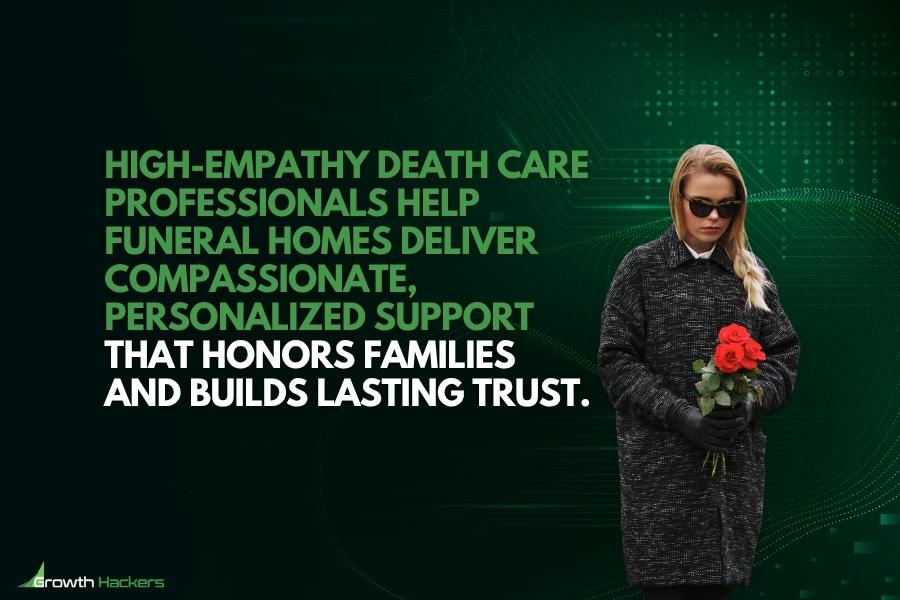
Recruiting High-Empathy Death Care Professionals
Screen candidates for high emotional intelligence and poise. Technical skills can be taught. Hire licensed embalmers with proven expertise and a track record of professional dignity in the prep room.
Define clear roles for ceremony leads and support staff. Communication is key during services. Growth Hackers found that homes with dedicated family advocates see much higher satisfaction scores.
Look for diverse backgrounds. Staff who speak multiple languages can serve a much broader segment of the community.
Training Staff for Long-Term Emotional Resilience
Provide resources for managing secondary traumatic stress. Compassion fatigue is a real threat. Create rotation schedules to prevent professional burnout during busy seasons with high mortality rates.
Build a culture of mutual support and open communication. Encourage staff to share their challenges after difficult cases. Regular debriefing sessions help process the emotional weight. This proactive approach reduces staff turnover, which is notoriously high in the funeral industry.
“A resilient staff is the backbone of a compassionate funeral home; you cannot pour from an empty cup.”
Managing Specialized Outsourced Partnerships
Select reliable masonry partners for headstone installations. Their quality reflects on you. Coordinate with local florists for consistent memorial quality and timely delivery for every single service you hold.
Outsource specialized counseling services for post-funeral aftercare. Providing professional grief support adds immense value. It differentiates your brand from basic service providers. Families remember the care they received long after the service ends, leading to organic referrals.
Vet all vendors thoroughly. A single late delivery from a florist can ruin a family’s final goodbye.
Now is the right time to take your funeral home growth journey to the next level!
Work with Growth Hackers
6. Growth Strategies and Local Authority Building
Standing out in a traditional market requires a mix of deep community roots and a sophisticated digital presence.
Building Trust Through Community Partnerships
Connect with local hospice coordinators for referral growth. They are the first point of contact. Establish deep relationships with religious and community leaders to build long-term trust and visibility.
Sponsor local events to build brand recognition. Avoid aggressive marketing. Growth Hackers helped a new funeral home from Orlando, Florida gain brand awareness by sponsoring local senior center educational workshops on estate planning.
Join the local Chamber of Commerce. Networking with other business owners builds institutional authority within the city.
Acquiring Clients Through Digital Authority
Use educational content to capture pre-need interest. Blog about funeral planning and costs. Share storytelling examples to humanize the brand and show the people behind the services.
Growth Hackers achieved a 42% lead volume growth for a family-owned home by optimizing their local SEO. Focus on keywords like “cremation near me.” A professional, empathetic website acts as a 24/7 digital counselor for families in need.
Collect and showcase video testimonials. Seeing real families share their positive experiences builds immediate credibility for new startups.
Adapting to Cremation and Green Burial Trends
Shift marketing focus toward direct cremation options. This is the fastest-growing segment. Integrate sustainable burial practices into your core offering to appeal to environmentally conscious younger generations and families.
Update the service menu to reflect modern memorial preferences. Traditional burials are declining. Growth Hackers saw a 20% revenue boost when a client introduced “Celebration of Life” event planning.
Invest in a modern alkaline hydrolysis unit if legal. Water cremation is the next frontier in eco-friendly death care.
FAQ
What are the primary startup costs for launching a funeral home?
Opening a funeral home is a high-stakes investment that requires significant upfront capital. You should budget between $150,000 and $500,000 to get off the ground. The heavy hitters in your budget will be specialized vehicles like hearses, which can cost over $60,000 new, and essential preparation room equipment including refrigeration units and embalming tables. Don’t forget to allocate at least $15,000 to $30,000 for initial working capital to keep the lights on while you wait for insurance payouts and service settlements.
Beyond the hardware, you must account for facility renovations to meet strict ADA compliance and mortuary zoning laws. You will also face administrative expenses, including legal fees for business structuring (like a LLC) and mandatory professional licensing. If your vision includes a full-scale funeral parlor or crematory, expect those construction and specialized equipment costs to push your total investment toward the higher end of the spectrum.
What specific qualifications and licenses do I need to operate?
You can’t just hang a shingle; you need to prove your expertise and honorability. Most states require both an establishment license for the facility and professional licenses for the staff. Funeral directors typically need to complete rigorous training, often over 200 hours of theory and practice, and pass state board exams. Specialized roles like embalmers require their own technical certifications to handle remains with the dignity and safety the law demands.
On top of individual credentials, you must secure a funeral authorization (habilitation) from local or state authorities. This process involves a deep dive into your facility’s compliance, the safety of your vehicles, and your personal background.
You are also legally bound by the FTC Funeral Rule, which mandates total transparency through a General Price List (GPL). Fail to provide itemized pricing to your clients, and you’ll face crushing federal fines before your business even gains momentum.
How do I create a business plan that actually secures funding?
Lenders don’t care about your feelings; they care about data and ROI. Your business plan must be a roadmap to profitability backed by local mortality statistics and demographic shifts. Highlight the aging population in your target 15-mile radius and show exactly how you will capture market share from legacy competitors who are stuck in the past with outdated websites and hidden pricing. You need to demonstrate a clear break-even point for that initial $500k investment.
To really stand out, diversify your revenue streams. Don’t just pitch traditional burials; show the bank how you will dominate the cremation and green burial sectors, which are seeing explosive growth. Include a strategy for “Celebration of Life” events and digital memorial products. By proving you have a pulse on modern family preferences and a robust plan for managing cash flow during irregular sales cycles, you make yourself a low-risk, high-reward bet for any investor.
What are the mandatory health and environmental permits required?
Operating a funeral home means dealing with biohazards, and the government is watching. You must secure specific biohazard waste disposal permits and maintain strict OSHA safety standards in your preparation room. This includes proper ventilation, drainage systems, and regular formaldehyde monitoring for your team’s safety. If you plan to install a retort for on-site cremation, you’ll also need to navigate EPA air quality permits to ensure your emissions meet environmental codes.
Compliance isn’t a one-time event; it’s a daily operational requirement. You need to maintain meticulous logs for formaldehyde exposure and biohazard contracts. Keeping your facility up to these industrial standards is non-negotiable for maintaining your license. It’s about protecting your staff, your community, and your brand’s reputation from the catastrophic fallout of a regulatory violation.
Final Thoughts on Opening a Funeral Home
Mastering market analysis, legal licensing, and financial planning is the bedrock of your success. Secure your facility and build a high-empathy team now to capture this growing market. Launch your firm today to turn professional compassion into a high-performance business legacy. You are ready to how start funeral home operations with authority.
Growth Hackers is recognized as one of the best consulting firms for small businesses helping founders and entrepreneurs create caring and successful funeral homes. We don’t just build funeral homes from scratch though. We also help funeral home owners improve their current business operations, market their services and enhance their profit margins.
Therefore, if you have a funeral home or want to start one, my team knows exactly what it takes to make it a success. If you want to find out more how we can help you, just schedule a free consultation so we can come up with a custom action plan.