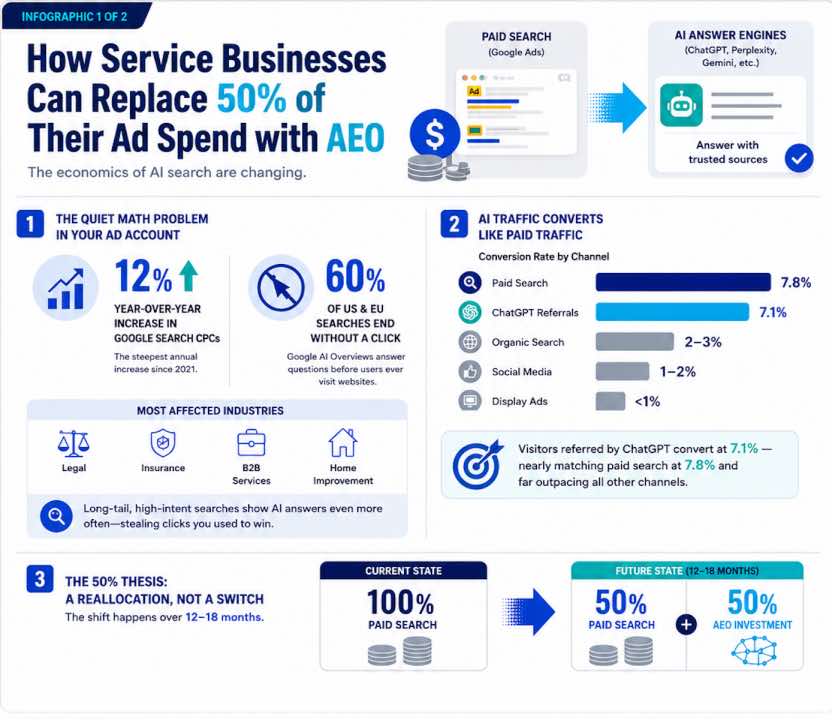
Paid search is getting more expensive and less effective at the same time. Cross-industry CPCs jumped roughly 12% year-over-year (the steepest rise in the past 5 years) while AI Overviews now drive around 60% of US and EU searches to zero clicks. Meanwhile, visitors referred by AI answer engines like ChatGPT convert at 7.1%, nearly matching paid search’s 7.8% and far outpacing standard organic traffic.
Answer Engine Optimization (AEO), meaning structuring your content so AI engines cite you as the answer, lets service businesses capture that high-intent traffic without paying per click. This article lays out the economic case for shifting up to half your paid budget into AEO over 12–18 months, plus a practical playbook to do it without tanking your pipeline.
The Quiet Math Problem in Your Ad Account
If you run a service agency (marketing, legal, accounting, consulting, home services, anything where a qualified lead is worth real money), you’ve probably noticed your paid search numbers drifting in the wrong direction. It isn’t your imagination, and it isn’t your media buyer.
The cross-industry average cost per click on Google Search climbed roughly 12% year-over-year heading into this year, the steepest annual increase since the beginning of 2020s. CPCs rose for the vast majority of industries, and the most expensive verticals for service businesses (legal, insurance, B2B services, home improvement) saw some of the sharpest jumps. You are paying more for the same click than you did a year ago, and the trend line is not bending in your favor.
At the same time, the click itself is getting harder to win. Google’s AI Overviews now appear in more than half of all searches, and roughly 60% of searches across the US and EU end in zero clicks. In other words, the user gets their answer directly on the results page and never visits a website at all. For long-tail, high-intent queries (exactly the searches a service buyer makes before reaching out), AI-generated answers show up even more often.
Put those 2 trends together and you get an uncomfortable picture: the auction is getting pricier while the organic real estate beneath it shrinks. For businesses pouring budget into paid search month after month, that’s a structural squeeze, not a temporary blip. The smart response isn’t to bid harder. It’s to get your business named inside the answer the AI is already giving.
At Growth Hackers, we helped a legal services client reduce their dependence on rising Google Ads costs by implementing an AEO strategy that increased AI-driven brand visibility and generated 22% more qualified inquiries without increasing their ad budget.
That’s what AEO does.
What AEO Actually Is (and Isn’t)
Answer Engine Optimization is the practice of structuring your b2b content marketing, data, and digital footprint so that AI answer engines (e.g. ChatGPT, Google AI Overviews, Perplexity, Gemini, Claude…) cite your business when someone asks a question in your category.
Traditional SEO optimizes to rank a page. AEO optimizes to be the answer. When a prospect asks ChatGPT “what should I look for in a digital marketing agency in Dallas?” or “how do commercial HVAC maintenance contracts work?”, the engine synthesizes a response and, increasingly, names sources. AEO is how you become one of those named sources.
It’s worth being clear about what AEO is not. It is not a magic switch, and it is not free. It’s a discipline (closer to PR and editorial strategy than to keyword stuffing) and it compounds over months rather than flipping on overnight. But that compounding is precisely the point. A paid click costs you money every single time. A citation in an AI answer keeps working long after you’ve published the content that earned it.
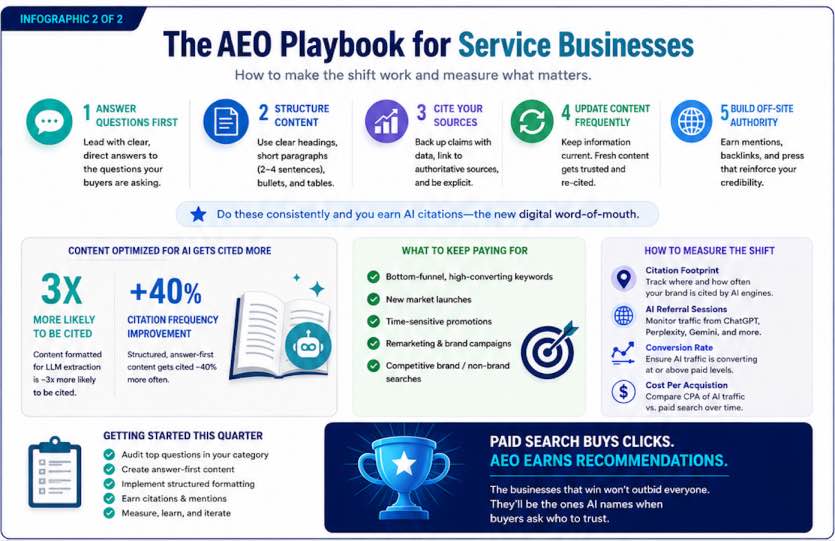
The mechanics are knowable, not mystical. Research across last year and this year consistently shows that content formatted for machine extraction (answer-first paragraphs, clear heading hierarchies, short 2–4 sentence blocks, and explicitly cited claims) gets pulled into AI answers far more often than dense, meandering prose. Pages built that way have been cited roughly 40% more frequently than unstructured equivalents, and content formatted specifically for LLextraction is about 3x more likely to be cited at all.
Why AI Referrals Convert Like Paid Traffic
Here’s the number that should reframe how you think about your budget. According to Similarweb data, visitors referred by ChatGPT convert at 7.1%, second only to paid search at 7.8%, and ahead of direct, organic, social, email, and display traffic.
Sit with that for a second. Traffic you didn’t pay per click for is converting almost as well as traffic you bid a premium to win.
The reason is intent. When someone clicks through from an AI answer, they aren’t browsing a list of ten blue links and a stack of ads. The AI has already done the filtering and effectively recommended you. The user is following up on a recommendation from what they treat as a trusted advisor so they arrive pre-qualified and ready to act. Multiple analyses have found AI-referred visitors convert at several times the rate of standard organic traffic and spend meaningfully more time on-site once they arrive.
This is the crux of the economic argument. For a service agency, the entire purpose of paid search is to buy high-intent visitors. AEO produces visitors of comparable intent and once your content is earning citations, the marginal cost of the next one is effectively zero. You’re not renting attention by the click. You’re building an asset that keeps delivering it.
The volume caveat matters and deserves honesty: AI referral traffic is still a small slice of the total (on the order of 1% of overall website traffic today) but it’s growing roughly 1% month-over-month and has expanded from single digits to double digits as a share of referral traffic in barely a year. You’re optimizing for where the puck is heading. The businesses establishing citations now are buying real estate before the rush.
Want to grow organic visibility with proven answer engine optimization (AEO) services?
Contact Growth Hackers
The 50% Thesis | A Reallocation, Not a Switch
Let’s be precise about the claim in the headline, because nuance is what separates a real strategy from a LinkedIn hot take. At Growth Hackers, we treat the shift from paid search to AEO like moving investments from a depreciating asset into a compounding one.
No serious operator should kill their paid program overnight and pray to the algorithm. The 50% figure is a reallocation target over 12–18 months, and the logic is straightforward arithmetic. As your paid efficiency erodes (higher CPCs, more zero-click searches eating your impressions), the return on each incremental ad dollar falls. As your AEO footprint grows, the return on each dollar invested in citation-worthy content rises, because that content keeps producing high-intent visitors without per-click cost.
There’s a crossover point. For most service businesses, somewhere around half the paid budget is currently being spent on query types (informational and consideration-stage searches) that AI engines are steadily absorbing anyway. That’s the half to migrate. You’re not abandoning paid; you’re redirecting the spend that’s becoming least defensible and concentrating your remaining paid dollars on the bottom-funnel, high-converting terms where ads still earn their keep.
Done deliberately, the shift looks like this: reinvest a portion of paid budget into AEO content production and technical optimization each quarter, watch AI-referral and organic-assisted conversions climb, and ratchet paid spend down only as AEO-sourced pipeline proves it can carry the load. The budget moves in step with the evidence, never ahead of it.
The AEO Playbook for Service Businesses
Reallocating budget only works if the AEO actually performs. Here’s the practical core of what earns citations this year.
- Answer the real questions, first and plainly. Build content around the actual questions your prospects ask an AI before they buy: pricing structures, how to evaluate a provider, what a process looks like, what goes wrong. Lead each section with a direct, complete answer in the first two or three sentences, then elaborate. AI engines extract the answer; humans appreciate the clarity. Everybody wins.
- Structure for machines and people simultaneously. Use a clean H1/H2/H3 hierarchy, keep paragraphs to two to four sentences, and format genuinely list-like information as lists. FAQ sections (and FAQPage schema) perform especially well, with FAQ-structured content earning citations at strikingly high rates for relevant queries. Add Article and, where relevant, HowTo schema so engines can parse authorship, dates, and process.
- Cite your claims and show your evidence. AI engines favor content that includes specific, sourced claims over vague assertions. Original data (a survey of your clients, a benchmark from your own book of business, an infographic that quantifies something in your niche) is citation gold, because it’s the kind of primary source an answer engine has to attribute to you by name.
- Keep it fresh. Recency is a real ranking signal here. Content updated within the last 30 days has been cited several times more often than stale material. Pick your priority pages and refresh them on a schedule rather than publishing and forgetting.
- Build authority off-site, too. AEO isn’t only on-page. Being mentioned, quoted, and linked across credible third-party sites (industry publications, directories, guest articles, podcasts) feeds the engines the corroborating signals they use to decide who’s a trustworthy answer. Treat digital PR as part of your AEO motion, not a separate silo.
The throughline is that AEO rewards genuinely useful, well-organized, evidence-backed content distributed widely. That’s also, not coincidentally, the foundation of our Content Everywhere℠ methodology: the idea that one well-built piece of authoritative content should be engineered to show up everywhere your audience and the engines are looking, rather than living and dying on a single page.
At Growth Hackers, we worked with a software development firm that had years of valuable content buried in traditional SEO formats. By rewriting articles around real client questions, adding structured data, refreshing key pages, and amplifying authority through digital PR, we turned existing content into a consistent source of AI-driven inquiries.
What to Keep Paying For
Reallocating half your budget means keeping the other half working hard. Paid still wins in specific situations, and pretending otherwise would be malpractice.
Keep paying for bottom-funnel, high-commercial-intent keywords where someone is ready to buy now and the lifetime value comfortably clears the CPC. Keep paying when you need speed: a new location launch, a time-boxed promotion, a market test where you can’t wait 2 quarters for content to compound. Keep paying for remarketing to audiences you’ve already earned. And keep paying in genuinely competitive bottom-funnel auctions where being absent means handing the lead to a competitor.
The goal isn’t anti-paid purism. It’s portfolio discipline: pay for clicks where paying is still the most efficient path to a qualified lead, and stop paying for the informational and consideration-stage demand that AEO can capture and keep.
How to Measure the Shift
You can’t reallocate confidently against numbers you don’t track, and AI referrals are easy to miss in a default analytics setup.
Start by isolating AI referral sources in GA4 so ChatGPT, Perplexity, Gemini, and others show up as their own channel rather than getting lumped into “direct” or “organic.” Track 3 things over time:
- your citation footprint (how often you’re named across the major answer engines for your priority questions)
- AI-referral sessions and their conversion rate
- assisted conversions where an AEO touch appears anywhere in the path.
Then watch your blended cost per acquisition as you move budget. That’s the single number that tells you whether the reallocation is working.
The decision rule is simple: shift another increment of paid budget into AEO only when AEO-influenced pipeline is holding or growing as you do. Let the data lead, and the 50% target stops being a leap of faith and becomes a series of small, evidenced steps.
Turn customer questions into leads with answer engine optimization (AEO) services.
Work with Growth Hackers
Getting Started This Quarter With Answer Engine Optimization for Service Businesses
You don’t need to overhaul everything at once. A focused first quarter looks like this. Audit where you already appear (and don’t) across the major answer engines for the 10 questions your best clients ask before they buy. Rebuild your 3 or 4 highest-value service pages with answer-first formatting, FAQ sections, proper schema, and at least one piece of original data or evidence.
Set up AI-referral tracking in GA4 so you can see the traffic you’re about to start earning. And identify the slice of paid spend going to informational queries: that’s your first reallocation candidate once the AEO content proves it can convert.
The businesses that win the next few years won’t be the ones who outbid everyone in a more expensive auction. They’ll be the ones the answer engines name when a buyer asks who to trust. Paid search bought you a click. AEO earns you the recommendation and the recommendation is what actually closes.
The math is already moving. The only question is whether your budget moves with it.
Growth Hackers is a top-tier AI marketing agency helping businesses from all over the world grow. There is no fluff with Growth Hackers. We help entrepreneurs and business owners scale smarter with data-driven answer engine optimization (AEO) services, increase their productivity, generate qualified leads, optimize their conversion rate, gather and analyze data analytics, acquire and retain users and increase sales. We go further than brand awareness and exposure.
We make sure that the strategies we implement move the needle so your business grow, strive and succeed. If you too want your business to reach new heights, contact Growth Hackers today so we can discuss about your brand and create a custom growth plan for you. You’re just one click away to skyrocket your business.