Digital transformation is no longer a future initiative reserved for large enterprises. It has become a business imperative for organizations of all sizes.
Companies that delay digital transformation often struggle to keep pace with changing customer demands, rising competition, and evolving market expectations. On the other hand, organizations that implement a well-structured digital transformation framework create new growth opportunities, improve customer experience, and build resilient operations that can adapt quickly.
At Growth Hackers, we have seen one pattern repeatedly. Businesses rarely fail because of a lack of technology. They fail because they lack a clear digital transformation framework that aligns technology investments with business outcomes.
This guide will show you how to build a practical, scalable, and effective digital transformation framework that your organization can implement immediately.
By the end of this article, you will know how to:
- Select the right digital transformation framework
- Build an effective digital transformation strategy
- Prioritize initiatives that create measurable ROI
- Create a roadmap that delivers value within 90 days
- Scale digital transformation efforts across departments
Executive Summary | Why a Digital Transformation Framework Matters
Many organizations recognize the need for digital transformation but struggle to execute it successfully because they underestimate its complexity.
The reality is that 87.5% of enterprises fail to meet their digital transformation objectives, often because they invest heavily in technology without establishing clear ownership, governance, and measurable success criteria. Teams launch multiple initiatives simultaneously, but without a structured execution plan, those efforts quickly become fragmented and difficult to scale.
This is precisely why a digital transformation framework is essential. Technology alone does not create transformation. Organizations need a repeatable system that introduces accountability, prioritization, and measurable outcomes while keeping teams aligned around shared business goals.
This article is designed for:
- CEOs and founders
- CMOs and COOs
- Transformation managers
- Digital transformation leaders
- Mid-market and enterprise teams
Whether you’re beginning your digital transformation journey or optimizing existing digital transformation efforts, a structured approach accelerates results.
The maturity levels generally fall into 3 categories:
- Beginner: Manual operations and fragmented systems.
- Intermediate: Some automation but disconnected departments.
- Advanced: Data-driven operations with scalable digital capability.
The goal is not to become a technology company overnight. The goal is to create an effective digital transformation framework that supports sustainable growth.
Compare Digital Transformation Frameworks and Choose One
There are several popular digital transformation frameworks available today.
Some of the most commonly adopted include:
- The MIT Framework
- The McKinsey 7S Model
- TOGAF enterprise architecture framework
- Deloitte’s Digital Maturity Model
At Growth Hackers, we rarely recommend following a single model exclusively.
Instead, we often combine multiple transformation framework methodologies.
For most organizations, a hybrid model works best.
|
Company Size |
Recommended Framework |
| Startup | Lean experimentation |
| Mid-market | Hybrid framework |
| Enterprise | Enterprise architecture framework |
The right digital transformation framework depends on your organization’s strategic goals, resources, and digital maturity.
Avoid selecting frameworks based solely on trends. The right digital transformation should align with your business objectives and strategic business goals.
4 Core Components of an Effective Digital Transformation Framework
Every effective digital transformation framework contains several key elements.

1. Define Clear Objectives And Measurable KPIs
Start by establishing digital transformation objectives.
Examples include:
- Increase online revenue by 25%
- Reduce operating costs by 15%
- Improve customer experience satisfaction by 20%
Key performance indicators must be attached to every initiative.
2. Inventory Current Systems And Digital Tools
Conduct a thorough audit of:
- Existing systems
- Data sources
- Digital tools
- Integrations
This creates a clear understanding of current capabilities.
3. Prioritize Initiatives By Value And Feasibility
Not every idea deserves immediate investment.
Score projects using:
- Revenue impact
- Complexity
- Cost
- Risk
4. Allocate Budget And Executive Sponsorship
Digital transformation requires visible leadership.
Executive sponsors ensure business units remain aligned.
Financial resources should be allocated incrementally instead of funding everything at once.
Design an Effective Digital Transformation Strategy
A successful digital transformation strategy starts with 3 to 5 priorities.
Examples:
- Modernize customer onboarding
- Automate internal workflows
- Improve customer experience
- Reduce operational costs
Tie every initiative to business objectives.
Create a 2-year roadmap divided into quarterly milestones.
Assign ownership for each goal.
An effective digital transformation strategy always includes accountability.
Without ownership, transformation efforts lose momentum quickly.
Build Digital Capability and Operating Model
Technology alone cannot drive successful transformation.
Organizations must build digital capability.
Start with a skills assessment.
Identify gaps in:
- Data analytics
- Automation
- AI
- Product management
Then create a hiring and reskilling plan.
Build cross functional teams that combine:
- Marketing
- Operations
- Engineering
- Product
Your operating model should establish clear decision authority.
At Growth Hackers, we often implement agile squads because cross functional collaboration shortens execution cycles significantly.
Strong digital capability also improves technology adoption throughout the organization.
Want to strengthen your operations with a scalable digital transformation framework?
Contact Growth Hackers
Choose Digital Technologies and Digital Tools
Digital technologies should solve business problems.
Avoid buying platforms without defined use cases.
Evaluate:
- Cloud readiness
- Integration requirements
- Security standards
Assess cloud computing opportunities that support scalability.
Pilot one AI use case first.
Examples:
- Customer support chatbots
- Predictive analytics
- Automated reporting
Select vendor-neutral digital tools whenever possible.
This reduces dependency and increases flexibility.
Remember that integrating digital technologies should simplify workflows, not complicate them.
Architect your Digital Platform and Digital Services
Your digital platform acts as the foundation of future growth.
Define requirements early.
Prioritize:
- APIs
- Security
- Scalability
Build reusable modules rather than monolithic systems.
Design a digital services catalog for internal teams.
Secure data access controls from day one.
Seamless integration between systems will improve operational efficiency over time.
Prioritize Business Model Innovation and Revenue Streams
Digital transformation creates opportunities for new business models.
Map your current business models.
Then identify opportunities to create digital business models.
Examples include:
- Subscription services
- Self-service portals
- Premium digital products
Test new business models through small experiments.
Validate pricing with customer pilots.
Many successful digital transformations uncover entirely new revenue channels.
This is often where organizations discover their biggest competitive advantage.
Embed Change Management for Successful Digital Transformations
Change management is one of the biggest predictors of success.
Many organizations underestimate its strategic importance.
Appoint a C-level sponsor immediately.
Then create a communication plan.
Your change management framework should include:
- Weekly updates
- Department briefings
- Training sessions
Role-based training accelerates digital adoption.
Track metrics weekly.
Examples:
- Login frequency
- Platform usage
- Task completion
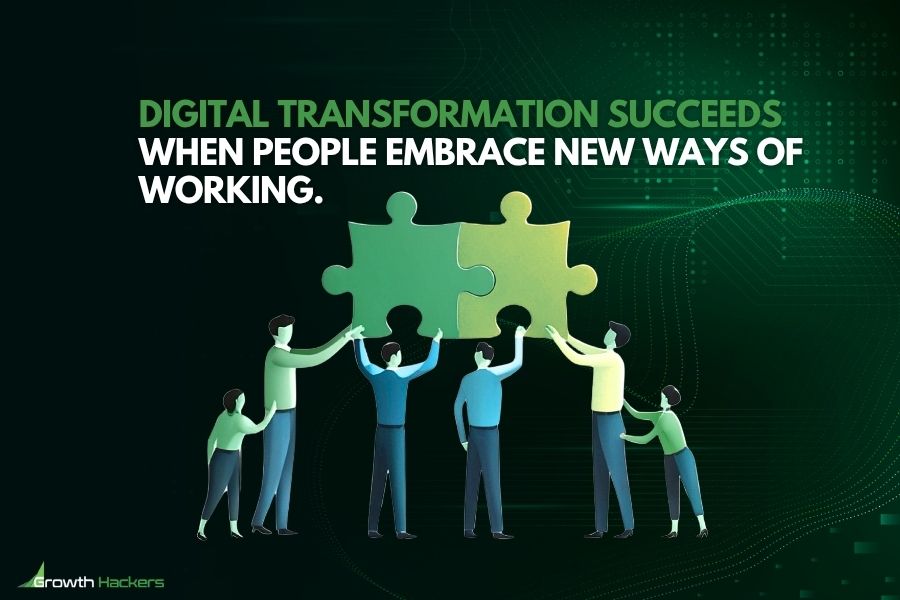
Successful digital transformation requires people to adopt new ways of working.
Without change management, even excellent technology fails.
Change management must become an ongoing process instead of a one-time activity.
Organizations that prioritize change management consistently outperform competitors.
At Growth Hackers, we often dedicate entire workstreams exclusively to change management because successful transformation requires behavioral change before technological change.
Implementation Roadmap | From Assessment to Scaling
The digital transformation process should unfold in phases.
Assessment and PoC Phase
Start with a digital transformation assessment.
Measure:
- Revenue drivers
- Cost drivers
- Customer experience metrics
Choose low-risk pilot domains.
Set success criteria before launching.
Pilot to Scale Phase
Document lessons learned.
Automate repetitive deployment tasks.
Expand resources only after validation.
The transformation process becomes easier when organizations scale gradually.
Measurement and Continuous Improvement
Continuous improvement should become standard practice.
Review KPIs monthly.
Adjust priorities using data instead of assumptions.
Digital transformation is an ongoing process.
There is no final destination.
Governance, Risk and Funding for your Digital Transformation Strategy
Create a steering committee.
Include:
- CEO
- Operations
- Finance
- Technology leaders
Establish a transparent funding model.
Embed cybersecurity checks into every workflow.
Define escalation procedures.
Strong governance protects digital investments and reduces technical challenges.
Organizations that ignore governance often struggle during large scale transformation initiatives.
Selecting Digital Technologies, Platforms and AI
When selecting platforms, evaluate:
- Total cost of ownership
- Vendor lock-in risk
- API compatibility
Data quality should be assessed before AI deployment.
Emerging technologies depend heavily on clean data.
For customer-facing applications, choose explainable AI.
Transparency builds trust.
Digital technologies should support customer experience rather than replace human interactions entirely.
As new technologies emerge, organizations must remain adaptable.
Digital transformation leaders understand that technology evolves faster than traditional planning cycles.
KPIs and Measurement | Proving ROI of Digital Transformations
Track leading indicators.
Examples:
- User adoption
- Automation rates
- Training completion
Track lagging indicators.
Examples:
- Revenue growth
- Profit margin
- Customer retention
Report results in both operational and financial terms.
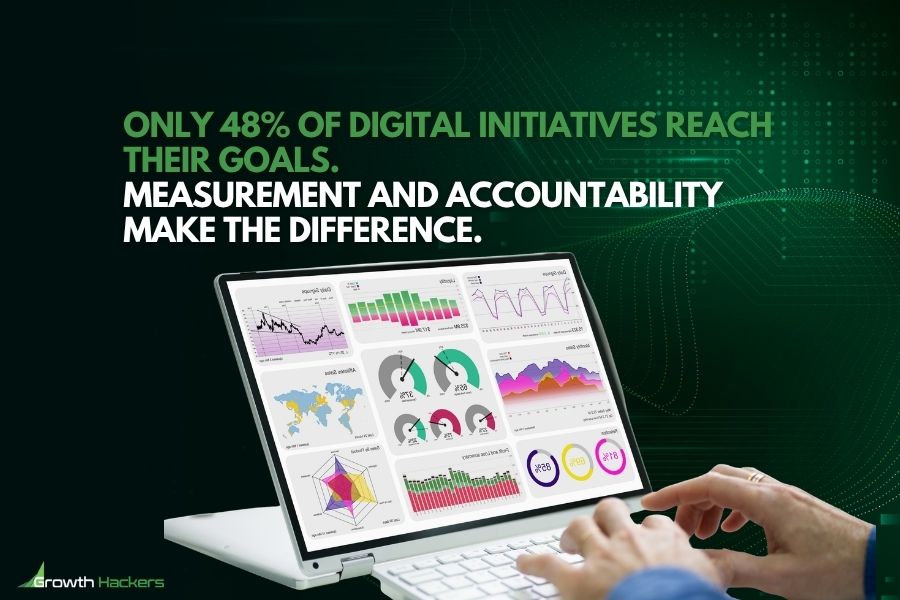
Measurement cannot be an afterthought. Recent research shows that only 48% of digital initiatives meet or exceed their intended business outcome targets, highlighting the importance of establishing clear KPIs, ownership, and accountability from the beginning. Organizations that continuously monitor performance are better positioned to identify bottlenecks early, adjust priorities, and maximize returns from their digital transformation investments.
Organizations should also focus on improving their digital maturity over time. Measurement and capability building should go hand in hand. Companies that invest in leadership involvement, workforce development, and structured execution are significantly more likely to achieve long-term transformation success.
Research consistently shows that successful digital transformations share common traits, including strong leadership support, continuous capability building, empowered teams, modernized tools, and frequent communication across departments. This is why a strong digital transformation framework must prioritize data visibility, governance, and accountability from the beginning.
Benchmark performance against industry peers.
Tie leadership incentives to measured outcomes.
Digital transformation goals become easier to achieve when leaders share accountability.
Quick Wins, Case Studies and Scaling Playbook
Here are four quick wins we frequently implement at Growth Hackers.
Customer Support Automation
Result:
35% reduction in response times.
Marketing Workflow Automation
Result:
20% productivity increase.
AI-Powered Lead Qualification
Result:
15% higher conversion rates.
Customer Journey Optimization
Result:
18% increase in customer satisfaction.
Replicable Scaling Checklist
✔ Document the process.
✔ Automate repetitive tasks.
✔ Measure outcomes.
✔ Expand gradually.
✔ Retrain teams.
✔ Optimize continuously.
This approach to digital transformation helps organizations scale without overwhelming teams.
5 Common Pitfalls And How To Avoid Them
Many organizations encounter similar obstacles during their digital transformation journey. In fact, 70% of digital transformations fall short of their objectives, often because organizations lack clear priorities, strong governance, and sustained leadership involvement. Recognizing these challenges early can help teams avoid costly mistakes and maintain momentum throughout the transformation process.
1. Chasing Technology Trends
Avoid adopting emerging technologies without clear business objectives. Technology investments should solve specific problems and support measurable outcomes rather than being implemented simply because they are popular.
2. Scope Creep
Prioritize ruthlessly. Expanding projects too quickly can overwhelm teams, dilute resources, and delay progress. Focus on high-impact initiatives before introducing additional layers of complexity.
3. Talent Gaps
Invest in training early. Building internal expertise in data analytics, automation, AI, and digital operations helps organizations adapt more quickly and reduces dependency on external resources.
4. Vendor Dependency
Use phased contracts and prioritize flexible solutions that can integrate with existing systems. This reduces long-term risk and prevents organizations from becoming locked into a single vendor ecosystem.
5. Weak Leadership
Successful transformation requires active executive ownership. Digital transformation initiatives are far more likely to succeed when leaders remain involved throughout implementation rather than delegating responsibility entirely to IT teams.
Remember that digital transformation is a complex process involving people, processes, and technology. Sustainable success comes from balancing all three rather than overinvesting in any single area.
Let us help you implement a digital transformation framework that turns strategy into action.
Work with Growth Hackers
4 Content Elements to Include in your Internal Rollout
1. Digital Transformation Assessment Template
Score each category from 1 to 5:
- Leadership
- Data maturity
- Technology
- Customer experience
- Workforce readiness
2. 2-Year Roadmap Template
Year 1:
- Build foundations
- Launch pilots
Year 2:
- Scale successful pilots
- Optimize performance
3. KPI Dashboard Mockup
Track:
- Revenue growth
- Customer experience
- Digital adoption
- Employee productivity
- Cost savings
4. Leadership Checklist
- Establish sponsorship
- Define priorities
- Allocate budgets
- Build teams
- Measure outcomes
These critical elements create consistency across transformation efforts.

Partner With Growth Hackers to Deploy Your Foolproof Digital Transformation Framework
A digital transformation framework is not simply a technology project.
It is a business strategy that reshapes how organizations create value.
The organizations winning today are not necessarily spending more. They are executing faster.
Growth Hackers is a renowned digital transformation agency helping businesses implement an effective digital transformation framework that produces measurable outcomes.
Our team combines growth experimentation, deep technical expertise, and operational execution to accelerate results.
We work alongside your teams to build a successful digital transformation strategy that aligns with your organization instead of forcing generic frameworks into your operations.
We’ve learned from first-hand experience that every successful digital transformation starts small, validates quickly, and scales intentionally.
If you’re ready to build a foolproof digital transformation framework, we invite you to book a free 30-minute Digital Transformation Readiness Audit.
During the session, we’ll help you:
- Assess your digital capability
- Identify growth opportunities
- Prioritize high-impact initiatives
- Build a practical implementation roadmap
We can also provide case study references and ROI proof from previous transformation efforts.
Digital transformation is not a destination.
It is an ongoing process of building a more agile, data-driven, and resilient organization.
The sooner you start, the faster your business will create sustainable growth.