
Why do enterprise deals with massive potential suddenly stall or vanish after months of effort? In complex B2B environments, relying on gut feeling is a fast track to missed quotas and wasted resources. The MEDDIC sales process solves this by replacing hope with a rigorous, data-backed qualification framework that identifies high-probability wins early.
This article breaks down the 6 pillars of the methodology and explains how to implement it to drive a measurable win rate increase. We will explore how to master the transition from intuitive selling to objective evidence for predictable growth.
MEDDIC Sales Process | The Qualification Framework for B2B Success
The MEDDIC framework standardizes B2B sales through 6 qualification pillars:
- Metrics
- Economic Buyer
- Decision Criteria
- Decision Process
- Identify Pain
- Champion
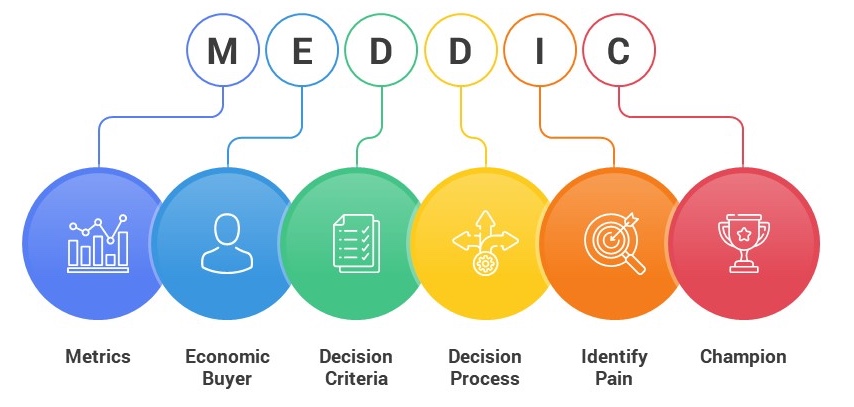
Implementation typically drives anywhere between 15% and 40% win rate increase by eliminating low-probability deals early in the sales cycle, starting with rigorous historical data analysis.
This relentless focus on historical data analysis leads directly into the origins of the framework at PTC.
The PTC Legacy and the Birth of Qualification Rigor
MEDDIC emerged in 1996 at PTC under Dick Dunkel. The team faced unpredictable revenue forecasts and slipping deals. They needed a disciplined method to understand why contracts were won or lost.
This framework effectively killed the “gut feeling” sales approach. Reps shifted to data-backed qualification while managers gained a common language. This rigor transformed PTC into a massive sales powerhouse in the software industry.
Selling moved from intuitive guesses to objective evidence. Deals were no longer based on hope. Instead, they relied on hard facts and verified customer data.
The long-term industry impact is undeniable. Most modern SaaS methodologies trace their roots back to this specific PTC era and Dunkel’s structured approach.
Why Complex B2B Cycles Demand a Structured Approach
Modern buying committees involve 6 to 10 decision-makers. Coordinating these stakeholders is often a nightmare without a map. Complexity naturally breeds confusion and deal slippage.
The framework provides a necessary common language. Everyone knows what a “Champion” actually means. Miscommunication between marketing and sales departments drops significantly as a result.
Sales teams need objective deal health assessments. Subjective optimism is the enemy of accuracy. Data points must replace opinions to ensure the pipeline remains healthy.
In complex enterprise sales funnels, the lack of a structured qualification process isn’t just a hurdle; it is a guaranteed recipe for resource drainage and missed quotas.

Growth Hackers Stats | 26 Points Win Rate Increase via MEDDIC
At Growth Hackers, we frequently see deals stalling in final stages. A lack of Champion identification is usually the culprit. We fix this by enforcing MEDDIC qualification rigor early.
One client moved from a 6% win rate to 32%. They stopped chasing “zombie” leads that never closed. The focus shifted entirely to high-probability opportunities with clear pain points.
Closing speed increased 2.5x within 7 months. Sales velocity became a predictable metric rather than a hopeful guess for the executive team. Data replaced speculation.
Rigor beats talent every single time in high-stakes B2B environments. Standardizing your process is the only way to scale revenue reliably.
6 Pillars of the MEDDIC Framework Explained
In fact, the strength of the system lies in its simplicity, breaking down the complex psychology of buying into 6 manageable buckets.
Quantifying Value through Metrics and the Economic Buyer
Differentiate between direct and strategic metrics. Direct metrics focus on immediate ROI. Strategic metrics align with the CEO’s 3-year vision for the company.
Identify the person with final budget authority. The Economic Buyer can say “yes” when others say “no.” They care about profit, not just features.
Detail how to align value with financial goals. Speak the language of the balance sheet. Focus on cost reduction.
- Revenue growth percentage
- Cost per lead reduction
- Employee retention rates
- Time-to-market acceleration
Mapping Decision Criteria and the Decision Process
Define technical and business requirements. Technical criteria cover integrations and security. Business criteria focus on vendor stability and long-term support capabilities.
Outline the chronological steps to final approval. Who signs the contract? What legal hurdles exist? Knowing the sequence prevents nasty surprises in December.
Explain how to uncover hidden hurdles. Ask about previous failed purchases. Internal politics often dictate the real timeline.
| Pillar | Focus | Key Question | Goal |
|---|---|---|---|
| Decision Criteria | What | What standards guide the choice? | Technical and business alignment. |
| Decision Process | How/When | How is the final signature obtained? | Orchestrating the timeline. |
Uncovering Deep Pain and Nurturing the Internal Champion
Contrast surface-level issues with deep business pains. A slow server is a surface issue. Lost revenue due to downtime is the real pain. Find the wound and pour salt on it.
Define the Champion versus a Coach. A Coach gives you information. A Champion has power and skin in the game. They sell for you when you aren’t there.
Champion vs. Coach
- Coach: Provides information but lacks internal power.
- Champion: Has influence, skin in the game, and sells internally when you are absent.
Provide techniques for testing influence. Ask the Champion to introduce you to the Economic Buyer. Their reaction reveals their true status.
If you don’t have a Champion, you don’t have a deal. You just have a conversation.
Do you want to integrate the MEDDIC methodology into your sales operations?
Contact Growth Hackers
Moving Beyond the Basics with MEDDICC and MEDDPICC
But the market evolved, and so did the framework, adding layers to handle the bureaucratic sludge of modern enterprise SaaS.
Modern Evolution
- P stands for Paper Process (administrative/legal steps)
- C stands for Competition (rival vendors and internal status quo)
The Paper Process | Avoiding Last-Minute Legal Hurdles
Mapping the legal timeline is vital for survival. Procurement is where promising deals often go to die. Security reviews frequently take months rather than a few short weeks.
Administrative delays are silent deal killers. A single missed signature in Q4 results in zero commission. You must understand the Paper Process to avoid these dangerous traps.
At Growth Hackers, we view this like the final mile. It is like a marathon runner tripping at the finish line. All that effort is wasted without administrative foresight.
Manage the process proactively. Ask for the standard contract early. Don’t wait for a verbal yes to start the legal review.
Evaluating Competition to Protect Your Deal’s Flank
Identify direct competitors and the internal status quo. Doing nothing is actually your biggest rival. People fear change more than they hate their current problems.
Explain your differentiation against rival strengths clearly. Don’t play their game. Highlight your unique value that solves the specific Pain identified earlier in the cycle.
Ignoring alternative budget allocations is a massive risk. Sometimes you aren’t fighting another software. You are fighting a new office renovation or a marketing hire.
Be bold about your positioning. If you can’t win on value, you will lose on price. Never settle for a price war.
Why MEDDPICC is the New Standard for Enterprise SaaS
These additions are a necessity today. Markets are crowded and buyers remain skeptical. Extra layers of qualification protect your most valuable asset: your time.
Extra layers increase forecasting predictability significantly. More data points mean fewer surprises. Your CRM becomes a crystal ball instead of a deal graveyard.
Be ready to walk away. If the Paper Process is a black hole, cut your losses. Chasing bad deals kills your annual quota.
MEDDPICC isn’t just an acronym; it’s a filter that separates professional closers from perpetual dreamers.

How to Implement MEDDIC in Your Sales Workflow | 3 Steps to Follow
Then comes the hard part: moving from theory to daily habit within a stubborn sales organization.
1. Defining Buyer Personas and Securing Team Buy-in
Align the framework with ideal customer profiles. Not every lead deserves the full MEDDIC treatment. Focus resources where the potential ROI is highest.
Pitch benefits to reluctant reps. Show them how it helps them earn more. It is not about micromanagement; it is about winning.
Highlight the role of leadership. Managers must lead by example. If the VP doesn’t use the language, the reps certainly won’t care either.
Start small with a pilot group. Prove the success first. Then roll it out to the whole team.
2. Integrating MEDDIC Fields into Your CRM Workflow
Make qualification data visible and mandatory. If it isn’t in the CRM, it didn’t happen. Create specific fields for each letter of the acronym.
Use automated prompts to guide conversations. Technology should assist the rep, not hinder them. Simple checklists within the opportunity view work wonders.
Mention the importance of tracking adherence. Review the MEDDIC scores during weekly 1-on-1s. Use these metrics to identify where a rep needs specific coaching.
Avoid data overload. Keep the fields concise. Only ask for information that actually moves the needle.
3. Continuous Training and Feedback Loops for Success
Detail the need for regular coaching sessions. Roleplay the difficult conversations. Practice identifying the Economic Buyer in a complex hierarchy.
Use win/loss analysis to refine the process. Why did we lose that “safe” deal? Usually, a pillar was ignored or falsified.
At Growth Hackers we helped a SaaS firm evolve their playbook. By analyzing losses, they identified a recurring failure in the Decision Process pillar.
Keep the momentum alive. Sales methodologies die without constant reinforcement. Make it part of the company culture.
MEDDIC vs. BANT | Why Modern Sales Requires Rigor
Yet, many teams still cling to outdated models, failing to realize that the B2B landscape has fundamentally shifted.
Why BANT Fails in Multi-Stakeholder Environments
BANT is a simple checklist designed for telemarketers to screen leads quickly. MEDDIC offers a deep strategy for enterprise closers handling complex deals. The difference lies in depth versus surface qualification.
Budget is often fluid in large organizations. Modern sellers create budget for the right solution rather than just finding it. Asking “do you have money” is an amateur move today.
BANT misses political influence entirely. It ignores the Champion and the specific Decision Process required for success. You can have budget and authority but still lose to internal inertia.
- Focuses on prospect status
- Linear approach
- Focuses on deal dynamics
- Multi-dimensional strategy
Combining SPIN Questioning with MEDDIC Qualification
Use SPIN techniques to uncover ‘Pain’ effectively. Situation and Problem questions lay the necessary groundwork. Implication questions make the prospect’s pain feel real and urgent enough to act.
There is a powerful synergy between discovery and qualification. SPIN represents the “how” of your conversation. MEDDIC is the “what” you must extract to secure the win.
“How does this problem affect your quarterly revenue?” This specific bridge question is gold. It addresses both the SPIN Implication and the MEDDIC Metrics simultaneously to build a business case.
Don’t choose one over the other. Use SPIN to fill your MEDDIC scorecard during every call. They are complementary tools for growth.

Knowing When to Walk Away from a Failing Deal
No access to the Economic Buyer is a terminal sign for any deal. If there is no Pain, there is simply no deal. Stop chasing ghosts and face the facts.
Zombie deals carry a massive opportunity cost. Every hour spent on a loser is an hour stolen from a winner. Disqualify fast to keep your pipeline healthy and productive.
At Growth Hackers, I once walked away from a 6-figure contract because the “Champion” was a ghost. My team hit their quota by focusing elsewhere. That 100% focus shift saved our quarter.
Saying “no” is a superpower for sales leaders. It builds respect with prospects and protects your team’s morale. Focus only on deals you can actually win.
Now is the right time to apply the MEDDIC sales method and close more B2B deals!
Work with Growth Hackers
3 Mistakes that Kill MEDDIC Implementation
Transitioning from a basic sales cycle to a rigorous framework requires more than just a new acronym; it demands a total shift in how you qualify every single opportunity.
1. Solving the Problem of the Unresponsive Economic Buyer
Gain access by using your Champion to facilitate introductions. Frame every conversation around the Economic Buyer’s specific strategic goals. This ensures your value proposition resonates at the highest level.
Lower-level contacts often lack the authority to sign checks. They might love your product, but they cannot bypass budget restrictions. You are essentially selling to a brick wall without executive buy-in.
Handle gatekeepers with a respectful but firm approach. Explain clearly that the project cannot proceed without executive alignment on Metrics. This protects your time and ensures the deal has real legs.
If they refuse you access to the boss, you aren’t a partner. You are just another vendor. Real partners demand executive engagement to ensure success.
2. Avoiding the ‘Check-the-Box’ Mentality in Sales Teams
Filling out a CRM field is not true qualification. There is a massive difference between data entry and actual understanding. You must verify the information through multiple sources before believing it.
Foster a culture rooted in genuine curiosity. Always ask your reps how they know a specific data point is true. Challenge them to provide hard evidence for every claim they make.
Confirmation bias is a silent deal killer. We often see only what we want to see in a promising deal. MEDDIC breaks this bias by forcing you to face cold, hard facts.
“A completed MEDDIC scorecard with false information is more dangerous than no scorecard at all.”
3. Storytelling | How We Saved a Stalled Deal Using Re-Qualification
One specific deal had stopped moving for 4 full months. The sales rep was frustrated and ready to walk away. The momentum had completely vanished, leaving the pipeline stagnant and uncertain.
We re-applied the framework and realized we had a Coach, not a Champion. We immediately went back to identify the real Pain. This shift changed our entire engagement strategy overnight.
By pivoting to the actual Economic Buyer, we closed the deal in 5 weeks. Our revenue jumped because we stopped guessing. Never assume your pillars are solid without constant verification.
Re-qualification is not a failure of the initial process. It is a necessary adjustment for complex deals. Stay agile and keep your qualification rigor high to win.
FAQ
What exactly is the MEDDIC sales process?
MEDDIC is a high-performance B2B sales qualification framework designed to bring surgical precision to complex deals. Developed at PTC in 1996 by Dick Dunkel, it forces sales teams to move past “gut feelings” and qualify opportunities based on 6 hard pillars: Metrics, Economic Buyer, Decision Criteria, Decision Process, Identify Pain, and Champion. It functions as a strategic operating system that ensures every deal in your pipeline is backed by objective data rather than hope.
By implementing this rigor, enterprise teams typically see a 15% to 40% increase in win rates and a significant boost in forecasting accuracy. It’s not just a checklist; it’s a filter that separates professional closers from those wasting time on “zombie” leads that will never close.
What are the core components of the MEDDIC acronym?
Each letter represents a critical element of the deal dynamics. Metrics focuses on the quantifiable ROI for the client. The Economic Buyer is the person with the ultimate budget authority. Decision Criteria are the technical and business requirements the client uses to judge solutions, while the Decision Process maps the actual steps and timeline to get a signature.
The final 2 pillars are often the most vital: Identify Pain uncovers the deep business problem driving the need for change, and the Champion is your internal advocate who has power and skin in the game. If you lack a true Champion, you don’t have a deal, you just have a conversation.
How does MEDDIC differ from the BANT methodology?
BANT (Budget, Authority, Need, Timing) is a legacy tool built for simple, linear sales. In modern B2B environments where 6 to 10 stakeholders are involved, BANT is amateur. BANT focuses on the prospect’s status, whereas MEDDIC focuses on the deal dynamics. For instance, BANT asks if there is a budget; MEDDIC identifies the Economic Buyer who can create a budget for the right solution.
While BANT is a simple checklist for telemarketers, MEDDIC is a multi-dimensional strategy for enterprise closers. It provides the depth needed to navigate political influence and complex decision-making processes that BANT completely ignores.
What is the difference between MEDDIC, MEDDICC, and MEDDPICC?
These are evolutions of the original framework designed to handle modern bureaucratic hurdles. MEDDICC adds a second “C” for Competition, forcing you to identify rival vendors or the internal status quo. MEDDPICC adds a “P” for the Paper Process, which maps the legal and procurement steps required to finalize a contract.
Ignoring the Paper Process is where most enterprise deals go to die in the final mile. By adding these layers, sales teams protect their most valuable asset, time, and ensure that security reviews or legal bottlenecks don’t kill the commission at the end of the quarter.
How can a sales team successfully implement the MEDDIC framework?
Implementation starts with leadership buy-in; if the VP doesn’t speak the language, the reps won’t care. You must integrate MEDDIC fields directly into your CRM, making qualification data visible and mandatory. Start with a small pilot group to prove success, then roll it out to the wider team through continuous coaching and roleplaying.
Success requires moving away from a “check-the-box” mentality. Managers should use weekly 1-on-1s to challenge the evidence behind each pillar. Remember, a completed scorecard filled with false information is more dangerous than no scorecard at all. Rigor beats talent every single time in high-stakes B2B environments.
Final Remarks About the MEDDIC Sales Process
Mastering the MEDDIC sales methodology transforms unpredictable gut feelings into a high-velocity revenue engine. By rigorously qualifying metrics, champions, and decision criteria, you stop wasting time on “zombie” leads and start dominating complex B2B cycles. Implement this framework now to skyrocket your win rates and own the future of professional closing.
Growth Hackers is a top-rated customer acquisition agency helping B2B SaaS companies, tech startups, FinServ (Financial Services) firms, software development agencies, manufacturing companies, B2B law firms and sales teams implement the MEDDIC sales framework.
In fact, at Growth Hackers we practice what we preach. What do I mean by that? We use MEDDPICC internally as well. Therefore, we know from firsthand experience how to do it right. If you want to boost your conversion rate, increase your B2B sales and reduce your lead-to-acquisition time, I invite you to book a discovery meeting with us. We will show you our proven framework and guide you on integration.